Default to Optimism: Lessons from the Arena
Second Level Thinking · Issue 19
Why Theodore Roosevelt's "Man in the Arena" is the ultimate mindset. Plus, a look at the return of Donald Trump and the power of positive defaults.
When Lehman Brothers collapsed on Sept. 15, 2008, the broader US market was down over 20% from its Oct. 2007 peak, and the government had announced its takeover of Fannie Mae and Freddie Mac as a result of heavy losses, in what has since been dubbed the subprime mortgage crisis. An event that had unprecedented impacts throughout Wall Street and the broader US economy, Ben Bernanke the then Chairman of the Federal Reserve labelled it, “the worst financial crisis since the Great Depression. There’s no question about it.”
Disappointingly, it was the foundational banking institutions that created the products and accepted the leverage that created the conditions that led to the downfall. As former Fed Chair Alan Greenspan stated at the time, “I made a mistake in presuming that the self-interests of organisations, specifically banks, were such that they were best capable of protecting their own shareholders.” Frustrations were heightened as the crash superseded the dot-com bubble and Black Monday before it, two market adjustments that were also cataclysmic.
In the height of the dot-com bubble, over a two-year period from 2000 to 2002, the NASDAQ index that is weighted with tech stocks fell almost 80% and many individual companies did not survive. On Oct. 19, 1987, the Dow Jones (DJIA) plummeted by 508 points, which represented a 22.6% decline - the largest single-day percentage drop in the history of the US stock market to this day.
All of these sudden and dramatic falls sent shockwaves across global markets and led to significant regulatory and structural changes in the financial industry to prevent similar events in the future. But they also did something psychologically, they demonstrated to the naysayers that such bravado was unsustainable and that market participants were incapable of learning from those before them. It validated the pessimists.
The Pessimism Trap
Last week Donald Trump won the US election and became the 47th president of the United States of America. In what will be his second but non-consecutive term in office, he didn’t just win, he tore the hearts out of the Democratic Party and those opposing him. He has now confirmed the popular vote, senate, and is on track to take the house of representatives in what required roughly 78 million American citizens to vote in his favour. Whether you like him or not, it is an extraordinary achievement.
The misinformation, catastrophising, and polarising expression on both sides of the political aisle in the lead up to and as a result of this outcome has been most extreme. Last week I watched Jimmy Kimmel, an American late-night TV host cry on national television as a result of the outcome. He was not alone, Stephen Colbert and Seth Meyers had similar rhetoric, as did many others. A paid comedian on a major network in prime-time TV placement was so depressed with the outcome he visibly sobbed on national TV, as opposed to generating humour, having fun, and lightening the emotions for millions of onlookers on both sides of the political spectrum.
For many though, it was relief that it was over, as it was merely a decision between the lesser of two evils and you can be forgiven for feeling like this is Armageddon. There are a multitude of reasons not to trust in the process, or trust the outcome and the 24/7 news cycle repeatedly evaporates any sense of optimism if we allow it. Just like the market crashes before it where earnings would surely disappoint, or valuations were too high, or interest rates would increase - back in the Obama administration it was believed the proposed healthcare plan would bankrupt the entire country.
This pessimism is not new but one thing’s for sure, identity politics is dead for the foreseeable future and the ripple-effects of such a mammoth outcome will be felt much closer to home in the upcoming elections. The US citizens, like many globally didn’t care for DEI ideology, they didn't care for the cultural colonisation of the current administration and the extreme patronising wokeism, that included the hypocrisy of having actors and musicians tell them how they should vote. Instead, the majority were more concerned with the cost of basic food and essentials and the price of fuel, as opposed to what pronoun to call the person behind the checkout counter.
The problem with pessimism though, is it’s intellectually seductive, and the arguments always sound smarter, especially when they intersect with our own beliefs and worries. Too often we label something as “bad,” or imply that we “hate” a certain thing or object. It’s too easy to make a list of problems or reasons of why things could be so much worse, this is effortless. Unfortunately, this often leads to unhealthy externalisation and prevents us from playing a bigger game. It clouds our thinking and impairs our judgement.
Where the Optimist Thrives
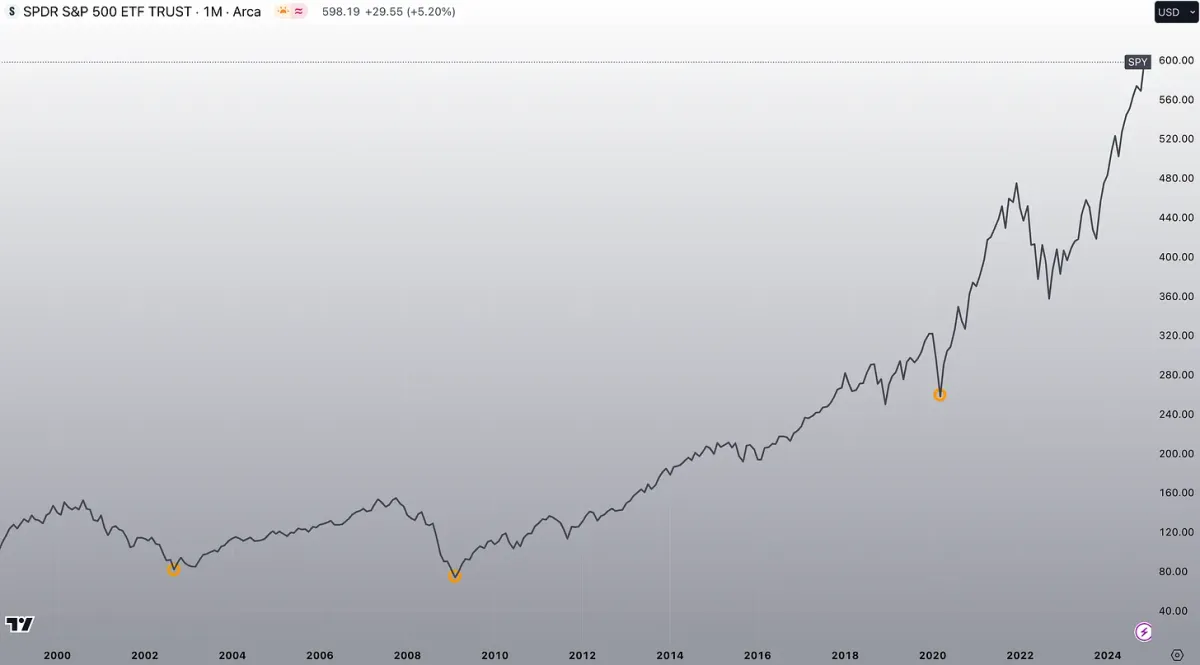
This is where the optimist thrives. It takes time and it takes courage, but the optimist is generally proven right over the long run. What do you see in the S&P 500 chart above? Can you see the 2002, 2008 and covid related market bottoms? Do they look like the end of the world, or do they look like market corrections that created improved buying opportunities. Was it a time to be greedy whilst others were fearful, as Warren Buffett famously states. It takes courage to act in those circumstances and it is extremely difficult, but the optimist benefits historically and is rewarded for the risk undertaken over the long run.
“Winners and other men and women of foresight and ambition do monumental things; pessimists watch them from the sidelines, making a list of all the reasons things won’t work out. The losers do get to win sometimes, too. But their victories tend to be pyrrhic, as every calamity ultimately leads to opportunity when the dust clears.” Josh Brown
For the first time in history, the S&P 500 broke above 6,000 last week, up +46% in 13 months. It now has a market cap of $50 trillion (yes, with a T), and saw almost $1 trillion of inflows since Trump’s appointment became probable. This is unrivalled; a 26% YTD return in the S&P 500, where our equivalent ASX 200 is up a modest 8% YTD. Non US exposure is impacting the returns of those who shun it.
Last week at breakfast a friend wore a MAGA Trump hat to the cafe we were meeting on the day of the election and the Ferrari red hat sparked more than a few onlookers. Although, those early morning roll-of-the-eyes were small in comparison to the look on my wife’s face when the same hat was later left in our home. Unfortunately, she failed to see the ironic jest in which he was purporting and was visibly impacted, I could see the sunken look on her face. When did we lose our sense of humour, I yelped! Have we always taken ourselves so seriously. I’m going to go out on a limb here, but stay with me: Trump is not Hitler, or invoking Nazi-like regimes. He is a narcissist. But he is not Hitler, and I am more than happy to eat humble pie in years to come as a result of that statement. Trump is now holding the ball and we will judge him on his future actions and ability to improve the living conditions for the American people and they get to decide how effective he is at doing that.
It was music to the ears of many when on the opening monologue to Real Time with Bill Maher last week, he stated, “We’re going to keep doing jokes here, both sides, right until the end. We’re going to keep having fun.” Hallelujah. Bill is of an older vintage than Jimmy Kimmel and appreciated the moment, even as an outspoken Harris supporter, he remained optimistic. Learned optimism is a concept that says we can change our attitude and behaviours by recognising and challenging our negative self-talk, among other things. Studies have shown increased optimism has been linked to improved intrinsic motivation, an ability to endure greater stressful circumstances and overall more goal-focused behaviour. An important contributor to healthy wellbeing, both at home and in the workplace.
How could you benefit from bringing a little bit more optimism to your day. History won’t repeat itself but it will rhyme and even if you think I am wrong, invest in your future anyway on the small chance these words have merit, it starts with our mindset. And even if you refute the whole pessimism versus optimism theme, just get in the arena and try something, run experiments and play your own game. And if that’s not enough, I’ll leave you with an outstanding quote from the 26th president of the United States of America, Theodore Roosevelt, taken from a speech made in 1910.
Parting Shot
“It is not the critic who counts; not the man who points out how the strong man stumbles, or where the doer of deeds could have done them better. The credit belongs to the man who is actually in the arena, whose face is marred by dust and sweat and blood; who strives valiantly; who errs, who comes short again and again and again, because there is no effort without error and shortcoming; but who does actually strive to do the deeds; who knows great enthusiasms, the great devotions; who spends himself in a worthy cause; who at the best knows in the end the triumph of high achievement, and who at the worst, if he fails, at least fails while daring greatly, so that his place shall never be with those cold and timid souls who neither know victory nor defeat.”
— Theodore Roosevelt