
How to Optimise Your Portfolio and Your Mind
Second Level Thinking · Issue 17
Position sizing like a pro with the Kelly Criterion. 5 essential gratitude practices and the power of radical self-discipline.
The Practice of Gratitude
It’s hard to believe that thankfulness could actually have measurable benefits, but the science exists. Gratitude has been linked to better mental health, self-awareness, better relationships, and a sense of fulfilment, writes Jay Shetty in his book Think Like A Monk.
Gratitude, monk David Steindl-Rast defines as the feeling of appreciation that comes when you “recognise that something is valuable to you, which has nothing to do with its monetary worth.” It can be wide-ranging, from a simple kind gesture to the improved health of a loved one, and everything in-between.
Gratitude is an interesting concept. It’s one of those qualities that everyone accepts you should do, but that we rarely talk about how to do. It’s sort of like saying you should “live in the moment.” It’s easy advice to give, but you’ll rarely hear people explain how they actually live in the moment, claims James Clear.
“When the monkey mind which amplifies negativity tries to convince us that we’re useless and worthless, the more reasonable monk mind counters by pointing out that others have given us their time, energy, and love. They have made efforts on our behalf. Gratitude for their kindness is entwined with self-esteem, because if we are worthless, then that would make their generosity toward us worthless too.” Jay Shetty
So, let’s take a look at some practices to help you get started, or build on your existing routines.
Gratitude Practices:
When you sit down to eat dinner, say one thing you are grateful for happening today. I find this an excellent way to embed the behaviour with family and go around the table, so each person has a turn.
When you awake in the morning, right there in bed, take a moment to think of whatever is good in your life; the air, the light, the people you love, the coffee awaiting you, etc.
Gratitude in hindsight: identify things you were not grateful for when they first happened; your education, something someone taught you, a friendship, a work project, etc. Or conversely, choose a negative outcome that is no longer painful. In both instances, take a moment to consider in what way the experience is worthy of gratitude; did you benefit in an unexpected way, did you subsequently learn a new skill, did it improve a relationship, etc.
Every night spend five minutes documenting what you are grateful for in an evening journal, or evening wind-down routine.
Conduct a gratitude-centred exercise through a meditation app, such as Headspace, Waking Up, or Calm, to name a few.
In The Science of Gratitude & How It Works of the Huberman Lab podcast, Andrew discusses gratitude and concludes that evidence suggests simply forming a list of all the things you are thankful for each day, or at your chosen frequency was an ineffective practice, which is counterintuitive to some of the practices I listed above.
Instead, he argues, that to build an effective gratitude practice the narrative must be grounded in a story and one where you received genuine thanks or feedback. Or a story of you giving or witnessing someone receiving thanks or feedback. For this Huberman suggests writing down 3-4 bullet points as a cue of the story and including specific detail about the state before and after receiving the gratitude and how that change felt. It is then a requirement to embed and reactivate this each day allowing us to re-experience the positive emotions.
Scientifically though, all forms are known reducers of stress and anxiety, and we now know gratitude has the ability to shift wellbeing positively. I personally have found building the habit through a more simplistic process much easier to sustain before digging deeper into storytelling and its creation. For me, accountability and kindness are key. I have a variation called “beautiful moments” where I capture 2 per day and then at the end of the week share them with an accountability partner to embed the practice. I have found this very beneficial.
I would suggest trying each of the above practices and finding what works for you - just work through the list and play around with it until something sticks. For those with core routines established, I suggest listening to the Huberman Lab episode above and exploring the art of storytelling. I also suggest reading Jay Shetty’s Think Like A Monk and digging deeper through some of Sam Harris’s works, the creator of the Waking Up app. Have fun with this and progress through the exploratory phase with your partner or someone close to you.
The Kelly Criterion
The Kelly criterion is a mathematical formula developed in 1956 by John L. Kelly Jr. while working at AT&T's Bell Laboratories. It helps determine how much to invest in a given asset to maximise wealth growth over time. Initially picked up by gamblers who applied it to horse racing, it wasn’t until claims that Warren Buffett and Bill Gross used the tool that the investing world took notice.
There are two key components to the formula for the Kelly criterion:
Winning probability factor (W): Probability a trade will have a positive return.
Win/loss ratio (R): Equal to the total positive trade amounts, divided by the total negative trading amounts.
The result tells investors what percentage of their total capital should apply to each investment. The term is often called the Kelly strategy, Kelly formula, or Kelly bet.

Where:
Kelly % = Percent of investor’s capital to put into a single trade.
W = Historical win percentage of a trading system.
R = Trader’s historical win/loss ratio.
How to apply:
To start applying, you will require a formed data set of investments, trades, or even bets. This can be backtested data, but preferably data collated on executed positions. The Kelly Criterion assumes you trade the same way now as you have in the past. I suggest aiming for a minimum of 50 inputs.
Calculate "W," the winning probability. Divide the number of trades that returned a positive amount by your total number of trades, both positive and negative. This number is better as it gets closer to one but any number above 0.50 is thought to be good.
Calculate "R," the win/loss ratio. Divide the average gain of the positive trades by the average loss of the negative trades. You should have a number greater than one if your average gains are greater than your average losses. A result of less than one is manageable as long as the number of losing trades remains small.
Input these numbers into Kelly's equation.
Record the Kelly percentage that the equation returns.
The percentage is a number less than one that the equation produces to represent the size of the positions you should be taking. For example, you should take a 5% position in each of the equities in your portfolio if the Kelly percentage is 0.05. This system essentially lets you know how much you should diversify.
From my experience common sense must prevail and in most instances the model will provide an optimal risk allocation far greater than what you are currently executing at, or are capable of executing at relative to your risk tolerance. With that in mind, one rule might be to set a maximum allocation, or fractional amount at an individual level. If required, please refer back to one of our previous issues where we discussed R multiples and the percent risk model made popular by the late Van Tharp.
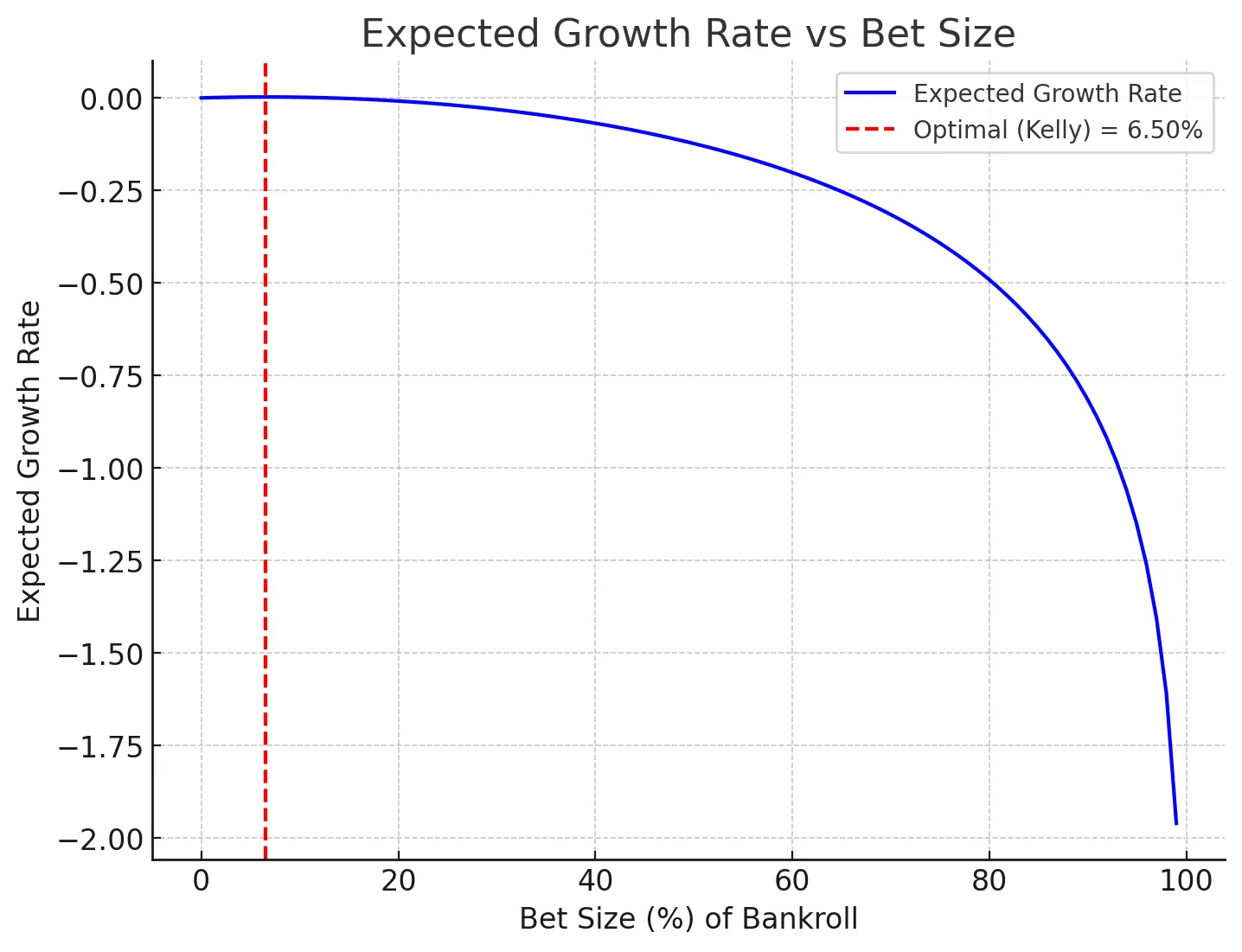
As a real life demonstration, I ran a test on actual data from one of my trading systems where I inputted 150 trades with a winning probability of 0.49 and a win/loss of 1.20. As you can see from the chart below, according to the Kelly Criterion I should allocate 6.5% of my account to an individual position in order to maximise long-term growth.
In other words, the expected growth rate versus the bet size: the red dashed line indicates the optimal bet size according to the Kelly Criterion, which is 6.5%. At this point, the expected growth rate is maximised, meaning it’s the ideal allocation for long-term growth. And I should also note, far above my current position sizing.
In many instances application of the theory is said to improve performance in the long run but in reality, an investor’s constraints are a significant factor and many argue against it. It is extremely difficult to optimise a growth rate mathematically without considering psychological impacts, including loss aversion and complete risk of ruin.
The conventional alternative includes Expected Utility Theory, which asserts that bets should be sized to maximise the expected utility of outcomes. It is noted that even Kelly supporters usually argue for fractional Kelly (betting a fixed fraction of the amount recommended) for a variety of practical reasons, such as aiming to reduce volatility, or protecting against non-deterministic errors in one’s edge.
Only one of many models that can be used to help you diversify and position size. It will not pick stocks for you but it can provide useful insights in limiting your losses and maximising your gains at an efficient rate. I found it a worthwhile exercise that challenged my current strategy, but also my beliefs on risk in a meaningful way.
Parting Shot
“Be tolerant with others, strict with yourself. They’re your standards, your goals, your beliefs. You can hold yourself to them, not other people.”
“We have to remember the thing is not causing us anxiety, we're causing the anxiety within ourselves. It's within us, which means that we can just let it go. We don't have to give ourselves over to it.”
— Marcus Aurelius