Principles, Values, and the Death of the 60/40 Portfolio
Second Level Thinking · Issue 10
The crucial difference between principles and values, and how to build your own. Is the traditional asset allocation model dead?
Principles and Values
In his influential book, The 7 Habits of Highly Effective People, Stephen R. Covey outlined the difference between principles and values. In Covey’s view, principles are rules or laws that are permanent, unchanging, and universal in nature. Values are internal and subjective, and they may change over time.
Principles
For Covey, principles are self-evident and — as part of most traditions and philosophies over the ages — they’ve been woven into the fabric of societies throughout human history. They often concern human behaviour and govern interactions between people.
Principles represent an objective reality that transcends cultures and individuals. For example, Covey cites various principles, including fairness, integrity, and honesty. He declared, “a principle is a natural law like gravity. If you drop something, gravity controls. If I don’t tell you the truth, you won’t trust me; that’s a natural law.”
There are certain principles that transcend cultural differences and do not change over time. They determine the ultimate outcomes or consequences of behaviour and actions, as much as gravity determines that something will fall when dropped.
Values
In contrast, values are beliefs and opinions that people hold regarding specific issues or ideas, and are ultimately internal, subjective, and malleable. They may change as demands or needs change. If a given belief or opinion is something that might be altered if the conditions are right, then it’s a value.
Values are important in expressing our individual beliefs and opinions, and they can be used tactically to accomplish certain objectives based on our current circumstances, demands, and needs. Values can ultimately reflect or determine the current but potentially alterable goals that we have in our professional, family, and personal life.
Using Principles
If you’re looking to create a timeless sense of purpose and to shape the overall mission of your life, then you should use principles. Establishing a set of principles creates a compass to which you can refer whenever something is in doubt or you need to take a stand or evaluate any particular opportunity, behaviour, or situation.
Moreover, principles can ultimately drive your values and goals. Principles can help you determine your goals and values can help you choose between them when confronted with conflicting issues or circumstances. You can build a personal value system based on principles, which will help you avoid running afoul of their natural consequences. Principles can be a convenient and comforting reference point that will support reducing uncertainty.
When conducting personal planning and setting goals, keep in mind this distinction between principles and values, and consider how both of them can be useful. Consider identifying and outlining the universal principles that you want to embrace and that you want to shape your overall mission.
Then, as you identify the things you value most and the goals you want to pursue in your personal, professional, and family life, you can use these principles as a reference point. You can build your values and goals according to these principles, or you can use them to help you realise where your current values, goals, and behaviour may be inconsistent with universal realities about human behaviour and interactions.
Even if you find that you’ve not always been living up to the principles that you want to embrace, you can make meaningful changes and ultimately incorporate those changes into your values and goals.
Covey pointed to this using the example of honesty and truthfulness. “If I tell you the truth consistently and try to live it, and apologise when I don’t, and try to get back on track, then I’m living a natural-law repentance, making improvements to showing change.”
In his book Principles, Ray Dalio describes a framework for helping each of us determine our principles for success which you may find useful:
You need to think for yourself about what is true.
Embrace reality and deal with it.
Truth is the foundation for achieving good outcomes.
Dreams + reality + determination = successful life.
Each of us chooses goals based on our values.
Come to see problems like puzzles that will reward you.
Pain + reflection = progress.
Ask Yourself…
What are the universal, unchanging principles that you can clearly identify? What are the values that you now hold? Do your current habits reflect those values and, ultimately, do your habits and values reflect the principles that transcend current circumstances and can provide a purpose and mission? As we peel back the onion it should really allow the reader an opportunity to connect the dots with past issues and with a proper understanding of the differences between values and principles, you can address all of these questions and use the answers to guide you in your planning and goal pursuits.
The 60/40 Portfolio
Equities and bonds have traditionally been the main building blocks of multi-asset portfolios. The key reason for this pairing is that the asset classes have historically had uncorrelated return profiles. Generally, in periods when risk sells off, equities will weaken and bonds will perform better. This provides the investor with a degree of protection in challenged environments. Reflecting this, the so-called ‘balanced portfolio’ was premised on a combination of a 60% allocation to equities and a 40% allocation to bonds, with an objective of achieving attractive risk-adjusted returns over the long term.
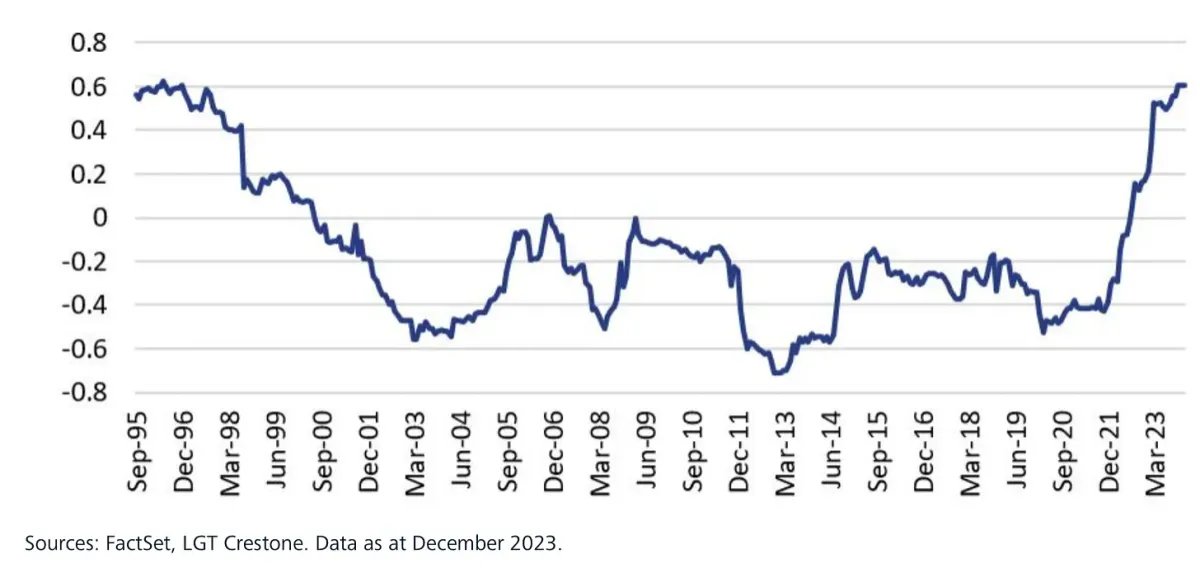
The reality is that the relationship between equities and bonds is not that simple and their correlation has not always been negative. Over time, correlations have been volatile and at times, positive, as has been the case more recently. The long-term correlation between global equities and bonds has generally been negative. Between 1995 and 2023, this relationship has been negative nearly 80% of time, however, correlations peaked at the end of 2022. Since then, they have remained positive (and volatile), according to Crestone.
“The 60/40 portfolio, defined as a mix of 60% U.S. equities and 40% U.S. Treasury bonds, saw a rollercoaster ride down 17.5% in 2022 and up 17.2% in 2023. Two hundred years of historical analysis suggests there is an 80% probability of positive returns in the two years following a year of negative returns for both stocks and bonds. We believe mean reversion of returns and diversification benefits make this portfolio a reliable starting point for asset allocation.” Morgan Stanley
Historically, inflation has been the most important driver of the correlation between stocks and bonds. An analysis of 150 years of data reveals that whenever U.S. inflation exceeded 2.4%, there was an increase in the median correlation between stock and bond returns:
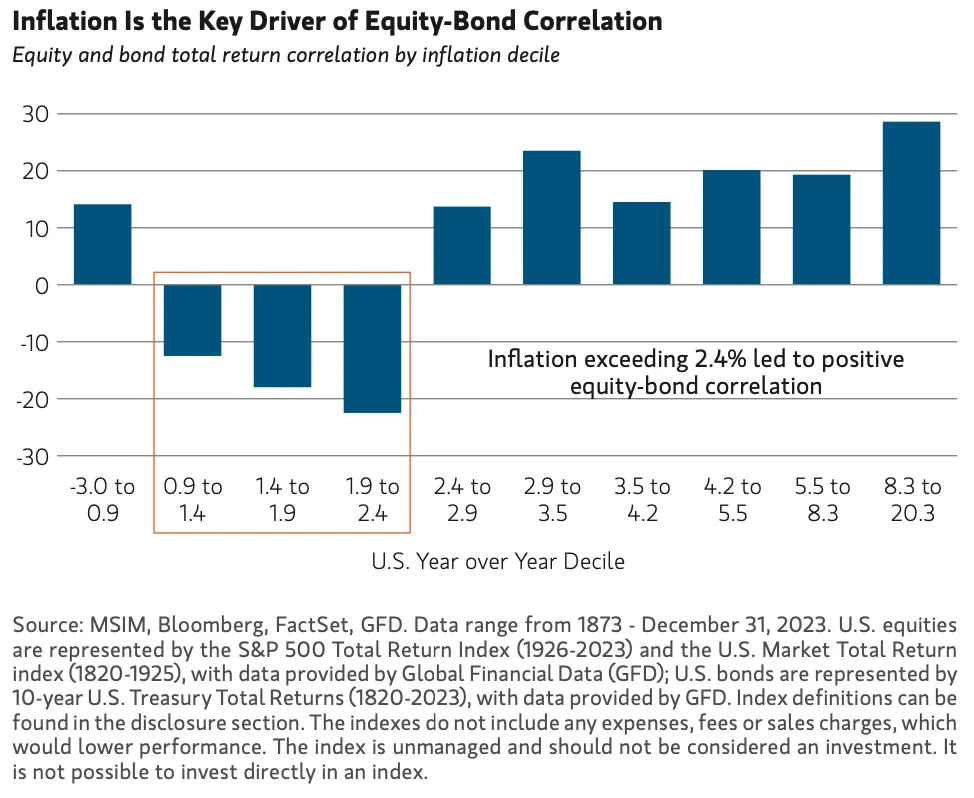
The 60/40 portfolio is a solid starting point for strategic asset allocation. It has achieved a compounded annual growth rate of 7.3% over the 200 years’ worth of data conducted in this analysis. More importantly, both stocks and bonds experiencing negative returns in the same year occurred in only 16 instances—including 2022—implying only an 8% probability of both stocks and bonds experiencing negative returns in the same year.
The All Weather Portfolio
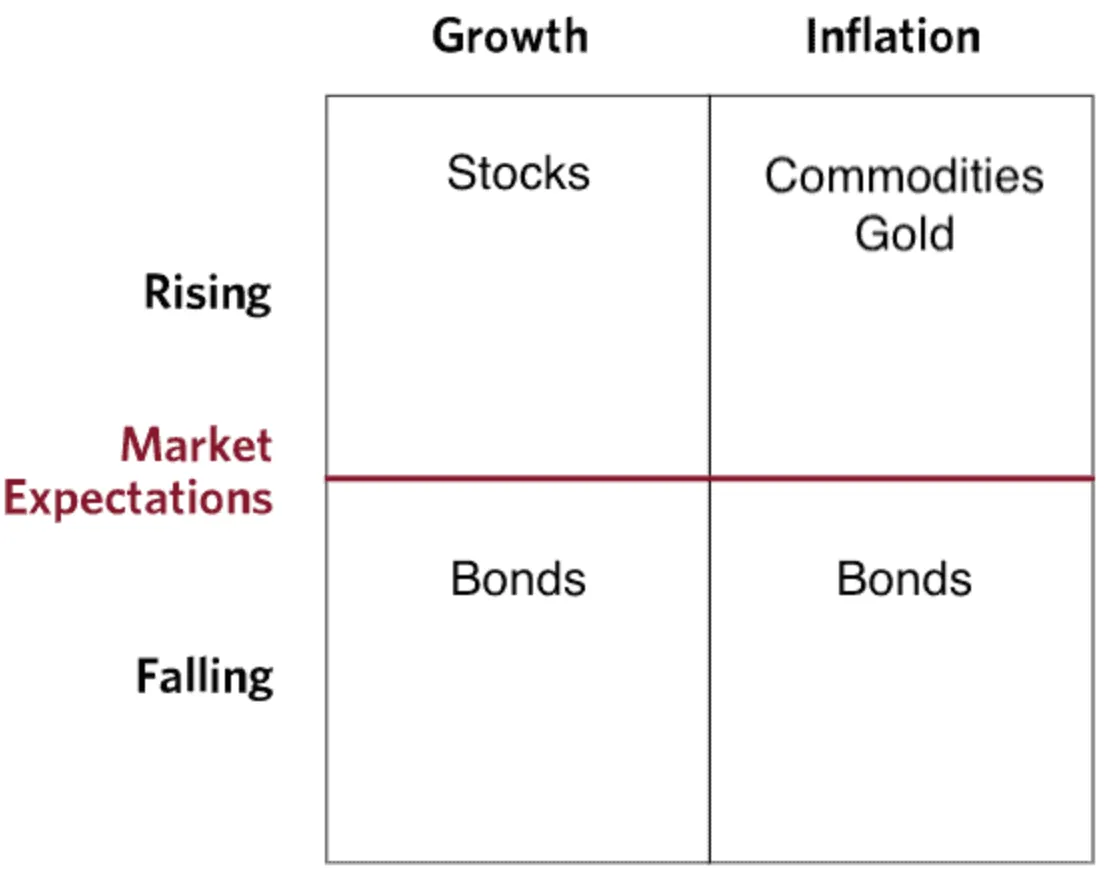
Alternatively, the All Weather Portfolio is a well-diversified, low-risk portfolio from Ray Dalio designed to “weather” any environment. Bridgewater finally formed the All Weather in 1996 and have used it as a key component in building the world’s largest hedge fund. In it, they frame four economic environments in a matrix and with this, we can assign the best performing asset under each economic condition:
Its returns have been comparable to a 60/40 investment strategy over the last 25 years. It is more defensive and does outperform during periods of major crisis, however, in environments of high growth, it does underperform, neutralising its effect.
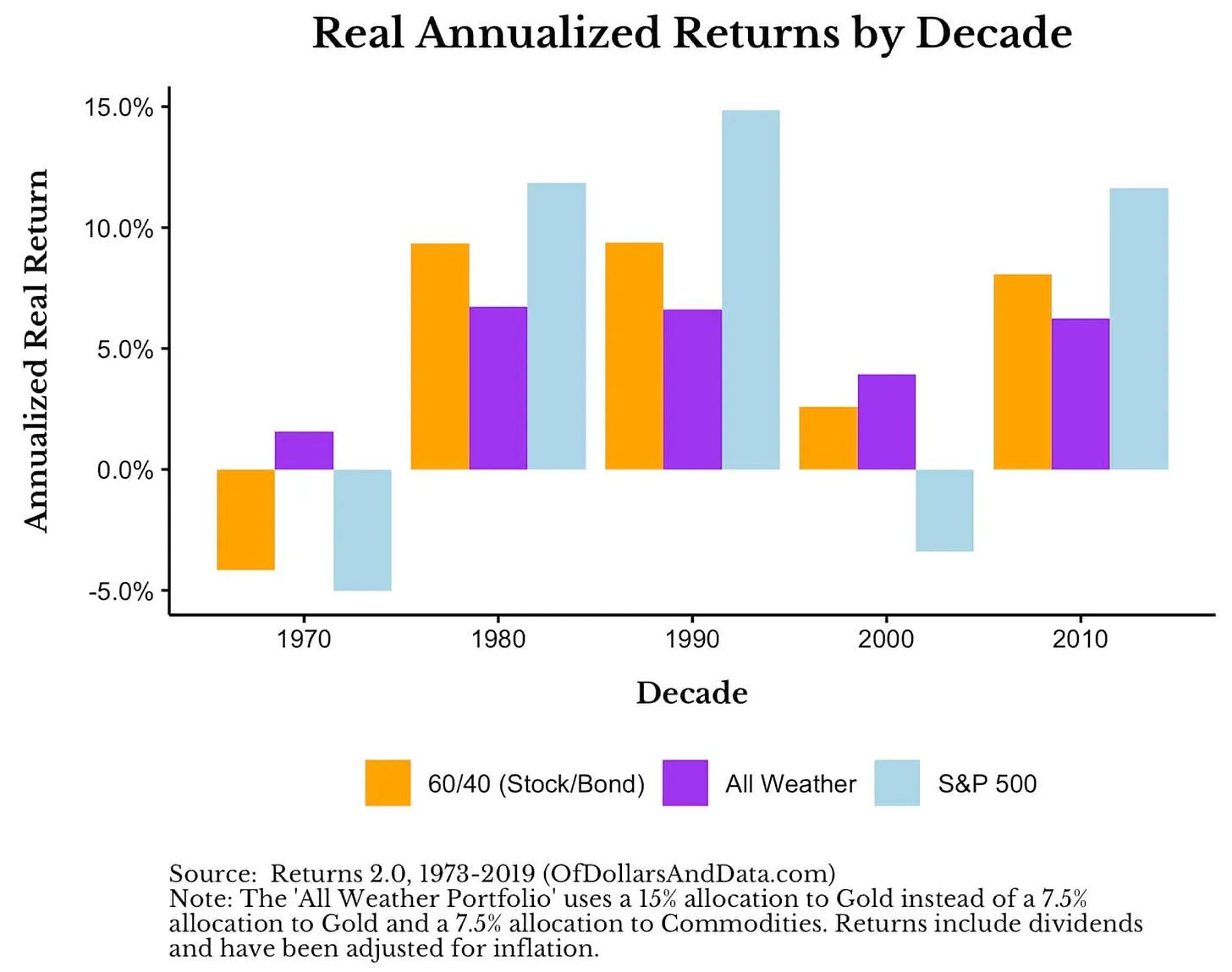
Essentially then, investors should consider the All Weather portfolio who are risk averse to managing drawdowns and those seeking a simple and easy way to preserve their capital with decent growth. An easy way to do this through a selection of low-cost ETFs would be:
40% TLT (Long-Term U.S. Bonds)
30% SPY (S&P 500)
15% IEI (Intermediate Term U.S. Bonds)
7.5% GLD (Gold)
7.5% DBC (Commodities Index)
Obviously, there are multiple ways to create similar exposure and I stress, please do your own research. Additionally, if you want a more aggressive approach to areas of the market this is not the right strategy for you. For example: imagine owning gold from its peak in early 1980 and not seeing it reach new all-time highs again until 2008, 28 years later. Understanding how this supports you in a crisis but limits you in high growth phases is a critical element to think about.
I hope this prompts additional second level thinking on what your current investment time horizon is, what your risk profile is and what you seek to get out of the markets, among other things. Remember our return = cash + beta + alpha.
Parting Shot
"Clarity isn't about knowing what you want to do with your life, it's about knowing what you want to do this week.
You don't need to have it all figured out. You just need to know your next step.”