The Truth About Growth Mindsets and Market Pivots
Second Level Thinking · Issue 14
Debunking growth mindset clichés and the psychology of success avoidance. Survival guide for September volatility and the statistical reality of initial rate cuts.
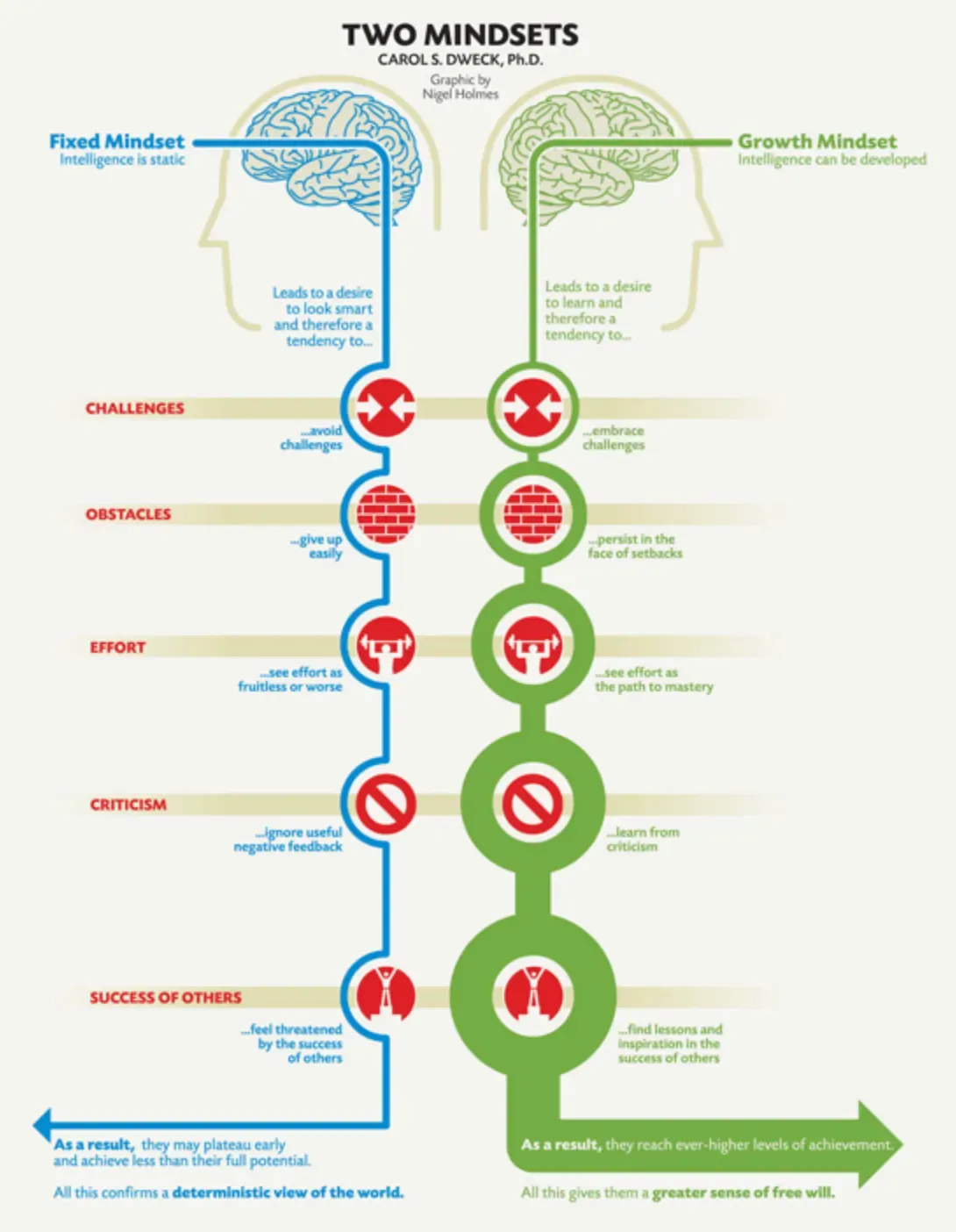
The Truth About Growth Mindsets
‘Growth mindset’ has become a buzzword in recent times, from large companies to high-performing individuals, it is being discussed in team meetings and being plastered across company mission statements. I should not have been surprised then when on a recent visit to my children’s primary school, I found it was being taught to mere eight-year-olds.
The first edition of Carol Dweck’s book Mindset: The New Psychology of Success where the concept derives from was published in 2006 and in a recent Harvard Business Review article Carol summarised her findings as:
“Individuals who believe their talents can be developed (through hard work, good strategies, and input from others) have a growth mindset. They tend to achieve more than those with a more fixed mindset (those who believe their talents are innate gifts). This is because they worry less about looking smart and put more energy into learning.”
“When entire companies embrace a growth mindset, their employees report feeling far more empowered and committed; they also receive greater organisational support for collaboration and innovation. In contrast, people at primarily fixed-mindset companies report more cheating and deception among employees, presumably to gain an advantage in the talent race.”
Sounds easy, right? If we just maintain an open mind and praise effort, we are demonstrating a growth mindset. Well it turns out, this is the wrong approach and rather than write another newsletter on the concept itself, today I want to focus on the misconceptions of the idea and why so many get it wrong. Interestingly enough, when Carol and her team dug deeper, they found the following mistakes:
I already have, and have always had, a growth mindset. People often confuse a growth mindset with being flexible or open-minded or having a positive outlook and suggest these are qualities they believe they’ve always had. They summarised this as demonstrating a false growth mindset. Everyone is actually a mixture of fixed and growth mindsets, and that mixture continually evolves with experience. A pure growth mindset doesn’t exist, which we must acknowledge to attain the benefits we seek.
A growth mindset is just about praising and rewarding effort. This isn’t true for students in schools, and it’s not true for employees in organisations. In both settings, outcomes matter. Unproductive effort is never a good thing. It’s critical to reward not just effort but learning and progress, and to emphasise the processes that yield these things, such as seeking help from others, trying new strategies, and capitalising on setbacks to move forward effectively. In their research, the outcome follows from deeply engaging in these processes.
Just espouse a growth mindset, and good things will happen. Mission statements are wonderful things. You can’t argue with lofty values like growth, empowerment, and innovation. But they are meaningless to employees if the company doesn’t implement policies that make these values real and attainable. Organisations that embody a growth mindset encourage appropriate risk-taking, knowing that some risks won’t work out. They reward employees for important lessons learned, even if a project doesn’t meet its original goals. They support collaboration across organisational boundaries rather than competition among employees or units. They are committed to the growth of every member, not just in words but in deeds such as broadly available development and advancement opportunities. And they continually reinforce growth-mindset values with concrete policies.
The core reason this is difficult is we all have our own fixed mindset triggers; when we are challenged, receive criticism, perform poorly relative to our own standards or when compared with others - the resulting insecurities and defensive behaviours limit and restrict our ability for growth.
“I’ve seen so many people with this one consuming goal of proving themselves — in the classroom, in their careers, and in their relationships. Every situation calls for a confirmation of their intelligence, personality, or character. Every situation is evaluated: Will I succeed or fail? Will I look smart or dumb? Will I be accepted or rejected? Will I feel like a winner or a loser?”
So, are your beliefs holding you back? Do you believe things, such as:
“I’m not good with numbers.”
“I’m not a natural athlete.”
“I’m not creative.”
“I’m a procrastinator.”
“It’s hard for me to lose weight.”
It’s pretty clear that those fixed mindsets will cause you to avoid experiences where you might feel like a failure. As a result, you don’t learn as much and it’s hard to get better.
It should be no surprise then that to remain in a ‘growth zone’ is no different to any other behavioural change and will require one to identify the triggers that impact their being or state. If you are a company this is shifting your focus from the lofty vision and mission statements of what you plan to achieve and dig into the values and behaviours you are demonstrating. If your employees don’t see a respectful environment where collaboration, innovation and feedback is fluid, it is not a conducive one to sustaining a ‘growth’ culture. And like we discussed in our habits issue back in April, skill is something you can cultivate, start small, identify with it and build the small habits required to enact behavioural change. And the next time you hear your child mention the phrase, get a little more curious about how this is being adapted in the classroom.
September Volatility and the First Rate Cut
Stocks played into the September “yips” narrative this week posting their worst day since our mini-meltdown on August 05, with the S&P 500 falling more than 2% on Tuesday alone. As growth and monetary anxieties combined to hurt risky assets, Nvidia Corp. shares tumbled 9.5%, wiping out $278.9 billion in the biggest loss of value ever for a US stock. It is now down 16% in the four sessions since it reported earnings that failed to live up to lofty expectations.
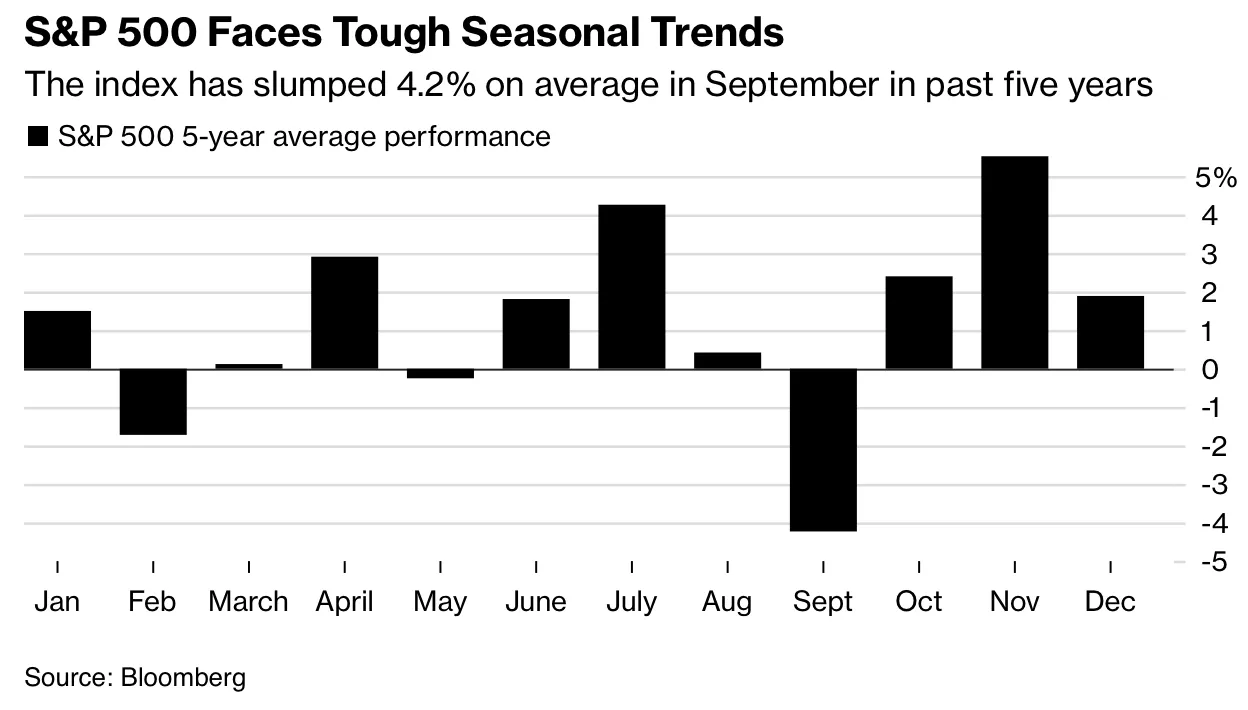
September has been the biggest percentage loser for the S&P 500 since 1950, according to the Stock Trader’s Almanac. Callie Cox at Ritholtz Wealth Management, stated that aside from the macro picture, there’s also the fact that we’re entering what’s often a “miserable time” of the year for equities.
“While history isn’t gospel, it’s not crazy to think that this September could be especially volatile. But this isn’t the conclusion to draw from decades of seasonal market data. Instead, your attention should be on why this is a buyable dip, because there are a lot of reasons to be optimistic here,” stated Cox.
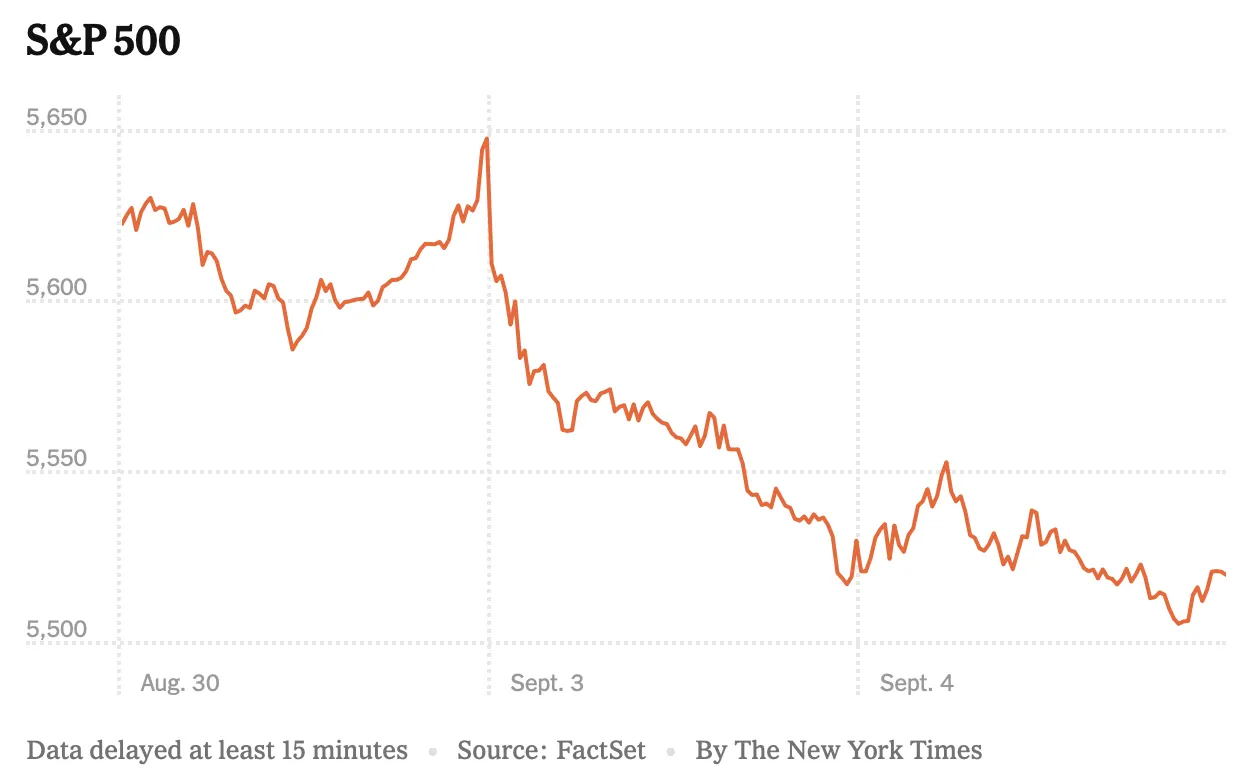
Rich Ross at Evercore says the S&P 500 has had at least a 5% drawdown from the August/September highs in nine of the last 10 years. “This year should be no different after the late August squeeze into resistance at an all-time high. The S&P has a strong downside bias buttressed only by a bent towards ‘low volatility’ defensives and financials — which benefit from lower rates and steeper curves.”
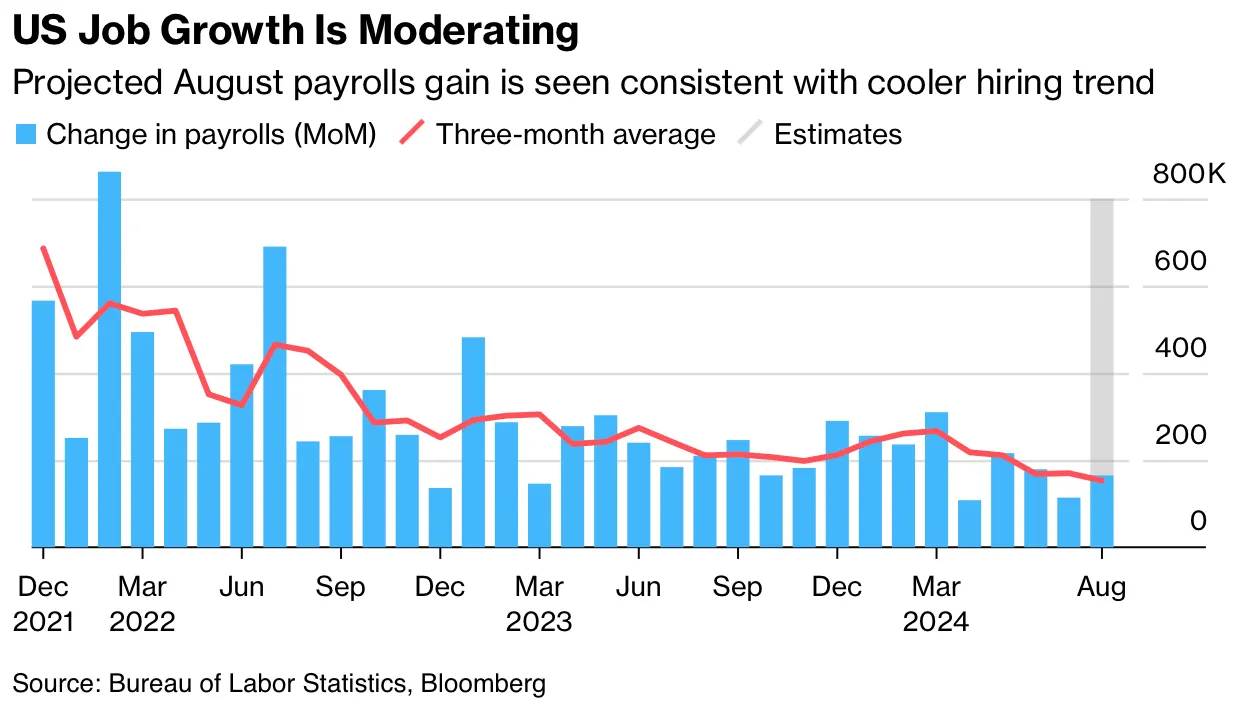
“This week’s jobs report, while not the sole determinant, will likely be a key factor in the Fed’s decision between a 25 or 50 basis-point cut,” said Michael Reynolds at Glenmede. “Even modest signals in this week’s jobs report could be a key decision point as to whether the Fed takes a more cautious or aggressive approach.”
On Friday, the August jobs report is expected to show payrolls increased by about 165,000, based on the median estimate in a Bloomberg survey of economists. While above the modest 114,000 gain in July, average payrolls growth over the most recent three months would ease to a little more than 150,000 — the smallest since the start of 2021. The jobless rate probably edged down in August, to 4.2% from 4.3%, stated Bloomberg.
“A key lesson from the last few weeks is that big-tech stocks have not proven defensive during the recent market pullbacks,” said Philip Straehl at Morningstar Wealth. “While there is little evidence of a slowdown in AI spending, valuations have set a high bar for incoming corporate and macro data.”
It is also worth noting that October to December are typically the strongest three-month stretch for the S&P 500, following the current month’s (potential) decline.
So in understanding the need to be cautious, how can we leverage September’s increased volatility to our advantage? Rate cuts are on the way but what does that mean for stocks? According to the Kobeissi Letter, over the last 70 years, large-cap and small-cap stocks returned +15.6% and +26.6% on average within 12 months from the first rate cut. Within 6 months of the first rate cut, large caps gained +9.4% and small caps gained +14.2% on average.
On the other hand, when a recession occurred in 2007, performance was significantly worse, with the S&P 500 and Russell 2000 falling -24% and -16% in the 12 months after the first rate cut. In the 2011 recession, small-caps substantially outperformed and gained 2% while the S&P 500 fell -14%.
If the Fed can avoid a recession, then history says more upside is coming, while others fear the landing will not be so smooth. Whichever the case, reflect on how you have played previous market dips and what worked and what didn’t? Is there opportunity to buy, or are you looking to skim some gains off your existing portfolio? In any way, we are never short of opportunities, stay positive and always manage your risk.
Parting Shot
"People are afraid of success. You could have some people really bright, and they just, somehow when they get to the end of the year they just haven't performed at a level that they expect themselves to.
People have a funny way of looking at the world in the way they cut the data. They're not honest with themselves...they are not looking at the way the world really is as opposed to the way that they want the world to be.
This is the internal war that people have to fight to get to what the truth is and ultimately what success looks like, and how you get closer to success.
The more truthful you can be with yourself and the more that you can be reflective and get to real transparency with yourself, the more likely that you will fix the problems that you have and deal with the issues that you have so that you can perform at a level of maximum performance. The more you're willing to ignore it, the more that you're willing to blame the outside world for your problems.
You always hear people say, 'Well, it's the market, it's the market.' What the hell does that mean? I don't even know what that means as opposed to what did you do to...I mean, the world's going to exist whether you like it or not. I always say I got to live in this world; I don't create it. The world's happening, what are you going to do about it? It's amazing how people attribute outside forces to what's happening to them as opposed to being accountable and dealing with it."
— Steve Cohen