A Goal Setting Framework and Copper Highs
Second Level Thinking · Issue 8
A robust framework for setting (and actually hitting) your goals. The copper supply squeeze explained. Plus, why the success of others is a leading indicator for you.
Setting & Achieving Goals
Goal setting is everywhere; we set goals for our careers, our health, and our lives in general. It would seem modern society is always encouraging us to think about the next milestone or goal pursuit. However, what we don’t think about enough is the science and strategy of how to accomplish our goals. Many, including Andrew Huberman have provided an array of content that delves into the science of goal setting, whilst today’s discussion looks to break down the science into a practical framework that you can apply to your life.
Start by asking yourself or your team the following:
Decide - what goal do you want to pursue.
Prioritise - pick 1 goal and avoid goal stacking.
Define - spend time establishing the specific details of the goal.
Be Audacious: If a goal is too easy to achieve it won’t recruit the desired brain pathways that get us into the necessary action continually to achieve it. We must shift our nervous system into states that are somewhat uncomfortable but safe. Any goal we are considering should encompass uncomfortable states, such as, failure, anxiety, or errors along the way. The latter are the states that shift the brain into modes of neuroplasticity, they give it the ability to change.
In other words, if you can complete it easily, there is no mechanism for change or growth occurring.
“The frustration, anxiety, or discomfort is the gateway for change and is the shift in neuro circuits, and is where growth occurs.” Andrew Huberman
Next, define the specific verbs, the actions that are involved in pursuing the goal. Avoid title states like, “I want to be rich,” “I want to be fit,” “I want to speak a certain language.” Instead, strive for: I am going to run x km’s per week, on y days, for z weeks. Specificity and measurability are paramount and can double your probability of success.
Goals must be measurable: Define how long the goal will take and how much time you are going to spend in pursuit of it. 12-weeks (regardless of completion) seems to be a good balance of time factoring in seasons, calendar year, work schedules and other factors. Where we don’t have a quantifiable result, like athletics, or finance - which is most pursuits - the verb actions are so critical to your success.
To shift from goal setting to goal pursuit and maintain motivation, now ask yourself or your team:
Do I want to pursue this goal?
Am I highly motivated, or somewhat motivated?
Do I feel some resistance and does this vary from day-to-day?
Where you are motivated to complete the required task on a given day, taking a moment, or a few minutes to visualise the feeling state of achieving the goal and what success looks like is beneficial. But, where you are not motivated, or struggling with commencing your required task and procrastinating, the above is not helpful. Studies show that visualising failure in this instance and how terrible you will feel is much more effective. Yes, there is a place for negative thinking on some occasions.
Visual focus in-session when progressing your goal can be a helpful tool to remain focused on the task at hand. Narrow visual attention and ensure your phone is on silent, in the next room, or on aeroplane mode – whatever works.
If you reward yourself every time you complete a milestone, or 2 hours of work you will reduce motivation over time. Furthermore, if you only reward yourself when you achieve the goal, this will undermine your probability of success. The best way to incorporate the mechanics of the dopamine system so you can achieve immediate and ongoing motivation is referred to as random intermittent reinforcement (what casinos use), randomly reward yourself and randomly don’t reward yourself – make it irregular and flip a coin if needed.
Dispelling the Myths:
Post-it note fallacy: simply placing a post-it note on a monitor, or as a visual cue is not effective, nor is anything that shows up regularly in our visual environment, as we cancel it out over time. Instead: write out a different note each day and place it in a different location. Visual cues can be effective, but not in a repetitive manner.
Accountability fallacy: by telling people you are going to complete a certain goal, such as friends and family, we generally receive positive feedback (which it should be). This feedback stimulates different reward systems that dissipate and then make it harder for us to complete the required action necessary to achieve the goal. Instead: have an accountability partner, or buddy but don’t tell the world! Someone strictly there to address accountability and hold you to account for what you need to do. “Remember, above all else, intrinsic motivation, motivation that is directly attached to the thing you are doing is the most powerful and sustainable source of motivation.” Andrew Huberman.
Generally, people have a lot of motivation early and late in goal pursuit when the finish line is in sight but suffer from a lull in the middle that can increase failure rates. Just knowing that this is a natural process that many people experience is helpful. Tool: make the middle bout its own separate thing. Build in an option to split your pursuit into three buckets start > middle > end and understand where you are at in your journey.
Circadian rhythms: three times during the day where you stand to have the highest level of focus and attention. Obviously, time will depend on when you went to bed, sleep quality, when you woke up, but those times are: 30 minutes, 3 hours, and 11 hours after waking up.
Leverage natural shifts in body and temperature to increase your probability of success. Be careful not to consider it a rule and remember it is most important that you progress in your goal pursuit, not the minute in the day you do it. Much of our subjective feelings toward energy and wellbeing are not just centred on how well we slept the night before but how positive we view our previous day’s experiences and how positively we view our next day’s experiences to be. Reflect on this and the systems you can put in place, such as, gratitude to support sustained, consistent effort and be sure to have fun along the way.
Copper Highs
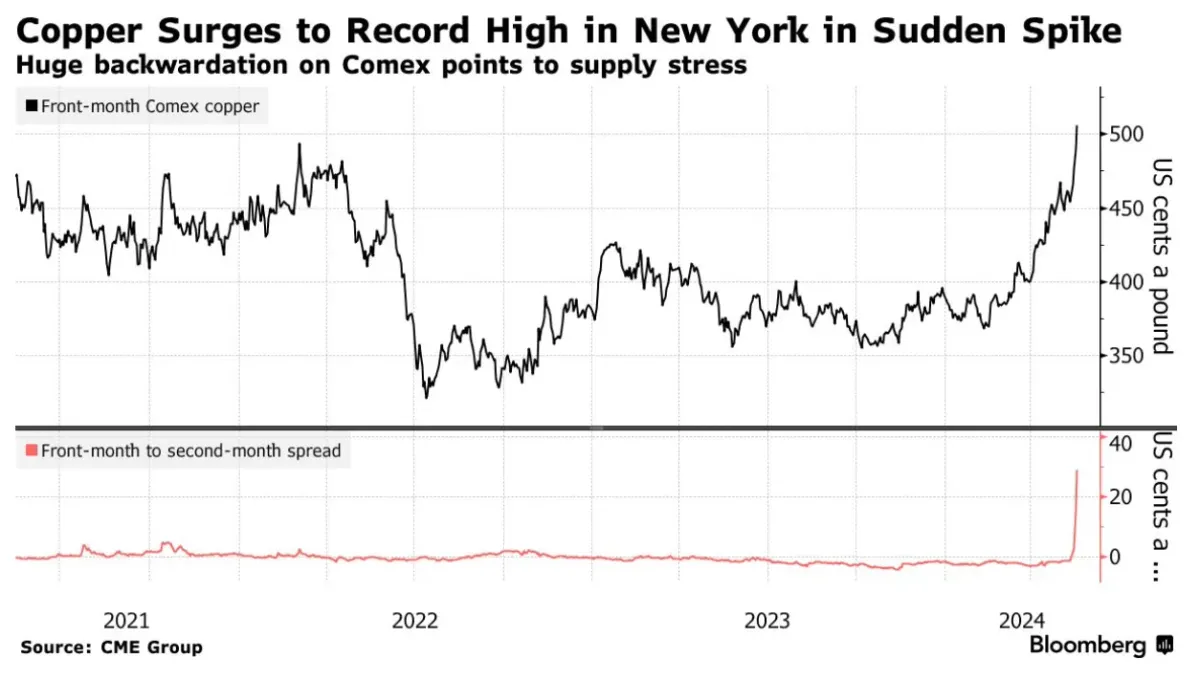
Copper’s rally momentarily broke all-time highs as industrial metals saw broad advances, with fresh Chinese stimulus measures boosting sentiment this week. Copper prices have increased about 30% this year, largely a result of major supply disruptions and rising hopes of a rebound in manufacturing and industrial activity.
With the world already producing less copper than it consumes, we are now adding even more sources of demand that could further worsen supply-demand balances into the future. “First it was the energy transition, now also data centres and AI - growth has suddenly exploded,” said Saad Rahim, chief economist at Trafigura, a Swiss commodity trading giant.
Further increasing the spotlight on the intense demand for copper was BHP’s record nearly $43 billion (USD) takeover bid for Anglo American which was rejected on Monday. While London-listed Anglo produces a range of commodities, from diamonds to nickel, BHP made clear that its most prized assets were the company’s copper. With Anglo stating they will now communicate a future growth strategy to investors, many believe alternate bids, including from rival companies may be coming.
Citi expects copper demand will exceed supply this year and is pencilling in a deficit of one million metric tons over the next three years. Morgan Stanley forecasts a 700,000 metric ton deficit in 2024. China, which consumes about half the world’s supply, has seen copper demand rise sharply in late 2023 and early 2024; demand has been up an average of 18% year on year over the last 5 months, reported the WSJ. Although, some are forecasting supply growth could surprise to the upside, with Deutsche Bank forecasting a 3% deficit next year in supply if the First Quantum’s Cobre Panama mine fails to reopen. However, if it does reopen, the market would be in surplus by 1.8%.
Drilling down into a trading perspective and using the Commitments of Traders (COT) report to assess the positioning of market participants, we can see acute levels relative to the last two years for all three groups.
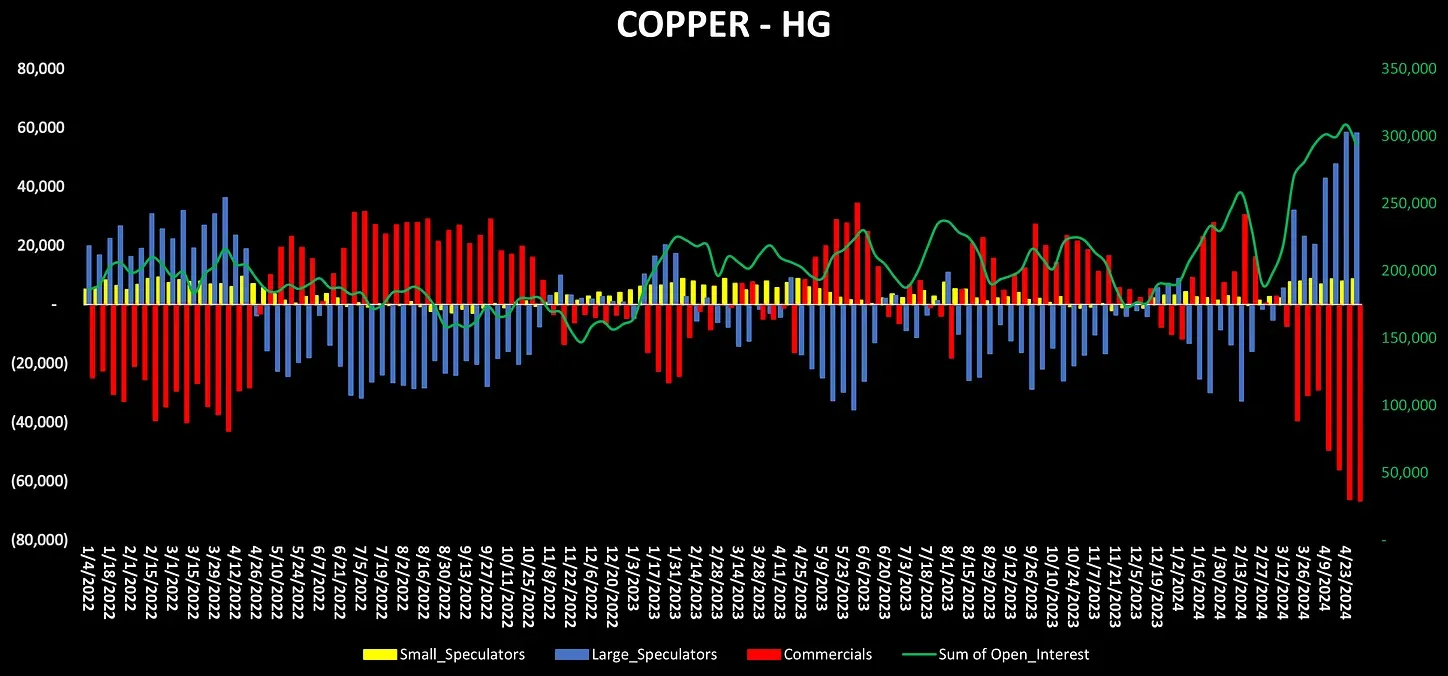
With many trend following strategies in long positions for roughly 2-months now, this has increased significantly with large speculators in recent weeks. The contrarians and mean reversion traders are ready and a failure of price on a key news event, economic indicator, or AI announcement (among others) may result in a sharp correction in price. Even with such a news catalyst, be mindful of short squeezes to the long side as price makes new highs, like we have seen this week with copper up more than 7%! Short-squeeze rallies typically occur in commodities markets as loss-making traders are forced to exit positions under pressure from ballooning margin calls or the threat of having to deliver physical material — or pay a big rollover fee — when the contract reaches expiry.
More broadly, be careful chasing price in either direction, always execute your personal system or strategy and maintain discipline. One thing that is safe to assume; copper’s future is going to be a bright one but don’t expect the path to be a straight line. Consider the imbalances in the Chinese economy and other supply and demand side impacts, including developments in both AI and the global EV transition, and always manage your risk.
Parting Shot
"You should always be rooting for the people you know. Not only because you may need their support tomorrow, but also because it feels good to celebrate something.
Celebration can rescue your day, even if it is someone else's victory. Envy will ruin your day, even if you're actually winning.”