A New Framework for Money and Success
Second Level Thinking · Issue 29
Shifting your financial relationship and building a personal success engine. Featuring Roger Federer’s radical take on "practicable" talent.
A reality of capitalism is the pursuit of financial gain by many for pure materialistic purposes, well exceeding healthy levels of comfort. This has been exacerbated by technology advancements, including the likes of social media, where we are left continually comparing ourselves to others every day, that is especially evident in Western cultures.
A recent impact of this is increased rates of suicide, depression and inequality amongst Generation Z and now Generation Alpha. A critical conversation that far exceeds the scope of this newsletter. The silver lining (if there is one), is that in understanding the negative implications of our current technological advancements and political landscape, you are already equipped with the knowledge to act independently and with more considered thought:
First, by focusing on what you can control, being your attitude and your effort. Everything else is noise and a distraction.
Second, by adopting a more holistic approach to how you define success.
Success is not money. Money is not success. Money plays a role and is a singular component of success if you choose to adopt it, but it is not success in and of itself.
Money is a magnificent utility that serves multiple purposes and can assist us greatly in many ways above meeting our basic needs of food, shelter, and providing for our families. Whether it be further education for our kids, the initial seeds of a business venture, valuating an investment, exploring another part of our magnificent world, or a bold plan to take us to another one, our options are endless.
There is no escaping it, therefore, we need to improve our relationship with it, whilst enjoying the benefits of it, and minimising the dark depths of fear and greed in which it can drive us. This doesn’t mean you should not desire nice things or feel shame for wanting them. In fact, these thoughts are perfectly natural and what makes its devilish lure so difficult. I am just asking you don’t judge yourself and others through it as a standalone beacon in which everything else is secondary. I will refrain from going on a Fight Club style rant, but I will remind you, you are not your car keys or the home in which you live. You are so much more.
So, let’s introduce the framework I have created and want to share with you.
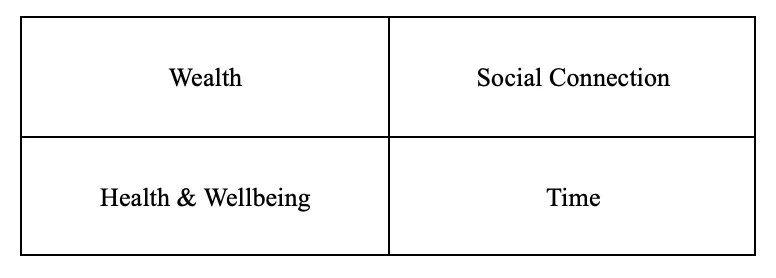
Four Quadrants of Success Framework
Ask Yourself:
Wealth: are your expenses less than your income?
Social Connection: are your relationships with family and/or friends healthy?
Health & Wellbeing: are you in a good place both physically and emotionally?
Time: do you have enough time per day or week to do the things you enjoy?
Wealth: there is no magical formula, you must spend less than you earn and identify ways to earn money whilst you sleep. Only then can you activate the compounding effect and create the space required to spend time in the other three quadrants of this framework. It is acceptable to have financial-specific goals but be realistic and do the inner work required not to weight wealth any higher than you should be.
Social Connection: I would aim for 3-5 family members or friends and 1-2 community activities in which you engage with locally. With the individual relationships, ask yourself, am I comfortable calling these people in the night and am I vulnerable with them? For the community activities, ensure it involves others and is even better when it connects to developing a skill irrespective of age. This is setting a low bar but in my case studies you would be surprised how few meet this minimum standard.
Health & Wellbeing: Two simple questions to support this effort are 1) what am I working on physically? 2) What am I working on emotionally? I have used these questions with clients, and it is more challenging than what it appears at face value. Dig deep and hold yourself accountable to them. Do not move on without the results being sustained.
Time: the finite resource that defines our existence, is profoundly important because it is the currency through which we navigate life. Unlike material wealth, time cannot be saved, earned back, or extended—it flows forward relentlessly, making every moment unique and irreplaceable. Its scarcity compels us to prioritise what truly matters, whether nurturing relationships, pursuing passions, or contributing to the world. Recognising time’s value encourages mindfulness and intentional living, reminding us that the quality of how we spend our time ultimately shapes the meaning of our lives.
What the Research Says
I believe each of the quadrants are critical to a healthy and fulfilling life, that is supported by one of the longest-running studies on human life, which provided profound insights into factors contributing to health, happiness, and longevity.
The Harvard Study of Adult Development, initiated in 1938, tracked two groups: 268 Harvard sophomores and 456 boys from Boston over decades, with the research expanding to include their spouses and children over time.
Key Findings:
Quality of relationships predicts longevity and happiness: Warm, supportive relationships are the strongest predictors of long-term health and life satisfaction, more than wealth or fame. Loneliness is as harmful to health as smoking or obesity.
Emotional health is crucial: Managing stress effectively is essential for maintaining physical health. Emotional well-being in midlife predicts healthy aging.
Physical health and mental well-being are interconnected: Participants who developed strong coping mechanisms early on were more resilient to physical and mental decline. Healthy habits, such as exercise, diet, and avoiding substance abuse, correlated with better outcomes.
Purpose matters: Those who maintained a sense of purpose and continued to engage in meaningful activities enjoyed better health and happiness later in life.
Economic factors have limited impact: Beyond basic financial stability, wealth did not significantly contribute to happiness or health.
The study underscores the importance of social and emotional connections in an increasingly disconnected world. Its findings are often cited to advocate for prioritising meaningful relationships and mental health.
I hope you find this framework useful and urge you to give it a try. As always, feedback is welcome and remember: “When someone is properly grounded in life, they shouldn’t have to look outside themselves for approval.” Epictetus
Parting Shot
Roger Federer on the kind of talent you can practice:
“Yes, talent matters. I’m not going to stand here and tell you it doesn’t. But talent has a broad definition.
Most of the time, it’s not about having a gift. It’s about having grit. In tennis, like in life, discipline is also a talent. And so is patience.
Trusting yourself is a talent. Embracing the process—loving the process—is a talent. Managing your life, managing yourself. These can be talents, too. Some people are born with them. Everybody has to work at them.”