Applying the 80/20 Principle and Gold Highs
Second Level Thinking · Issue 7
Gold smashes all-time highs: what it tells us about inflation and global instability. A framework for applying the 80/20 principle to your time and why curiosity is your best fuel.
The 80/20 Principle
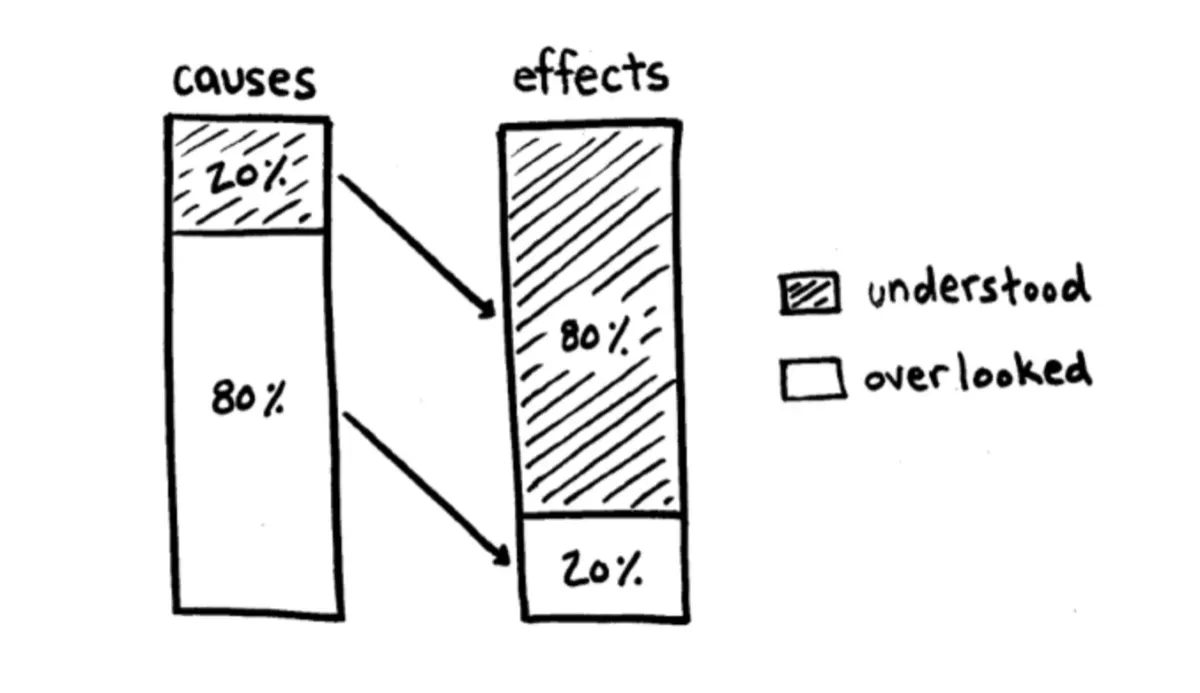
“The 80/20 principle tells us that in any population, some things are likely to be much more important than others. A good benchmark or hypothesis is that 80 percent of results or outputs flow from 20 percent of causes, and sometimes from a much smaller proportion of powerful forces,” writes Richard Koch.
Also known as the Pareto Principle after the late 19th century Italian economist, Vilfredo Pareto, who noticed that 80 percent of the pea pod harvest from his garden came from 20 percent of his pea plants. Based on Pareto’s observation, he then calculated that 20 percent of the people in Italy owned 80 percent of the country’s wealth. This distribution of wealth is an example of Pareto distribution. Koch’s book, The 80/20 Principle, is well worth reading.
Many of you will have seen this in your workplace, as it is not uncommon to see people who appear to be busy all day but seem to accomplish very little. This is almost always because they are busy working on tasks that are of low value while they are procrastinating on the one or two activities that could make a real difference to their companies and their careers.
Professional Application:
In a business setting, the 80/20 principle has been popularised as a management tool and used across an array of functions to support goal setting, problem solving, recruitment, sales, and other business-critical activities. Not to be seen as a magic formula, whether it is 70/30, or 76/24, results will vary but the approximate 4-to-1 ratio does arise constantly and it is rarely true that 50% of causes lead to 50% of results. The universe is predictably unbalanced and few things really matter.
So how can you apply this to your business? If 80% of your results in business are derived from the 20% of your inputs, we can apply this thinking regardless of business type and size. Small e-commerce entrepreneurs find that software spends 80% of its time executing only 20% of the available instructions. Even Apple used a version of 80/20 while developing the Apple Newton Message Pad, an electronic personal organiser in 1993. They found that 0.1% of a person’s vocabulary was sufficient to do 50% of the things you want to do with a small handheld computer.
Start by asking yourself and your team:
Which 20% of your products are responsible for 80% of your sales and/or profits?
Which 20% of your repeat buyers are responsible for 80% of the repeat purchases? Follow up with them to re-connect.
Which 20% of your customers cause 80% of the complaints and headaches? Consider eliminating them.
Which customers spend the most? 80% of the overall revenue comes from 20% of your customers or clients. Focus on nurturing the relationship with these buyers.
Which states or countries do 80% of your sales come from? Focus most of your marketing efforts on these.
Which 20% of employees contribute to 80% of company sales?
Which ads have the greatest effect and return on investment?
What are your most visited pages on your website? 80% of persuasion happens on 20% of your web pages.
Which 20% of the tasks on your to-do list account for 80% of your productivity?
Personal Application:
If being busy is not the same as being productive, the 80/20 implies that we should turn conventional wisdom upside down and do the following:
Celebrate exceptional productivity, rather than raise average efforts.
Look for the short cut, rather than run the full course.
Strive for excellence in a few things, rather than mediocrity in many.
Exercise greater control over our lives with the least possible effort.
Delegate, or outsource as much as possible from our daily tasks.
Choose our careers and employers with extraordinary care and deliberation.
In every important sphere, work out where 20 percent of effort can lead to 80 percent of returns.
Additionally, you can apply it to any aspect of your life, including with health and fitness, relationships, and personal progress. Author Mark Manson gives us several simple framing questions that can be asked of oneself:
What are the 20% of your possessions you get the most value out of?
What do you spend 20% of your time doing that gives you 80% of your happiness?
Who are the 20% of people you’re close to who make you the happiest?
What are the 20% of the clothes you wear 80% of the time?
What’s the 20% of food you eat 80% of the time?
Although basic in nature, it’s a great starting reference in practising using the tool and you will start to see opportunities everywhere as you apply it both personally and professionally. Grasping the concept is easy, but application in a business setting is much more difficult. In other terms, it is easy to define the “why” as a founder or leader, but much harder to initiate the “how.” Simply knowing is not enough but “the 80/20 principle is the cornerstone of results-based living,” as stated by Tim Ferriss.
Gold Highs
Shifting expectations of US rate cuts and global geopolitical tensions have helped send gold prices to all-time highs this year, climbing above $2,400 an ounce. The metal’s robust performance has been linked to central-bank buying, surging interest in some Asian markets including China, and the possibility that investors may be seeking protection against sticky inflation.
China, licking the wounds of a property slump and its own market woes continues to buy aggressively with quarter-one purchasing of gold bars and coins up 26% YoY and amounting to around a third of total consumption, reported the Wall Street Journal last week.
“It isn’t just retail shoppers, futures traders and institutional investors who are snapping up gold bullion. China’s central bank, like its global peers, has been loading up on the precious metal for 17 consecutive months, with a total gold reserve of 2262.47 tons at the end of March.” WSJ.
China and India have typically vied over the title of world’s biggest buyer, but that shifted last year as Chinese consumption increased to record levels. Although China mines more gold than any other country, its imports are significant and greater than the sum of metal that backs ETFs against the precious metal globally!
The People’s Bank of China has been on a buying spree for 17 months, its longest-ever run of purchases, as it looks to diversify its reserves away from the dollar and hedge against currency depreciation, reports Bloomberg. ETF inflows have totalled $1.3 billion so far this year, compared with $4 billion in outflows from funds overseas with this commodity diversification expected to continue.
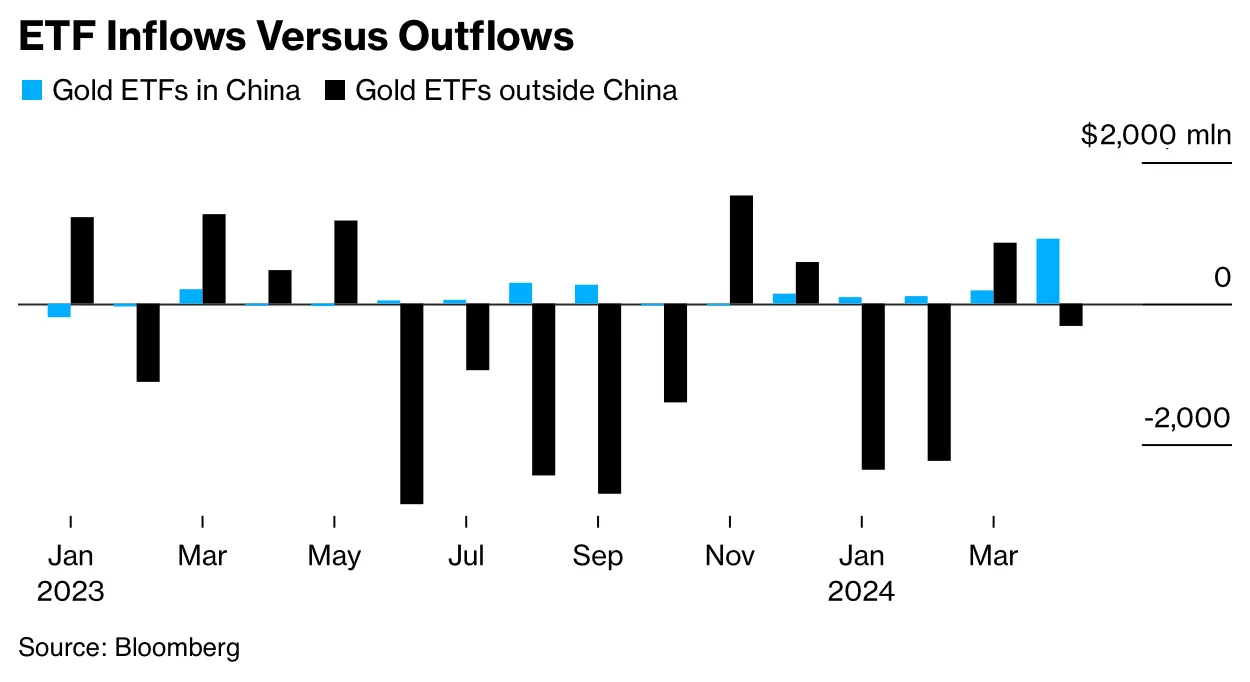
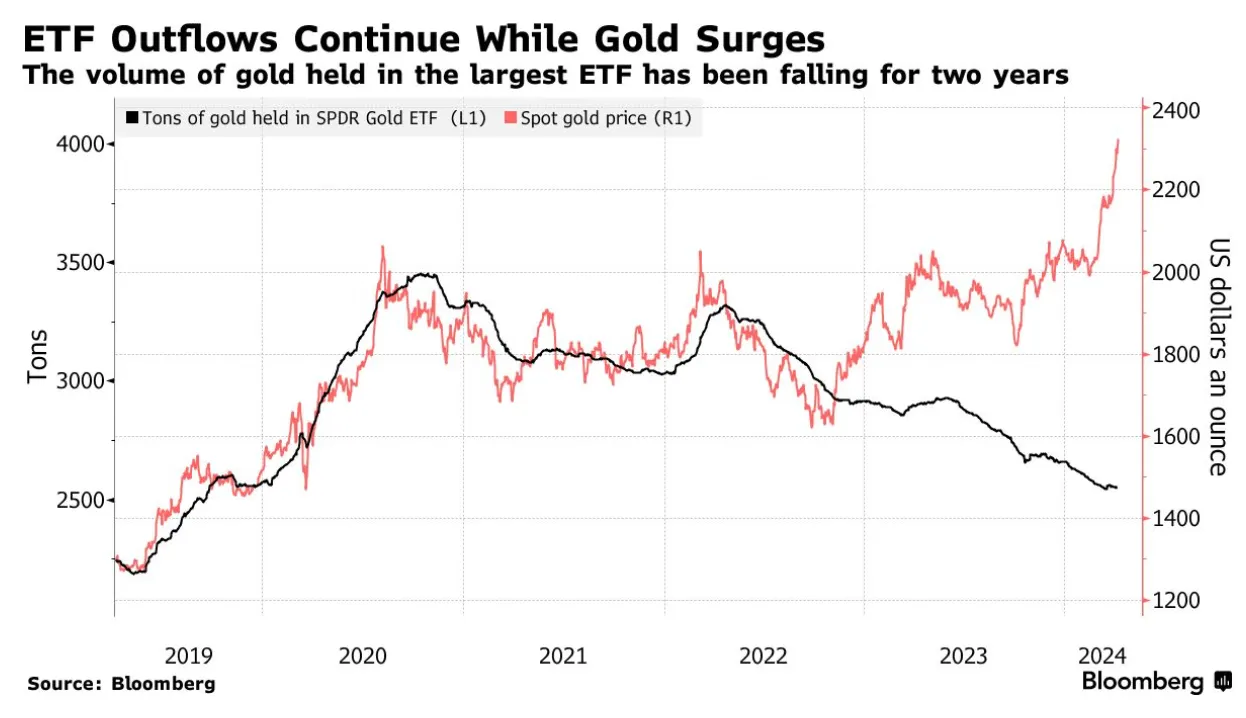
Interestingly enough, profit-taking by long-term investors who bought in years ago is how Citigroup Inc. explains why net ETF inflows have been notably weak. The fact that the steady and sizable outflows haven’t had a greater impact on prices also hints at strong demand for the bars by larger market participants.
In case you are left feeling this rally is an isolated affair, our US counterparts have taken to Costco for the purchase of gold, which started offering gold bars online and in some store locations last year. The WSJ reported that Costco has made it easier for members to shell out thousands of dollars on gold bars—and get a $1.50 hot dog while they are at it. Current estimates by Wells Fargo indicate that shoppers are spending as much as $200 million monthly on gold across the US.
Gold buyers in the US and in particular younger ones rated gold as a better investment than stocks and mutual funds last year for the first time in a decade and see it as a hedge against catastrophe. As sticky inflation further erodes trust in the US dollar and the overarching financial system, many searched for a safe store of value in gold - and Costco!
Geopolitical tension through Europe and the Middle East has added fuel to the fire and it is no surprise that the peak in gold prices coincided with a peak in Israel-Iran tension last week and as the likelihood of retaliation decreased so too did the price of gold, closing down for the first time in six weeks. "No new bad news is bad news for Gold (& Silver) bulls," wrote MKS PAMP metals strategist Nicky Shiels.
Other analysts surmised that gold's upward surge was due for a break. Senior commodity strategist David Wilson of BNP Paribas said that gold had been struggling recently to keep up its recent highs, a signal that some traders who had previously bought gold have been selling to take profit. This year's gold rally has lifted its price by more than 40% since the autumn of 2022. Earlier this month, Citigroup analysts raised their 6-18 month gold forecast to $3,000, citing the strength and breadth of physical buying.
Parting Shot
"People can help you in many ways throughout life, but there are two things nobody can give you: curiosity and drive. They must be self-supplied.
If you are not interested and curious, all the information in the world can be at your fingertips, but it will be relatively useless. If you are not motivated and driven, whatever connections or opportunities are available to you will be rendered inert.
Now, you won't feel curious and driven about every area of life, and that's fine. But it really pays to find something that lights you up. This is one of the primary quests of life: to find the thing that ignites your curiosity and drive.
There are many recipes for success. There is no single way to win. But nearly all recipes include two ingredients: curiosity and drive." — James Clear
“I think one thing that is a really important thing to strive for is being internally driven, being driven to compete with yourself, not with other people. If you compete with other people, you end up in this mimetic trap, and you sort of play this tournament, and if you win, you lose. But if you’re competing with yourself, and all you’re trying to do is — for the own self-satisfaction and for also the impact you have on the world and the duty you feel to do that — be the best possible version you can, there is no limit to how far that can drive someone to perform.” — Sam Altman