Finding Purpose and Market Misconceptions
Second Level Thinking · Issue 9
The Great Disconnect: why economic data and public sentiment are miles apart. A framework for finding purpose when the external world feels chaotic.
Finding Purpose
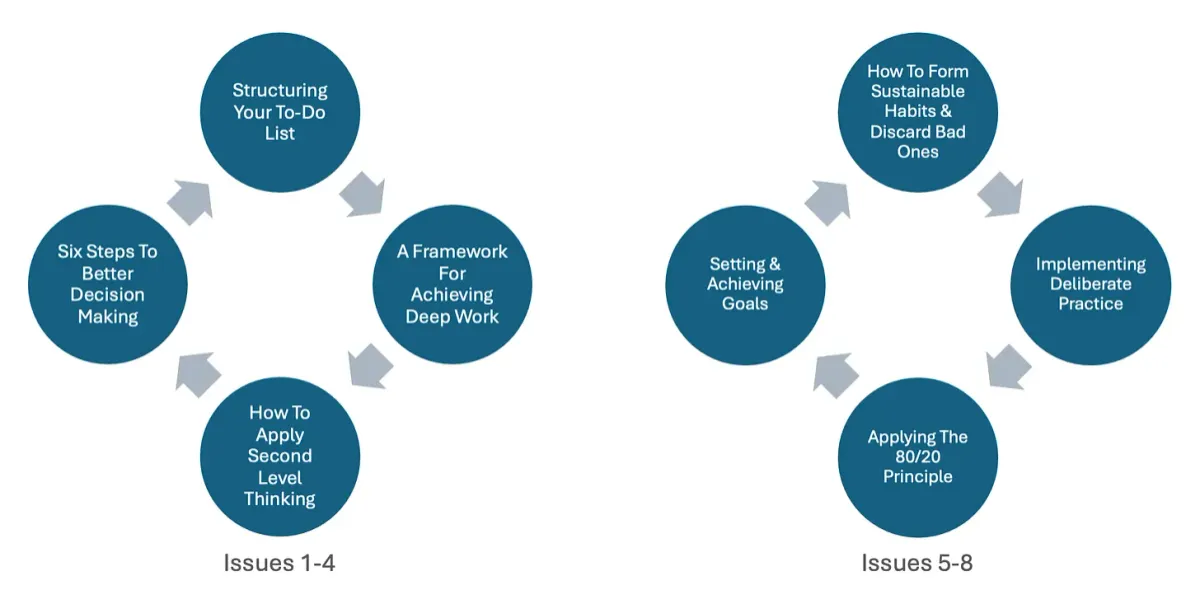
Taking the opportunity to recap on our first eight issues, below is a visual aid of the coaching topics discussed to-date. Be sure to reflect and refine how these tools overlap and fit into your underlying systems. All are heavily focused on the execution layer and cover a range of frameworks from goal setting right down to your daily to-do list.
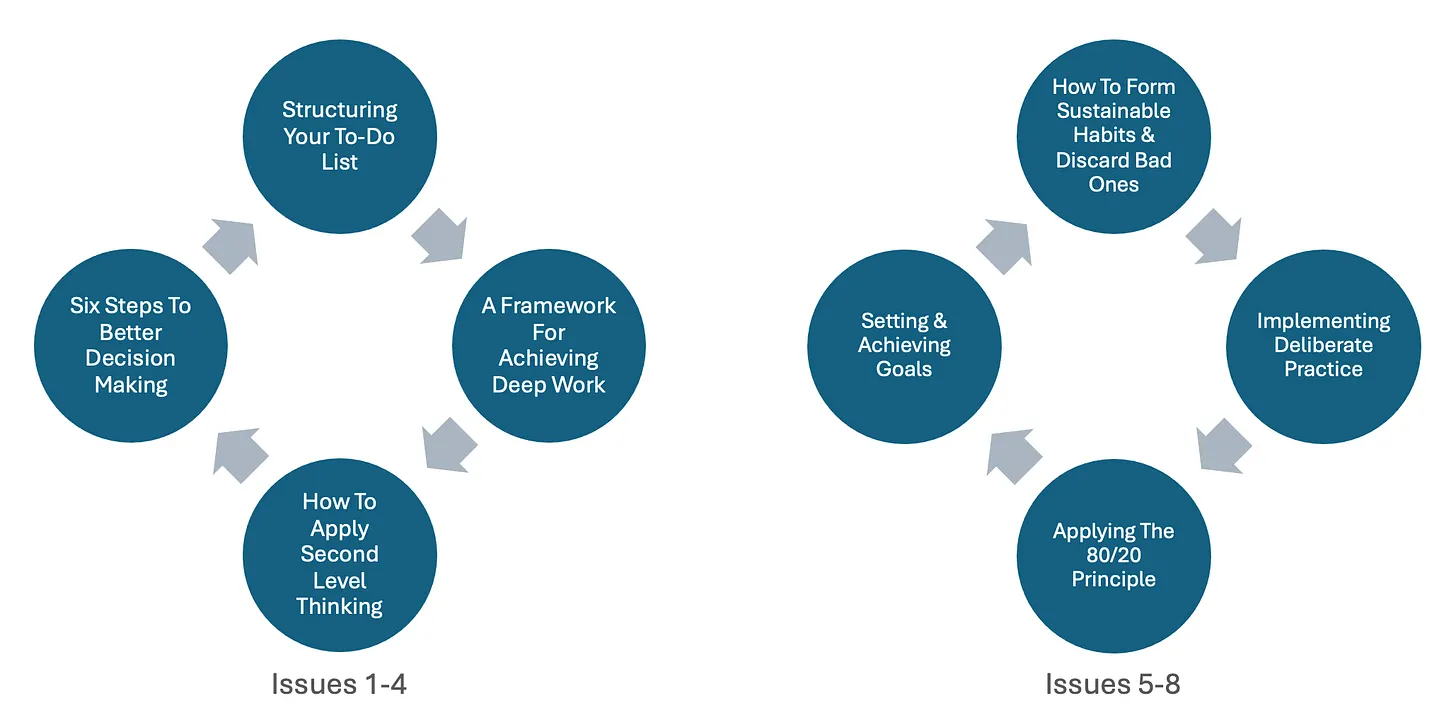
Over the next eight issues we will draw our lens outward and explore how to establish a vision and shift culture through a set of underpinning values or principles. We will explore ways to find purpose and agency in your life’s work, and look at several behavioural fallacies to watch out for, among other things. As always, thanks again for all the great feedback and support - happy reading.
Finding purpose as a human is an extremely difficult process; parents, mentors and other key figures in our lives can provide support but essentially - whether we accept it or not - we are on our own. Each day when we rise, there are an infinite amount of paths in which we can choose to take and this limitless volume of possibilities can leave us feeling overwhelmed and confused. If you allow it, this analysis paralysis results in procrastination on the surface, but can lead to deeper psychological issues, such as depression.
When you find your purpose, or what Robert Greene describes as “your life’s task,” everything has direction, everything has a purpose and our energy is concentrated.
Not to be seen as narrow or singular, this targeted effort should excite us. This is where we have agency and the vitality to wake up feeling well enough to want to begin our day, with enough energy to complete our day and to move back and forth along the continuum of driven and relaxed, maintaining a healthy balanced state.
So what’s the formula I hear you ask. As you already suspected, there isn’t one. But there is a way to explore this fundamental question in a deeper manner. First though, let me tell you a story about Sam.
Sam’s Story
When Sam was a small boy he had these child-like impulses and internal voices that drove his decision making. He couldn’t make sense of them but they were spontaneous, instant, and fun. Learning was invigorating and for Sam, one of his interests was an inherent passion for words and language. Very primitive in nature, Sam loved words; he loved writing them backwards, unpacking the structure of sentences and everything about them.
There are many cultural examples of this: for Tiger Woods this was a fascination with a golf ball and the broader game. For Albert Einstein his early love of physics would spawn from a compass he received at the age of 4 or 5 as a gift from his father. The thought of external forces controlling the compass and moving the small dial fascinated him - he was transfixed on the device.
As Sam grew he started hearing his parents and other adults tell him what was right and wrong and he became influenced by their feedback: do this, do that, don’t do this, don’t do that, this is right, this is wrong, etc. As a teenager sentiment shifted and Sam became heavily influenced by his peer group and what they were doing. The desire to fit into certain social settings and do what others were doing was too great.
Next came university and/or the ability to choose a career. Sam was expected to decide at this point what it was he wanted to pursue and do as his life’s work for the next 50 years or so. When deciding, Sam was extremely conflicted and didn’t feel he had developed the tools, skills, or had the lived experiences in order to adequately make such an important decision. To further compound this, he was heavily influenced by what his peers were doing. Not to mention his parents and other important adult figures who consistently reminded him of the risks associated with each of these options, the social hierarchy of the specific disciplines and the ability, or inability to generate wealth and provide for a family as a limiting factor in choosing one.
Enter the workforce: Sam isn’t extremely satisfied with his previous choices to-date but he has finished school, played some sport, had some fun, completed some further study and has accepted an offer for a job aligned with his degree. He has reoccurring thoughts about studying something else, or perhaps having a year off and travelling but this is squashed with a fear of disappointing his parents, falling behind socially and the risk of becoming a mature-age student with a lack of purpose.
Sam instead decides to take the job, throw caution to the wind and make hay whilst the sun shines. Everything now is about making money. Given his lack of passion for his chosen field, his fear of failure, societal pressures and other limiting beliefs, Sam is all about making money. He thinks this will solve everything and is quite competitive as a result: if only I can buy this car, if only I can buy this house, if only I can…you fill in the blank.
Fast forward and Sam has lifted himself to middle-upper class. Sam met a girl and got married and even has three small children. He has a four bedroom house, two German made cars, about $800k in debt and given his high income can comfortably pay his bills with some disposable income. He buys his coffee daily, is prone to shouting a round of drinks and is conflicted about which school he should send his kids to. Sam is mindful of his privileged state but is aware he has many years of work ahead of him, and can’t help but seriously challenge his previous decision making. Sam is not clinically depressed but he is not fulfilled either. Sam is lost at sea and there are moments in each day where he is extremely conflicted: Sam likes the comforts his salary enables him but he also understands it’s a means to an end, as he shares no equity in the business. Sam is worried he is missing too much time with his kids as a result of the hours he works. Sam understands the effort required to go out on his own and the high failure rate, not to mention the capital required. Sam is aware shifting careers will mean starting again and doesn’t want to move to a cheaper home and reduce his debt because socially this would appear bad. Also, it would impact the proximity to the school he has chosen for his kids, or at least one of his choices.
So Sam does some research and in speaking with a therapist designs a series of questions to further explore what to do next, as the pain of doing nothing became far too great. He just couldn't take it. He knew he would regret inaction as an older adult and this fear became greater than the enjoyment of the comfort he derived in his current state. He didn’t just skim the work and reflect momentarily, he journaled at length. He leant into the uncomfortable feelings, sat with the discomfort and put in serious work. It was a rollercoaster and didn’t happen overnight. He didn't just try and solve it with his logical mind, he went deep into the subconscious and sought help where required. He conducted a series of experiments to further define his future path. Sam challenged his beliefs and identified those that were helpful or hindering, he did the same with all relationships in his life and found many legacy friendships were entirely limiting in nature. He wasn’t only challenging simple habits but confronting social norms and in most cases required him to form and use different mental models - it greatly impacted the language used with himself. Sam knew that if he found his own uniqueness, what makes him, him, that he could go deep into that and create an alternate career path.
He tried not to mull on how you establish yourself when you are older and the small part of him that felt he had wasted his seed of uniqueness. Instead he focused more on acceptance of his current state and appreciation for coming to these questions now and not later in life. He sought out role models to support this transition and understood that when emotionally engaged you learn 3-4 times faster - he just wanted to feel consumed and energised in something, regardless of hierarchy of income.
Ironically, some of the work Sam did took him full circle and he kept coming back to things that interested him as a child; certain learning interests and the inherent willingness to help others. Sam kept digging and was certain if he found his life’s task everything would open up, not only in an intellectual manner, but a visceral one as well. He kept saying, it’s physical and I want to feel it!
This work took courage and was not easy. It was also a continuum and at no point was it one and done. It was a constant evolution that favoured the brave. It supported a value-set that many fail to display. And as for what happened to Sam…we’ll leave that story for another day and shift the narrative inwards, by taking a deeper look at one’s self.
The Great Disconnect
Recent economic data from the US has been extremely strong: in April inflation dropped to 3.4%, still above the Federal Reserve’s 2% target, but well below the 40-year peak of 9.1% in June 2022. Unemployment remains under 4% and as a result of these measures the stock market continues to grow. The Dow Jones index breached 40,000 for the first time this month as a result of market confidence, money continues to flow into a growing economy.
On the contrary, a poll conducted for The Guardian recently found that nearly three in five Americans wrongly believe the US is in an economic recession and the majority blame the Biden administration for these misconstrued economic woes. Furthermore, the misconceptions highlighted:
55% believe the economy is shrinking, and 56% think the US is experiencing a recession, though the broadest measure of the economy, gross domestic product (GDP), has been growing.
49% believe the S&P 500 stock market index is down for the year, though the index went up about 24% in 2023 and is up more than 12% this year.
49% believe that unemployment is at a 50-year high, though the unemployment rate has been under 4%, a near 50-year low.
These stats are strikingly damning: 72% of respondents suggested inflation was increasing, when it is down from a peak of 9.1% to 3.4% respectively and 70% of Americans said their biggest economic concern was the cost of living.
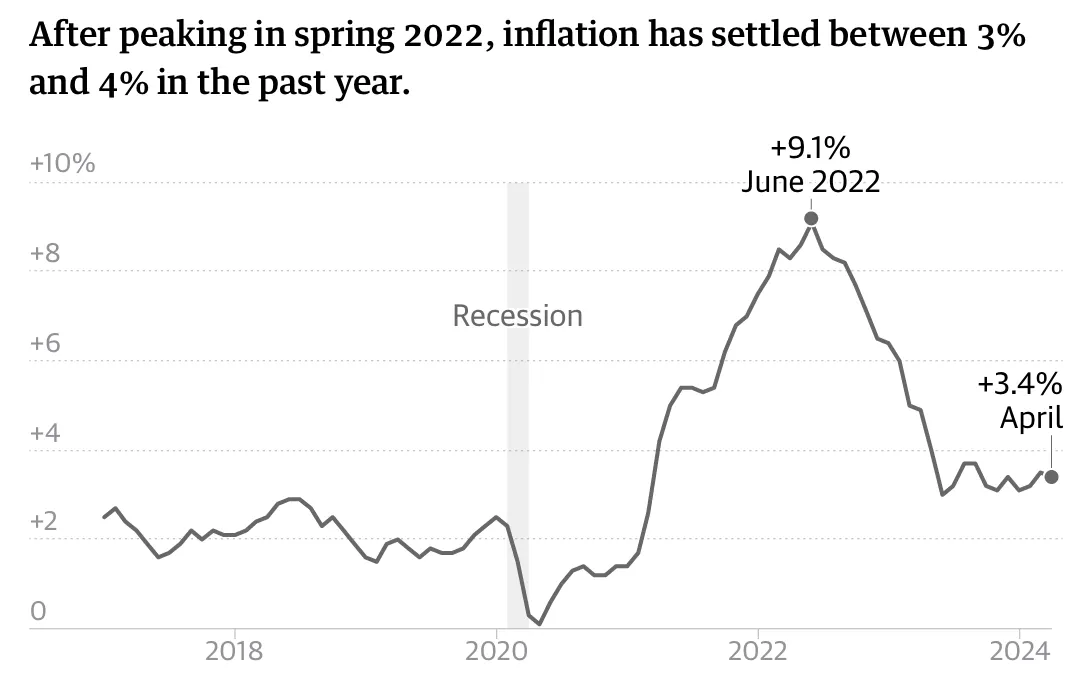
Feelings are not facts and distinguishing between reality and our emotions can be extremely difficult. Personally, I feel a similar melting pot is occurring here in Australia, but why is sentiment so far removed from our reality, or is the data misrepresented? Many believe the lagging data collation and reporting of key economic information to be a false account of a fast-changing world and this further highlights the variability between what economists track and use as a basis for decision making, versus what is representative of the underlying economy.
“At the heart of the issue is a misconception that bedevils academics, journalists, and ordinary Americans: the idea that the official inflation rate is an objective number, impervious to human biases, much in the way that someone’s height or weight can be objectively measured with a ruler and a scale.” Forbes
If you compare household net worth between the Trump and Biden administrations when adjusted for inflation, growth is actually flat during the Biden period. With interest rates near 6%, wages stagnant and government support stimulus being provided, people haven’t lost their jobs but they feel squeezed and are under-earning relative to the increase in costs for goods and services. “The average American’s ability to improve their condition is a result of the ability to borrow, not by their earnings and we are running into a wall with higher interest rates and inflation,” claimed David Friedberg, a Venture Capitalist this week. To support this hypothesis look no further than outstanding consumer loans; credit card debt in the US has now surpassed $1 trillion dollars. Yes, trillion with a t.
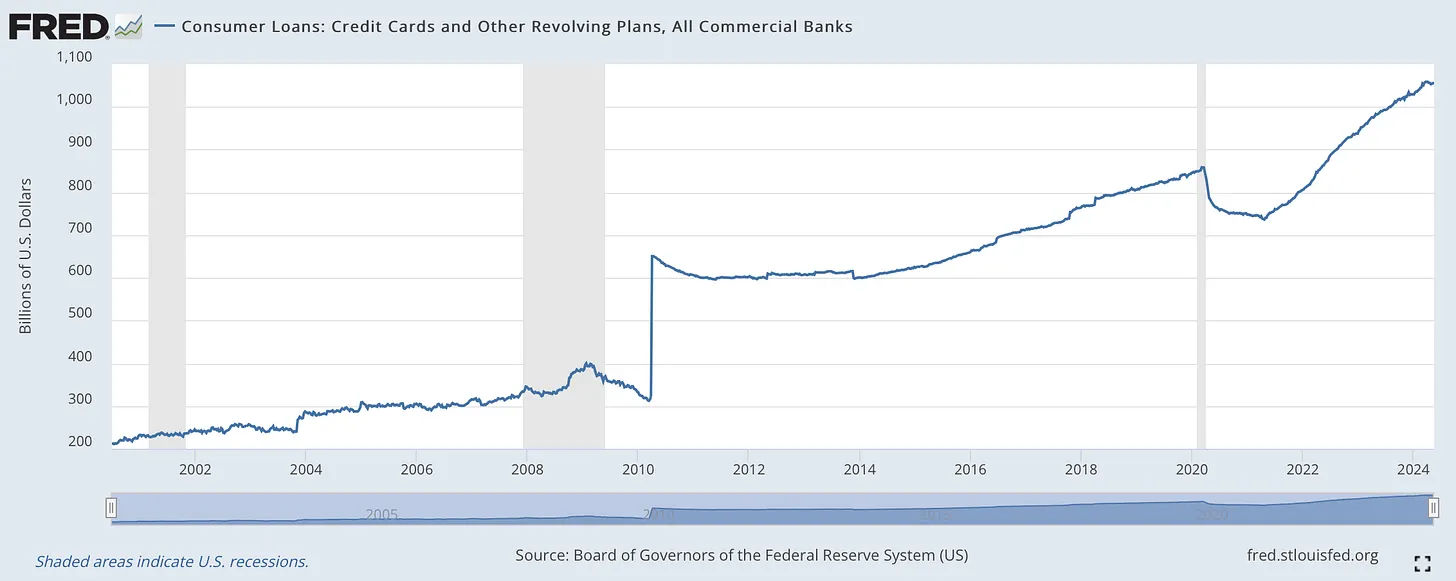
The Wall Street Journal stated last month that metrics like GDP and the Dow are the centre of discussion, especially in the news but they do not provide sufficient insight into American well-being.
“Shortly after its invention in 1934, GDP became the go-to measure for determining the size of national economies. Since then, it has become nothing less than an all-purpose weather vane, a stand-alone indicator of which way the financial winds are blowing. Yet GDP was never meant to carry so much weight. Even its inventor, economist Simon Kuznets, acknowledged that ‘the welfare of a nation can…scarcely be inferred from a measurement of national income.’ That’s even truer of the Dow. Drawn from the stock prices of just 30 companies, the Dow provides a rough encapsulation of the state of American business. It is far less reliable as an indicator of the state of American family finances. After all, around 40% of households—and nearly 60% of Americans under age 30—do not own any stock, including indirect ownership through retirement plans.”
This poses a real threat to Biden and his self-proclaimed “Bidenomics” in his re-election bid. Regardless your political position, as the election draws near you can expect interpretations to vary widely across parties. The experts have the statistics as their foundation and the population has their lived experience. As rate cuts continue to be pushed due to sticky inflation and the average American becomes further squeezed, one can’t help think of the famous Mark Twain quote: “There are 3 kinds of lies: lies, damn lies, and statistics.”
Parting Shot
Pure hell forces action, but anything less can be endured with enough clever rationalisation. Do you really think things will improve or is it wishful thinking and an excuse for inaction? If you were confident in improvement, would you really be questioning things so? Generally not.
This is fear of the unknown disguised as optimism.
— Tim Ferriss