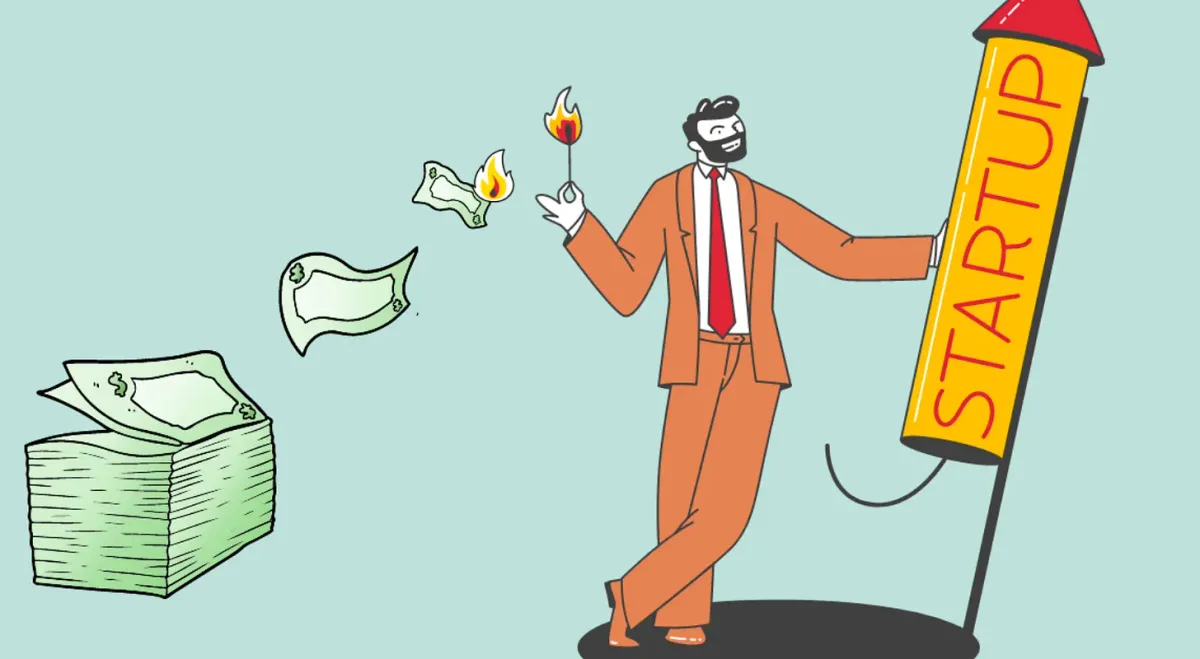
Growth is Vanity, Cash Flow is Sanity
Second Level Thinking · Issue 35
Navigating the tension between expansion and insolvency. Why mastering your capital is the prerequisite for sustainable long-term focus.
There’s a saying in startups that companies don’t die from lack of ambition, they die from running out of cash. A brilliant idea, an excited team, early customers even—and yet, eighteen months in, the lights go out. Not because the idea was wrong, but because the founder didn’t respect the financial game.
When you strip it back, staying afloat as a new business comes down to three things:
Mastering your COGS (Cost of Goods Sold).
Controlling your burn rate.
Extending your runway long enough to hit cash flow positive.
Sounds simple. But the difference between reading this and living it is the difference between having a company and writing a post-mortem.
Know Your Numbers Like They’re Family
As a founder, you don’t need to be an accountant. But you do need to know your numbers like they’re family—by name, by habit, by how they behave under stress.
COGS tell you whether your product is viable at scale.
Burn rate tells you how fast you’re bleeding.
Runway tells you how long you have left to solve the puzzle.
Archetype: The Optimist. This founder raises $200K, hires a small team, starts building, and assumes revenue will “catch up.” They only check the bank balance every few months. Twelve months later, they’re shocked to discover they have 30 days of cash left and no traction. The business didn’t fail because of the idea—it failed because they never understood the math.
Archetype: The Realist. This founder knows they have $50K in the bank. They calculate their burn at $5K a month. That’s 10 months of runway. They cut every unnecessary tool, run a tight marketing budget, and focus only on getting a single paying customer. They live in their spreadsheet as much as their product. Ten months later, they’re cash flow positive—not because they had more money, but because they respected the numbers.
Lesson: Optimism without numbers is delusion. Realism with numbers is strategy.
Respect Your COGS
COGS are the quiet killers. They rarely show up in the pitch deck, but they decide whether your business is actually making money.
Think of COGS as everything you spend to deliver your product: raw materials, packaging, shipping, fulfilment, storage, even refunds. If you don’t know these line by line, you’re building on sand.
Mini-case: The Supplement Startup. A founder I knew launched with a beautifully branded supplement. Great product, strong demand. But the packaging and fulfilment costs were double what they expected. Every $49 jar sold was generating only $7 in gross margin. With marketing layered on top, she was losing money at scale.
Contrast this with another founder who sourced smart. They negotiated their packaging down by 15%, switched fulfilment centres after spotting hidden fees, and bundled shipping to cut postage by a third. That margin discipline meant that when they turned on ads, every sale put oxygen into the business, not smoke.
Lesson: Respect your COGS early—or they’ll strangle you quietly later.
Burn Rate: The Silent Killer
Your burn rate is how fast you’re lighting cash on fire. Most founders underestimate it, and worse, they justify it with lines like, “We need to spend money to make money.” Sometimes true, but more often fatal.
Archetype: The Big Spender. Raised $1M seed round. Built a team of 12. Hired a PR agency. Burned $80K/month before they even had consistent revenue. By the time the product was ready, the bank account wasn’t. They had built a rocket ship—without enough fuel to leave the ground.
Archetype: The Lean Operator. Bootstrapped with $40K. Worked out of a kitchen table. Did sales calls themselves instead of hiring a sales team. Burned $3K/month, mostly on software and a part-time contractor. They weren’t glamorous—but they lived long enough to find product-market fit, and later scaled with real revenue.
Practical Guardrails:
Revisit expenses monthly. Treat each as guilty until proven essential.
Track burn multiple: (net burn ÷ net new revenue). If it’s over 2 for more than a few months, danger ahead.
Anchor every spend to runway: “If I hire this person, how many months do I lose?”
Lesson: Spending is easy. Survival is hard. Keep the fire small enough to last the night.
Speed with Constraint
Constraint is not the enemy. It’s the discipline that forces clarity. Some of the best businesses were built because their founders didn’t have money to waste.
Mini-case: Airbnb’s Cereal Boxes. In 2008, Airbnb was running out of cash. Instead of shutting down, the founders printed novelty cereal boxes during the U.S. election—“Obama O’s” and “Cap’n McCain’s.” They sold for $40 a box, raising $30K. It didn’t scale, but it bought them time. That scrappiness became part of their DNA.
Mini-case: The No-Code Hacker. A solo founder wanted to launch a SaaS but couldn’t afford developers. Instead of raising money, she built the first version on Webflow and Zapier. Customers signed up, revenue trickled in, and only later did she hire a technical co-founder. The constraint gave her proof before burn.
Practical ways to move fast within constraint:
Launch with an MVP in 30 days. Perfection is the enemy.
Spend $500 on ads to validate demand before you spend $50K.
Trade skills with other founders—design for dev, ops for marketing.
Use free/cheap tools. The stack exists to replace teams of five.
Lesson: Constraint breeds creativity. Creativity extends survival. Survival creates optionality.
The Runway Game: Get to Cash Flow Positive
Your job isn’t to raise the biggest round or land in TechCrunch. Your job is to survive long enough to hit cash flow positive. That’s when the game changes.
Archetype: The Fundraiser. This founder measures success in capital raised. $2M seed, $5M Series A. But the revenue never caught up. When the next round didn’t close, the company collapsed. They had plenty of investors, but no customers willing to pay.
Archetype: The Builder. This founder never raised a cent. They started consulting on the side to fund the product. First customer signed within 4 months. By month 12, the business was profitable. By month 24, they had more inbound leads than capacity. Today, they choose whether to raise—not because they need to, but because they can.
Runway Tactics:
Slash costs early—don’t wait until panic sets in.
Create early revenue streams (pre-orders, pilots, service work).
Time big hires to revenue milestones, not optimism.
Lesson: Runway is your bridge. Build it long enough to cross, or you’ll fall halfway through.
Closing Thoughts: Frugality is Freedom
The early stage of business is romanticised—pitch decks, glossy branding, “big vision” narratives. But behind the curtain, the founders who survive are doing very unromantic work: spreadsheets, hard negotiations, and relentless restraint.
The founders who make it aren’t necessarily the smartest or most charismatic. They’re the ones who learn to treat cash like oxygen and time like gold. They know that if they can just stay alive long enough, the odds tilt in their favour.
So if you’re starting out, remember this: your first milestone isn’t domination—it’s not dying. Nail that, and you give yourself the rarest commodity of all: time.
Because in the end, frugality isn’t limitation, it’s freedom.
Field Tools: Simple Frameworks to Stay Afloat
Here are a few practical tools you can copy straight into a notebook or spreadsheet to tighten your financial grip:
1. Burn Rate Calculator
Formula: Burn Rate = (Cash Outflow – Cash Inflow) / Number of Months
Example:
Monthly expenses = $25,000
Monthly revenue = $10,000
Net burn = $15,000
Burn rate = $15,000/month
2. Runway Estimator
Formula: Runway (months) = Cash in Bank / Monthly Burn Rate
Example:
Cash in bank = $120,000
Burn rate = $15,000/month
Runway = 8 months
Pro tip: Always subtract 1–2 months as a cushion for surprises.
3. COGS Breakdown Template
Create a simple spreadsheet with the following line items:
Raw materials
Manufacturing / production
Packaging
Shipping & freight
Warehousing / storage
Payment processing fees
Returns & refunds
Formula: COGS per unit = Total Direct Costs / Units Sold
Use this number to sanity-check pricing: Gross Margin = (Sale Price – COGS) / Sale Price
4. Burn Multiple (Investor’s Lens)
Formula: Burn Multiple = Net Burn / Net New ARR (or MRR)
<1.0 = Excellent: you’re adding more revenue than you’re burning
1.0–2.0 = Acceptable for early stage
>2.0 = Dangerous
5. The “Oxygen Test”
Before any spend, ask yourself:
How many months of runway does this cost me?
Does it move me closer to cash flow positive?
If the answer to the second question is “no,” pause.
Parting Shot
Most people waste their energy on decisions that barely matter. Businessman Larry Tisch points out what moves the needle:
“The most important thing is to stay focused on what matters. Most little things ultimately have no effect on an enterprise. It’s the big deals and the big decisions that do. Don’t spend too much time on little things. The important choices and opportunities are the ones that move the dial.”