Is the US Recession Here?
Second Level Thinking · Issue 12
A deep dive into US recession indicators and the current state of the indices. Learning to win "ugly": why Roger Federer believes perfection is impossible (and unnecessary).
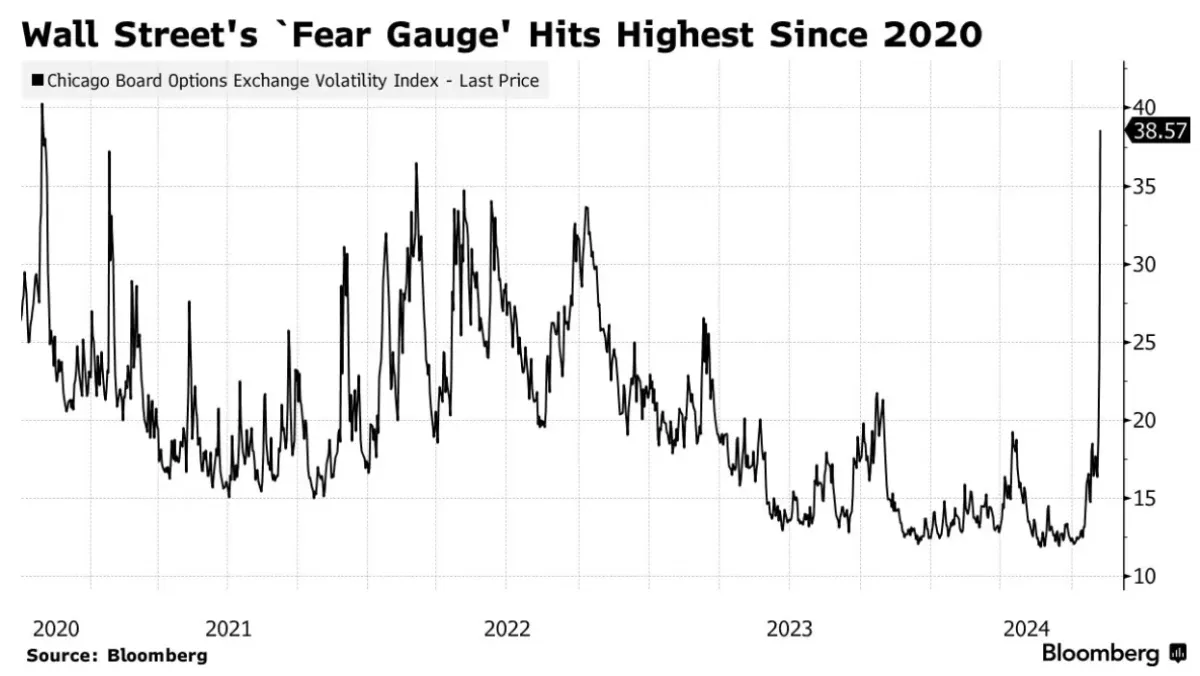
We’re back and oh what a week it’s been in financial markets. The saying “be careful what you wish for, as you might just get it,” seems fitting given investors’ reaction to the softening economy they’ve eagerly awaited. Fears of a recession and Federal Reserve misstep sparked a major selloff on Friday and Monday. From New York to Tokyo the selling was widespread, with tech-heavy Nasdaq 100 recording its worst start to a month since 2008. Wall Street’s “fear gauge” the VIX at one point registered one of its largest spikes in data going back to 1990, further compounding against a poor nonfarm payroll release on Friday detailing a modest 114,000 jobs added, raising the unemployment rate from 4.10% to 4.30%.
The Sahm Rule
The release also brought into play something called the “Sahm Rule,” which states that the economy is in recession when the three-month average of the jobless level is half a percentage point higher than the 12-month low. In other words, when the 3-month unemployment rate is above its lowest level from the last 12 months, we may be in a recession. And now it is. While others like Goldman Sachs took a different view, and modestly increased the probability of a US recession in the next year to 25% from 15%, respectively.
Immigration has been the largest factor on US employment recently and the new entrants to the work force typically have higher unemployment than more established workers. So some of the recent rise in unemployment may reflect friction rather than a weakening economy, wrote Paul Krugman. As Sahm explained herself, the rule wasn’t designed to predict recessions. It was, instead, meant to serve as a timely indicator that the federal government should move quickly to limit a recession’s depth. Although many pundits like Paul Donovan, a UBS economist were more direct, stating “The Federal Reserve has been late in cutting rates, but that has been true for some time.”
So was it all just the Fed’s fault? No. Earnings did disappoint, especially in tech where many are becoming concerned with the payback of AI - the biggest loser among major players was Nvidia. As one source put it, “Concerns about it being a bubble arise from the hype surrounding unproven AI applications and massive investments driving unrealistic expectations.” Who said that? AI of course, and more specifically, Bing’s Copilot. So maybe this isn’t about recession fears after all, it’s about fears that AI is another dot-com bubble.
The Unravelling Carry Trade
With a carry trade an investor borrows in the currency of a country with low interest rates, like Japan and China, and puts their money in one where they can get considerably higher returns. In recent years, the yen has been the most popular funding currency because of the Bank of Japan’s zero-rate regime. Yen-funded carry trades were among the most popular in emerging markets as volatility remained low and investors bet Japanese interest rates would remain at rock bottom. But the Bank of Japan raised rates for a second time at its latest meeting and signalled the potential for more. “The rise of Japan interest rates is changing the game rules,” said Pierre-Yves Gauthier, head of research at Paris-based brokerage AlphaValue. “In essence it’s the end of a free resource.”
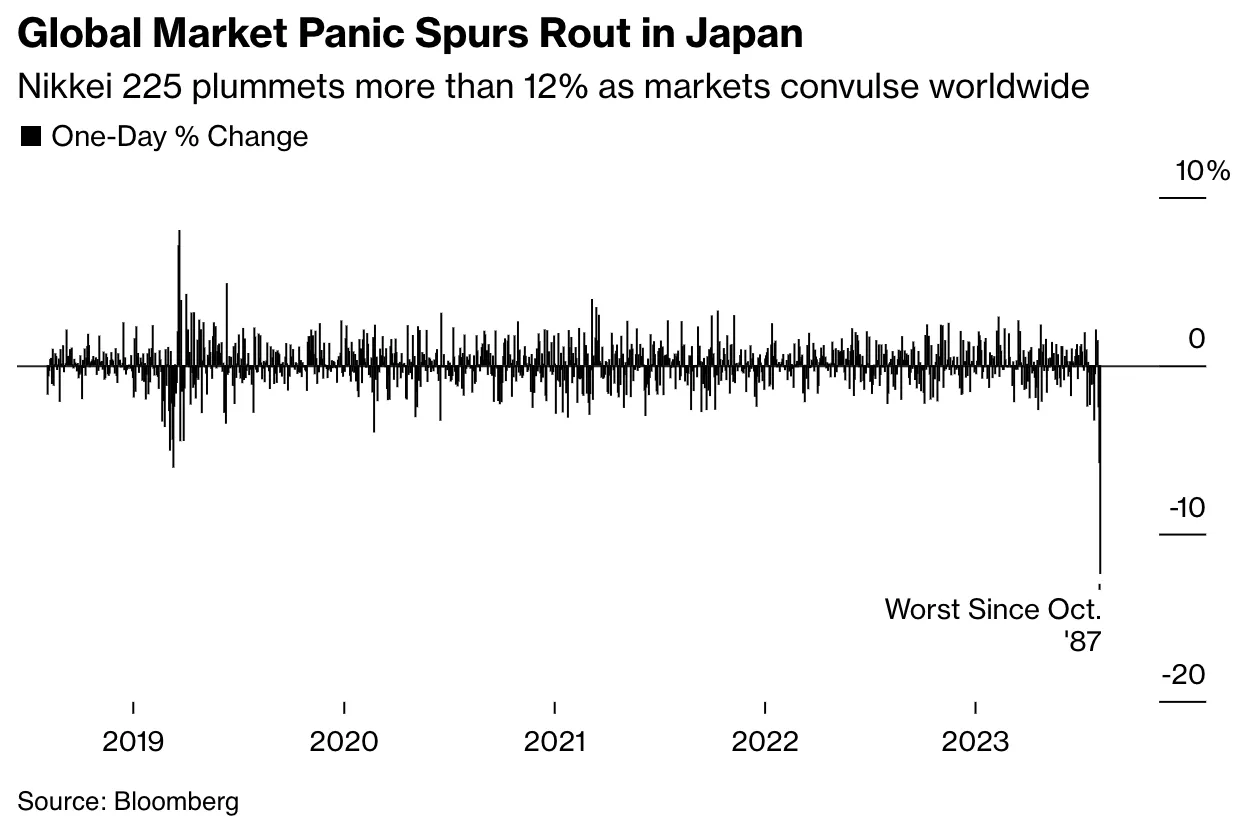
Another proxy to look at is Japanese banks’ foreign lending. The amount reached $1 trillion as of March, a 21% rise from 2021, according to data from the Bank of International Settlements. Much of the recent growth in cross-border yen lending has been in the so-called interbank market, where banks lend to each other, and to other financial firms such as asset managers. It’s an estimate of how much appetite foreign institutional investors have for yen-funded carry trades.
When a hedge fund has a highly concentrated position that starts to fall, it often needs to start selling assets and cutting risk elsewhere in the portfolio to satisfy its risk models. When a lot of funds have been buying the same things, that process can pressure a variety of investments, including some seemingly remote from the original bet. What have the majority of funds been buying, US tech of course and companies specifically associated with AI, which is another reason the selling was more prevalent in those areas of the market.
As Matt Levine put it in his highly popular newsletter, Money Stuff:
“Market crashes usually have the same mechanism. People like a thing, so they buy it, so it goes up. More people like it, so they buy more of it, so it goes up more. It goes up steadily enough that people think ‘ehh I should borrow some money to buy even more of this thing,’ so they do. Eventually a lot of very leveraged investors own a lot of the thing. Then something goes wrong with the thing, its price goes down, the leveraged investors get margin calls, and they have to sell the thing to pay back their loans. Their losses are big enough that they have to sell other things, things that were fine, to pay back their loans on the thing that went wrong. The big leveraged investors who owned a lot of the thing that went wrong also all own the same other things, also with leverage, so there is a generalised crash in the prices of the things that big leveraged investors own. In the special case in which the big leveraged investors are banks, this sometimes leads to a contraction in credit and serious economic consequences. In the general case in which the big leveraged investors are hedge funds, it’s mostly fine.”
Context Is Important
On Black Monday, October 19, 1987, the Dow Jones plunged a whopping 22.6% in a day. As markets crashed Robert J. Shiller (Nobel Prize winner) managed to get a questionnaire out to market participants as the event was unfolding and found that essentially, nobody was selling stocks as a response to news. Instead, their selling was a result of a fall in prices. In other words, the psychological panic fed on itself. The big question now is whether Monday’s wild gyrations mark the final bang of a global selloff that started to build last week or signal the beginning of a protracted slump. With 41 days until the next FOMC meeting, 73% of market participants believe a 50bps cut is probable and that 25bps isn’t enough. For those active traders, many are claiming that liquidity just isn’t there currently and those who attempted to buy the dip over the last two days have struggled.
So is the US already in recession? No. Not really. Sort of. It depends who you ask.
Should I buy now, or sell now? That I can’t tell you and be careful of those who proclaim to know what will happen next. And if you do have an actual working crystal ball…please DM me and for the rest, always manage your risk.
Parting Shot
“Perfection is impossible. In the 1526 singles matches I played in my career, I won almost 80% of those matches. Now, I have a question for you. What percentage of points do you think I won in those matches? Only 54%.”
In other words, even top-ranked tennis players win barely more than half of the points they play. When you lose every second point on average, you learn not to dwell on every shot.
“You teach yourself to think, okay, I double-faulted ... it's only a point. Okay, I came to the net, then I got passed again; it's only a point. Even a great shot, an overhead backhand smash that ends up on ESPN's top 10 playlist. That, too, is just a point.
And here's why I'm telling you this. When you're playing a point, it has to be the most important thing in the world, and it is. But when it's behind you, it's behind you. This mindset is really crucial because it frees you to fully commit to the next point and the next point after that, with intensity, clarity, and focus.
You want to become a master at overcoming hard moments. That is, to me, the sign of a champion. The best in the world are not the best because they win every point. It's because they lose again and again and have learned how to deal with it. You accept it. Cry it out if you need to and force a smile.”
— Roger Federer