Mastering the Day While Markets Shift
Second Level Thinking · Issue 1
Debunking the confidence myth and a framework for daily task mastery. China update: analysing falling factory prices and the new 'Slow Bull' regulatory era.
Mastering the Day
Regardless of the tools we use to track our daily tasks and habits, and despite our best efforts, we often get caught in the miscellaneous and urgent, allowing external forces to pull us in different directions. Journaling can be a useful organising device, but without deliberation it can create feelings of overwhelm or further procrastination, especially when it is simply used to record a long list of tasks without a structured base.
Greg McKeown returned to the Tim Ferriss podcast recently and presented a tool worth considering, called the Daily 1, 2, 3 Method. In its simplest form, it is the transfer of 1 essential item, 2 urgent items and 3 important items into a daily to-do list.
The Daily 1, 2, 3 Method
Essential: What is the 1 essential thing, relationship or task you need to do today? This has also been described as your most important thing, or eating the frog.
Urgent: What are the 2 urgent tasks, or things with a deadline, that must be completed today?
Important: What are 3 important things, maintenance tasks or items that will pay dividends in the future or prevent reactive work later? This helps us see the forest for the trees.
Our aim is to substitute busy for meaningful.
Don’t underestimate the impact of clearly defining what a successful day looks like; this is in the eye of the beholder. Studies have shown it produces significant psychological and productivity benefits over time, and it supports a deeper transition from being extrinsically motivated to internally driven.
I highly recommend Greg McKeown’s books Essentialism and Effortless. For those not ready to commit to the full text, Greg offers a free 30-Day Essentials Roadmap on his website that can be applied individually or across a team.
The framework above derives from Stephen Covey’s prioritisation matrix, and you may wish to adopt his quadrant-style system as an alternative. Many of you will have heard of Covey’s bestseller, The 7 Habits of Highly Effective People, so I will refrain from digressing here.
A third and final alternative is Andrew Huberman’s daily routine, which he discussed at length on the Huberman Lab podcast. It has five components, captures key elements from the science of goal setting, emotional health and motivation, and was developed by a colleague of his at Stanford University.
Huberman Morning Routine
5 gratitudes
Plans for the day
Any fears or resentments
Things to watch out for
Things to strive for
Personally, I really like the inclusion of gratitude here. You could also overlay the Daily 1, 2, 3 Method under “plans for the day” and still answer the remaining questions.
Be wary of trying to make this perfect; simply start with an approach and tailor it to your personality over time. Aim for six days out of seven and be kind to yourself. See it as an experiment and run the trial over the next 14–21 days. These tools are one piece of a larger puzzle, and this newsletter will provide other building blocks in subsequent issues. Stay tuned.
China: The Year of the Dragon
The Year of the Dragon represents bravery, strength and luck, and Xi Jinping is going to need all of these in spades if he is to turn a struggling Chinese economy around.
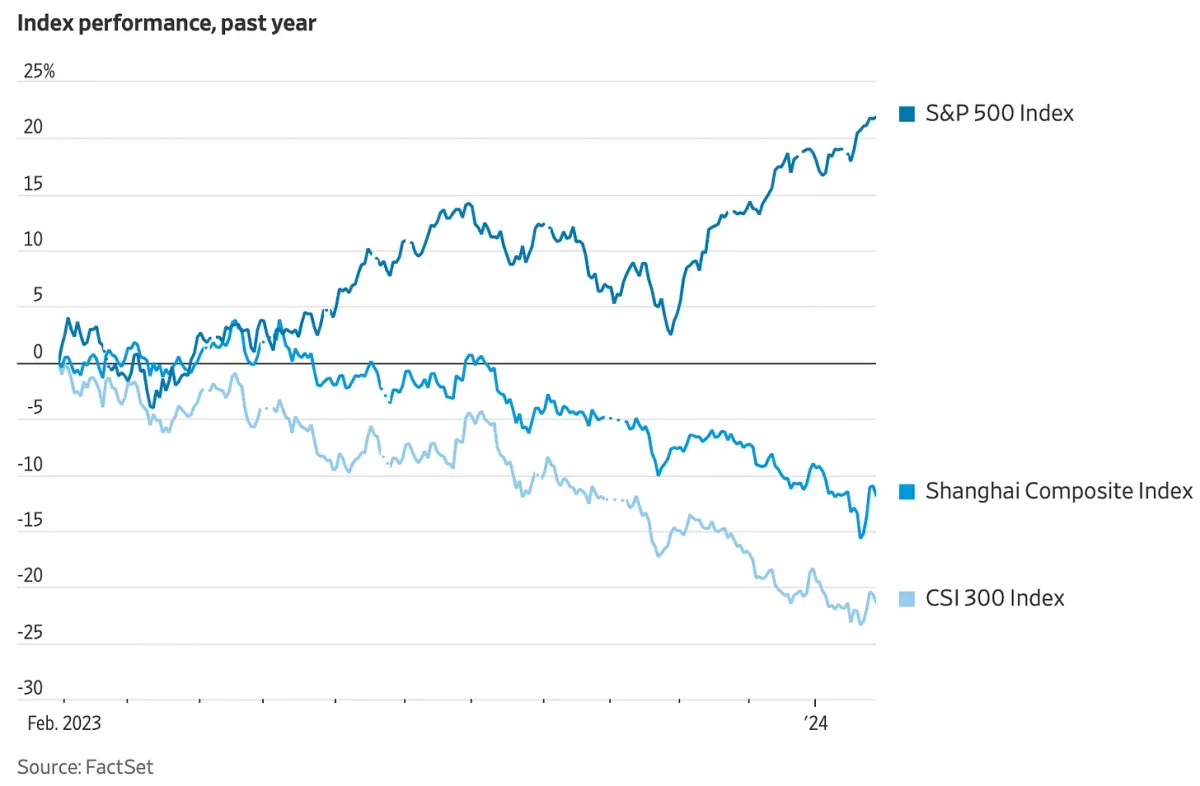
China’s woes have led authorities to consider a further 1 trillion yuan ($139 billion) stimulus package, which many regard as a sugar hit for the struggling economy. China’s benchmark CSI 300 index was at a five-year low prior to the announcement in late January, while bond yields were at a 22-year low of 2.47%. Here’s a list of measures China is taking to rescue its underperforming economy.
In real estate, we saw the collapse of Evergrande after its recent struggles, and the sharp decline in home sales has dragged on, with January data still in a slump. Evergrande’s fall from grace cannot be overstated: a company that surged as much as 800% in the decade after its public listing, whose founder Hui Ka Yan was one of the richest people in the world at its peak, has now been placed into liquidation by order of a Hong Kong court.
Morgan Stanley has cut its targets for major Chinese stock indexes, and raised its estimates for Japanese benchmarks.
It comes as no surprise that Morgan Stanley has cut its targets for Chinese stocks, but more interesting is its higher estimates for Japan: a potential spread trade as the gap between the two countries continues to widen. Another thought experiment is the impact on demand for iron ore and other Australian commodities as Chinese sales degrade. Iron ore futures dropped roughly 6% in mid-January off the back of poor Chinese data, but have recovered somewhat since.
The Wall Street Journal reported that Chinese stock funds saw the largest inflows in almost nine years at the end of January, totalling $12 billion according to Deutsche Bank, on the back of these multi-year lows. This was reinforced by Ray Dalio’s Bridgewater Associates, one of the world’s largest hedge funds, saying it was “moderately bullish” on Chinese stocks at these valuations. Interestingly, India has quietly become the world’s fourth-largest stock market, overtaking Hong Kong while all this was happening.
Parting Shot
Competence is often less of a problem than confidence.
An underrated aspect of doing anything hard is believing in yourself. Action creates both confidence and momentum. When action seems hard, narrow the gap between where you are and what you focus on.
An ultra-runner who has hit a wall doesn’t focus on the end of the race; they focus on getting around the next corner. Then the corner after that.
What’s the smallest step you can take right now to make progress?
— James Clear