The Stoic’s Guide to Essentialism
Second Level Thinking · Issue 31
How the four virtues of Stoicism provide the foundation for high performance. Why the best leaders focus on patterns rather than symptoms.
A virtue is a trait or quality that is considered morally good and desirable in a person. It represents excellence of character and promotes individual and collective wellbeing. The word comes from the Latin word virtus, which means excellence, with connotations of strength and courage. In ancient Roman thought, virtus was closely tied to the ideal characteristics of a Roman citizen, especially a man of honor and civic responsibility.
In Greek philosophy, particularly in the works of Plato and Aristotle, virtue (aretē) was understood more broadly as excellence in fulfilling purpose — whether in humans, tools, or animals. For humans, this meant cultivating rationality, wisdom, courage, and temperance.
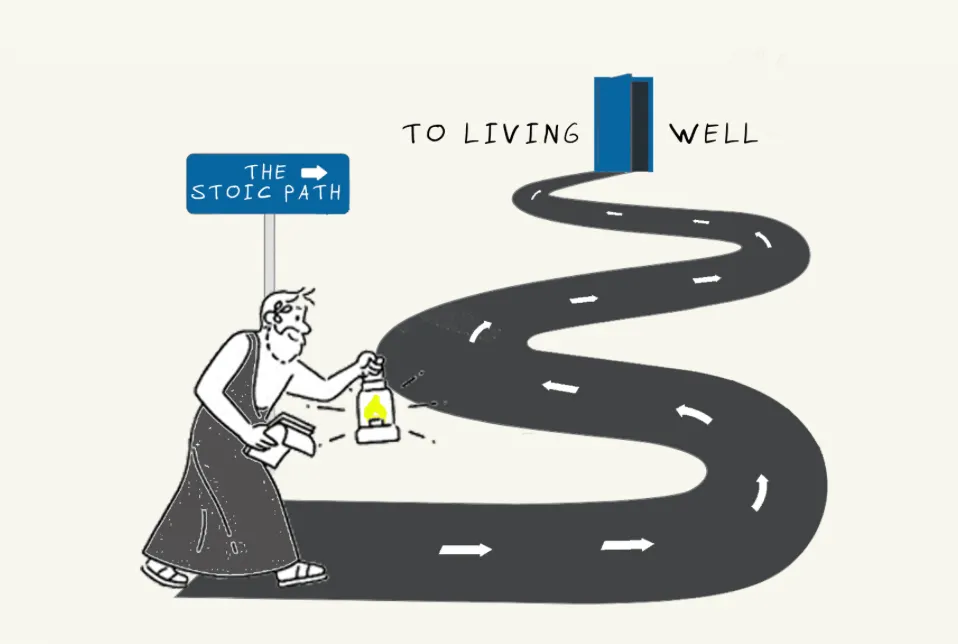
To the Stoics, they said that everything we face in life was an opportunity to respond with virtue. Even bad situations. Even painful or scary ones. If we act virtuously, they believed, everything else important could follow: happiness, success, meaning, reputation, honour, love. “The man who has virtue,” Cicero said, “is in need of nothing whatever for the purpose of living well,” states Ryan Holiday.
The Stoics held that there are four cardinal virtues because they believed these represent the essential qualities needed to live in harmony with nature and reason — which for them was the highest good. They are:
Wisdom – Knowing what is good, bad, and indifferent; making sound judgments.
Courage – Facing danger, pain, or hardship with reasoned endurance.
Justice – Treating others fairly and with respect; fulfilling your duties to society.
Temperance – Practicing self-control and moderation in all things.
These virtues are interconnected and derived from reason, the central concept in Stoic ethics and what we will explore in this newsletter.
Wisdom
“The chief task in life is simply this: to identify and separate matters so that I can say clearly to myself which are externals not under my control, and which have to do with the choices I actually control. Where then do I look for good and evil? Not to uncontrollable externals, but within myself to the choices that are my own.” Epictetus
Wisdom is the ability to discern what is truly good, what is bad, and what is indifferent — the foundation of moral clarity in Stoic thought. It involves understanding the nature of the world, judging correctly, and acting with reason. For the Stoics, wisdom isn’t just theoretical knowledge; it’s practical insight applied to life. It helps one navigate complexity with calm and purpose.
Wisdom ultimately informs action then. It was Viktor Frankl who said, “Between stimulus and response there is a space. In that space is our power to choose our response.” In that space is wisdom’s opportunity. Recognising that space is the first step. That space is where we either take the lessons from our reading and apply it or we throw it out the window and act impulsively and irrationally.
"Don’t demand that things happen as you wish, but wish that they happen as they do happen, and you will go on well." Epictetus
Temperance
“‘If you seek tranquillity, do less.’ Or (more accurately) do what’s essential—what the logos of a social being requires, and in the requisite way. Which brings a double satisfaction: to do less, better. Because most of what we say and do is not essential. If you can eliminate it, you’ll have more time, and more tranquillity. Ask yourself at every moment, ‘Is this necessary?’” Marcus Aurelius, Meditations
Temperance is self-restraint — the ability to control one’s desires, impulses, and actions. It is about living in balance, neither indulging nor denying, but acting in accordance with what is reasonable and necessary. The Stoics viewed temperance as essential for inner peace, preventing external things from mastering the soul.
Aristotle calls it the “golden mean,” which explains that virtue is found firmly in the middle, between excess and deficiency. Excess and desires are synonymous with discontent and dissatisfaction. They’re a self-defeating impulse. Seneca said, “You ask what is the proper limit to a person’s wealth? First, having what is essential, and second, having what is enough.”
The Stoics often used temperance interchangeably with “self-control.” Self-control, not just towards material goods, but self-control, harmony, and good discipline always—in pleasure or pain, admiration or contempt, failure or triumph. Temperance is guarded against extremes, not relying on the fleetingness of pleasure for happiness nor allowing the fleetingness of pain to destroy it.
"No man is free who is not master of himself." Epictetus, Discourses
Courage
“Don’t you know life is like a military campaign? One must serve on watch, another in reconnaissance, another on the front line. . . . So it is for us—each person’s life is a kind of battle, and a long and varied one too. You must keep watch like a soldier and do everything commanded. . . . You have been stationed in a key post, not some lowly place, and not for a short time but for life.” Epictetus, Discourses
Courage is not the absence of fear, but the mastery of it through reason. For the Stoics, courage means enduring pain, misfortune, or even death with dignity, and standing up for what is right regardless of the cost. True courage is moral strength — the ability to act justly even when it's dangerous or unpopular.
Ryan Holiday writes in the Daily Stoic: It is the timeless symbol of Stoicism—the lone knight fighting a war they cannot hope to win, but fighting bravely and honorably nonetheless. It’s Thrasea challenging Nero, even though the challenge will cost him his life and fail to stop the man. It’s Marcus Aurelius struggling not to be corrupted by absolute power, to be a good man even in the face of Rome’s decadence and decline. It’s Seneca’s last words to a deranged tyrant, “Nero can kill me, but he cannot harm me.”
Each fight, even if somewhat futile, required enormous amounts of courage. Each required resisting the comfort of the status quo and coming to one’s own judgment. That’s Stoic courage. Courage to face misfortune. Courage to face death. Courage to risk yourself for the sake of your fellow man. Courage to hold to your principles, even when others get away with or are rewarded for disregarding theirs. Courage to speak your mind and insist on truth.
"You may leave this life at any moment: have this possibility in your mind in all that you do, or say, or think." Marcus Aurelius, Meditations
Justice
“And a commitment to justice in your own acts. Which means: thought and action resulting in the common good. What you were born to do.” Marcus Aurelius, Meditations
Justice is the highest social virtue in Stoicism and is the commitment to treat others with fairness, kindness, and respect, recognising the shared rationality of all human beings. A Stoic does not seek advantage at others’ expense, but honors duty, honesty, and communal responsibility. Justice connects individual virtue with the wellbeing of society.
Of the Four Stoic Virtues, Marcus Aurelius said justice was the most important. To him, it was “the source of all the other virtues.” After all, how impressive is courage if it’s only about self-interest? What good is wisdom if not put to use for the whole world? Marcus’ favourite philosopher, the Stoic teacher Epictetus, said, “Seeking the very best in ourselves means actively caring for the welfare of other human beings.” And it was Epictetus’ teacher, Musonius Rufus, who said, “to honour equality, to want to do good, and for a person, being human, to not want to harm human beings—this is the most honourable lesson and it makes just people out of those who learn it.”
"What is not good for the hive is not good for the bee." Marcus Aurelius, Meditations
Living by Virtue
According to Ryan Holiday who has written a book on each of the four stoic virtues, virtue is how we live happy and free lives. It’s not grandiose nor vague. The Stoics shun complexity and worship simplicity. If we were to describe Stoicism in one sentence, it’d be this: A Stoic believes they don’t control the world around them, only how they respond—and that they must always respond with courage, temperance, wisdom, and justice.
Life is unpredictable. There’s so much we have no control over. That can be overwhelming and crippling or it can be freeing. Virtue is how we ensure the later. No matter what happens, we always have the capacity to use reason and make choices. We should always try to do the right thing. To let virtue guide us. It’s all that we control. Let the rest take care of itself, as it will with or without your consent.
We’ll leave you with this entry from Marcus Aurelius’s Meditations:
“If, at some point in your life, you should come across anything better than justice, prudence, self-control, courage—than a mind satisfied that it has succeeded in enabling you to act rationally, and satisfied to accept what’s beyond its control—if you find anything better than that, embrace it without reservations—it must be an extraordinary thing indeed—and enjoy it to the full.
But if nothing presents itself that’s superior to the spirit that lives within—the one that has subordinated individual desires to itself, that discriminates among impressions, that has broken free of physical temptations, and subordinated itself to the gods, and looks out for human beings’ welfare—if you find that there’s nothing more important or valuable than that, then don’t make room for anything but it.”
Parting Shot
Fix the Pattern, Not the Problem.
What? Most things aren't problems. They're patterns.
So What? You're not stuck because of the problem. You're stuck because of the pattern behind it. It's easy to jump in with a fix when something feels stuck. But most problems aren't isolated. They're echoes, signs of a deeper design flaw. Until you see the pattern, your effort stays reactive. Once you name it, you can start to redesign it. Change the pattern, and the problem loses its grip.
Now What? Think of one frustration that keeps showing up. Zoom out. What's the pattern? What's one slight shift that could break it, for good?
— Greg McKeown