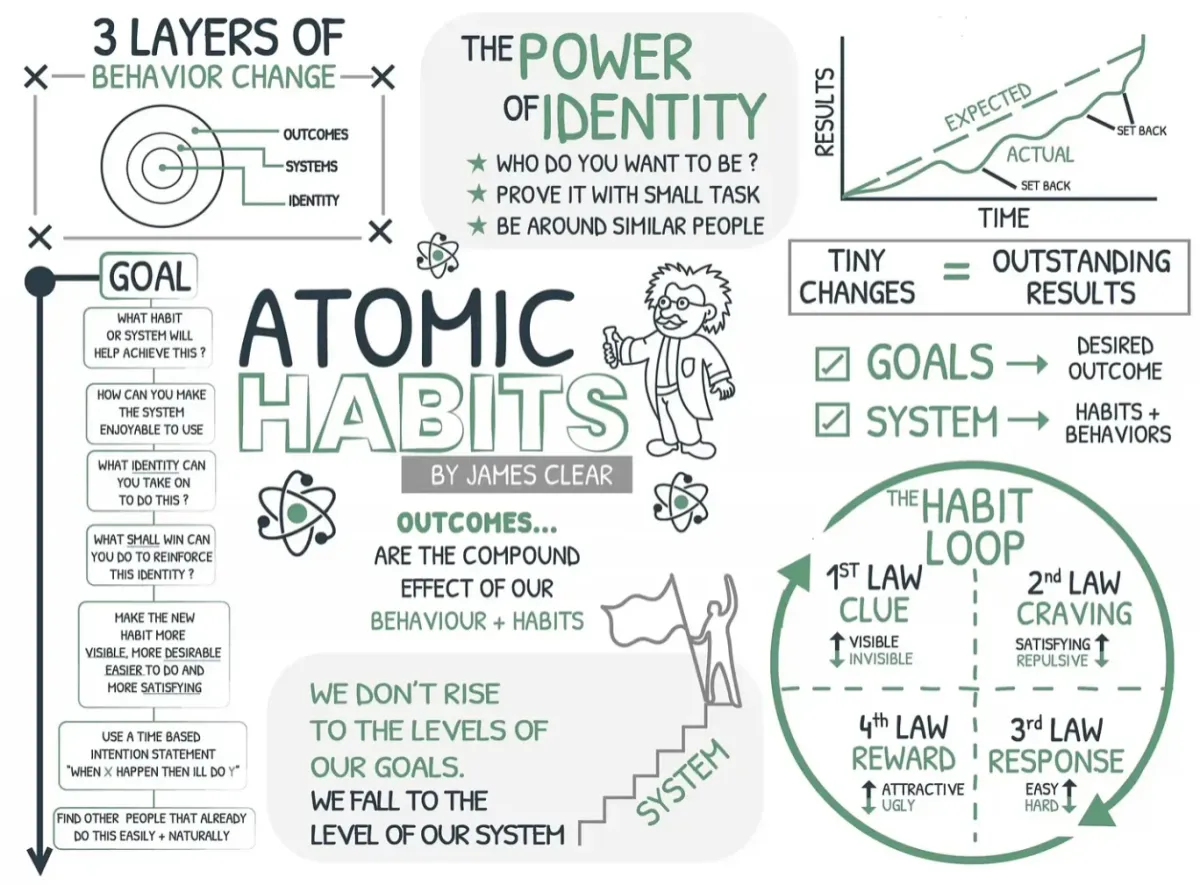
The Trajectory of Systems: Are You Priming for Success?
Second Level Thinking · Issue 41
Habits revisited.
We often overestimate the importance of one defining moment and underestimate the value of making small improvements on a daily basis. First-level thinkers obsess over the finish line - the weight lost, the book published, the revenue reached - viewing success as a singular event.
Second-level thinkers understand that the finish line is a mirage. As James Clear recently noted, “Winners and losers often share the same goals”. What separates them is not the desire to win, but the conditions they create to make winning a byproduct of their daily existence.
The body of this issue is extremely practical and avoids in-depth context and re-hashing old ground. Each section is designed to prompt deep reflection on your own habits, can assist mental framing and/or provide tools you can apply. Like I continually state: there is more work required.
1. The Art of the Sustainable Baseline
So much of mastery is simply the art of getting started. On your best days, intensity is easy. But your results are not determined by your peak performance; they are determined by your baseline - what you can stick to on your worst days.
Mastering Inconvenience: Can you handle five minutes of “showing up” when the weather is poor or your energy is “off?”
Reduce Scope, Not Schedule: On bad days, do not abandon the habit. Instead, shrink the effort. A habit must be established before it can be improved; don’t give imperfect conditions the chance to impact your momentum.
The 2-Minute Rule: Downscale your habits until they can be done in two minutes or less. This “entrance ramp” prevents decision fatigue and primes the environment for the first action to be effortless.
2. Trajectory Over Position: The 10-Year Hour
One of the most dangerous traps is becoming a victim of your expectations. We live in a digital world of instant feedback, yet physical transformation remains frustratingly delayed - a period Clear calls the “Valley of Disappointment”.
The second-level thinker ignores the current “number” and looks at the trajectory.
The Math of 1%: Getting 1% better each day for a year makes you exceptionally better; getting 1% worse declines you nearly to zero. Compounding is neutral; it magnifies whatever you feed it.
The Decade and the Hour: What can you do in the next hour that pays off in ten years? If you can do one thing daily that will persist through time, you aren’t just waiting for a decade-long reward - you are leveraging “delayed returns” into a present identity.
Accumulation vs. Evaporation: Not all 1% gains are equal. Are you making improvements that layer on top of previous effort, or are you spending time on trivialities that evaporate by morning?
Not all habits are created equal. Identify “Upstream Habits”—those core behaviours that, when anchored, naturally pull secondary positive behaviours along with them.
Anchor Habits: A 6:00 AM workout is rarely just about fitness; it is upstream of your nutrition, your morning focus, and your sleep hygiene.
The Meta-Habit: Reflection and review is the ultimate upstream habit. It provides the awareness necessary to see if your current system is actually delivering your desired future.
3. Habits as Identity Votes
We don’t just “do” habits; we cast votes for the person we wish to become. Every action is a data point for your self-belief.
Confidence as Displayed Ability: Confidence isn’t a feeling you summon; it’s the result of “reps”. You need the evidence of your own actions to believe in a new identity.
Social Architecture: We have a deep need to fit in. Join groups where the desired behaviour is the normal behaviour, because the desire to belong will often overpower the desire to improve if they are in conflict.
The Lifestyle Battle: Habits are not about crossing a finish line; they are an endless battle for a lifestyle. Identify with the process, not just the result.
4. The Second-Level Inversion
To change behaviour, you must understand the “Habit Card” loop: Cue, Craving, Response, Reward.
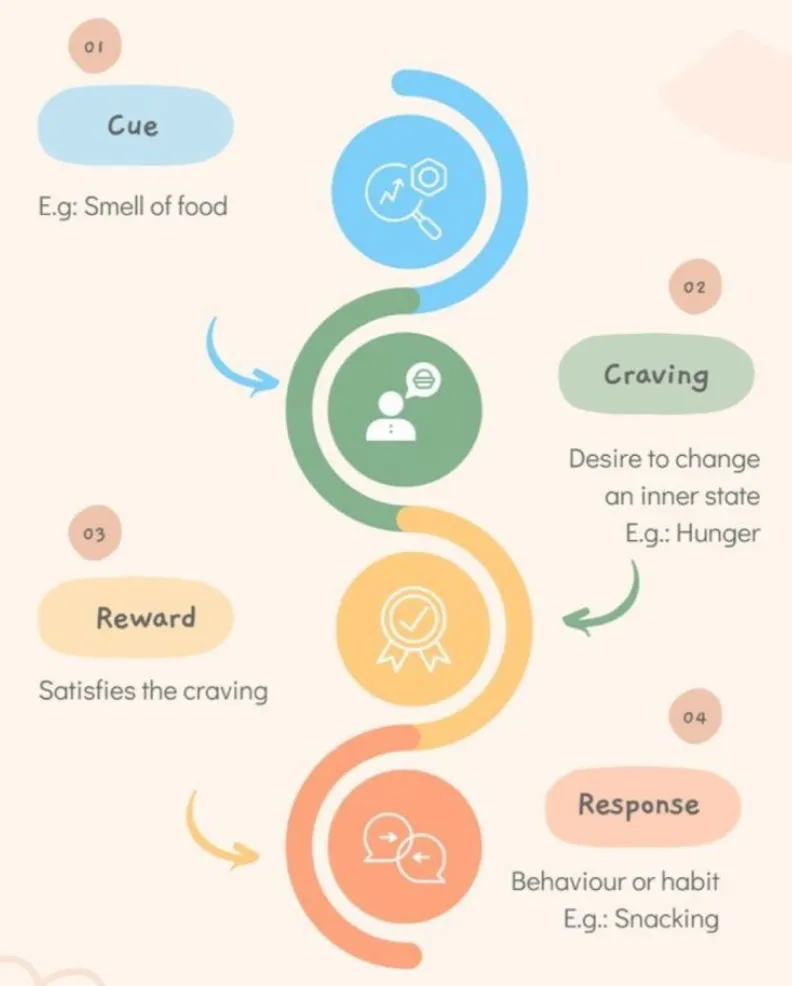
The Logic of Friction: To build a habit, make it obvious and easy. To break a bad one, make the cue invisible and the response difficult.
Time Sensitivity: The cost of a good habit is in the present; its reward is in the future. The cost of a bad habit is in the future; its reward is in the present.
The Solution: Pull the rewards of good habits into the now (satisfaction) and pull the consequences of bad habits into today (awareness).
Furthermore, a fundamental part of life is acknowledging trade-offs; you simply cannot be elite at everything at the same time.
Evolutionary Systems: Allow your habits to evolve and change with you. A system that worked in a “sprint” season of your career may need to be scaled back or traded during a season focused on family or recovery.
Internal Friction: Complaining about the difficulty of a trade-off only makes the habit heavier. Whining has no purpose in a system designed for growth. Take your current advantages and use them to create new ones rather than mourning the friction.
5. The Ambition Paradox: Growth without Dissatisfaction
There is a common myth that to be driven, one must be perpetually miserable or dissatisfied with the present.
Encoded to Grow: The second-level approach is different: “I am happy with where I am at each stage, but I am encoded to grow”.
Learning as Identity: We often talk about habits as a means of production, but fundamentally, we are talking about learning. Each repetition is a lesson in who you are becoming, allowing you to move through life with an optimistic narrative that doesn’t ignore reality, but chooses the more empowered route.
Reflection for the Week
As you look at your current systems, ask:
Is this habit “upstream” of other things, or am I optimising for the trivial?
Am I giving my best self to the hours I actually control?
If I fail today, am I ready for the “next play” - getting back on track immediately?
True, extraordinary performance comes from seeing what others don’t: that consistency is more powerful than intensity, and that your trajectory is more important than your current position.
Don’t be a victim of your expectations, like I often suffer from.
Stop focusing on the goal. Fall in love with the system.
More on the Topic
I enjoyed James Clear’s conversation with Steven Bartlett on the DOAC Podcast recently. Watch it on YouTube here, or stream it from all your usual podcast platforms.
Parting Shot
The “Next Point” mentality.
Roger Federer used tennis as a metaphor for life, revealing that even though he won roughly 80% of his 1,526 singles matches, he actually won only 54% of the total points he played.
By losing nearly half the points, Federer learned that it is impossible to win every point, just as it is impossible to be perfect in life. Whether it was a massive mistake or a spectacular success, he treated each point as temporary: “It’s only a point.”
Once a point is over, it is behind you. That frees you to fully commit to the next point with intensity, clarity, and focus.