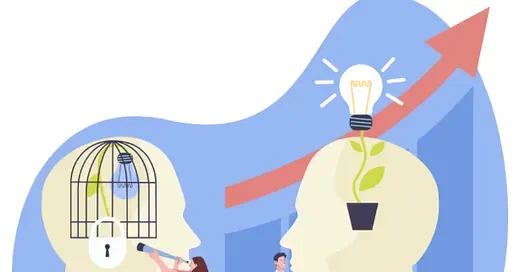
Your Only Real Opponent
Second Level Thinking · Issue 51
The fiercest competition is the one happening inside your own head, and how to win at anything you do.
Here is a book about tennis that is almost entirely not about tennis. Timothy Gallwey published The Inner Game of Tennis in 1974, and half a century later it sits on the favourite-books lists of people who have never held a racquet, because what Gallwey stumbled onto on the practice court turned out to be one of the sharpest accounts of human performance ever written. It’s a slim book. You can read it in an afternoon and I’d suggest you do.
The premise is deceptively simple: in every performance, Gallwey says, there are two games running at once. The outer game that is played against an external opponent, to overcome external obstacles, to reach an external goal such as, win the point, close the deal, deliver the speech. The inner game that is played inside your own mind, against opponents with names like self-doubt, nervousness, lapses in focus, and the relentless voice of self-criticism. And here’s his central, uncomfortable claim: for most of us, most of the time, it’s the inner game we’re losing. The outer opponent is rarely the one beating us. We are.
The two selves
Gallwey’s core observation, the one everything else hangs off, is that you contain two distinct selves, and the relationship between them determines almost everything about how you perform.
Self 1 is the conscious, verbal, analytical mind. The teller. The one that narrates, instructs, judges, and criticises — keep your elbow up, don’t slice it, why did you miss that, you always do this. It is the ego-mind, and it operates through words and effort and control.
Self 2 is everything else. The unconscious, intuitive body-mind — your nervous system, your muscle memory, your reflexes, the accumulated learning of a lifetime.
Self 2 is staggeringly capable. As you read this sentence, Self 2 is decoding thousands of visual symbols a second, running your heartbeat, coordinating a dozen systems, none of which you could consciously manage if you tried. It already knows how to perform. It learns naturally, the way a child learns to walk — not through verbal instruction, but through trying, observing, and adjusting.
The tragedy of most underperformance, Gallwey argues, is Self 1 not trusting Self 2. The teller cannot leave the doer alone. It over-instructs, second-guesses, tightens, and interferes, and the interference is precisely what we experience as “trying too hard.” The harder Self 1 grips, the more tension it floods into the system, and the worse Self 2 performs. He who tries too hard, fails.
He eventually compressed the whole thing into a formula:
Performance = Potential − Interference.
Sit with that, because it reframes everything. Most of us spend our lives obsessed with the first term — adding to our potential, acquiring more skill, more knowledge, more technique. Gallwey’s radical suggestion is that the faster path, very often, is to reduce the second term. You are almost certainly more capable, right now, than your performance shows. The gap isn’t a lack of potential. It’s the interference you’re generating yourself.
The champion’s actual edge
This is where the book stops being about tennis and starts being about everyone who has ever had to perform under pressure.
Watch what genuinely elite performers have in common, across wildly different fields, and it is rarely that they possess some superhuman level of the raw skill. Plenty of people can hit a tennis ball beautifully on an empty court. What separates the champion is what happens to that skill when it matters, when the crowd is watching, the stakes are real, and the pressure is on. The amateur’s Self 1 goes into overdrive: analysing, fearing, gripping. The skill, still fully present in Self 2, gets strangled on its way out. The champion has learned, through some combination of instinct and practice, to keep Self 1 quiet and let Self 2 play.
We have a word for the state where this happens perfectly: the zone. And Gallwey noticed something about it that anyone who has been there will recognise instantly; you cannot get to it by trying, and you cannot stay in it by noticing you’re in it. The moment Self 1 pipes up to say “I’m playing brilliantly, don’t stop now,” it’s already over. The hot streak dies the instant you consciously try to maintain it. This is why the zone feels so effortless and so fragile at once. It is simply the state of Self 2 operating without interference.
The champion’s real edge, then, is not more potential. It is less interference. And that — unlike raw talent — is a learnable skill.
The first skill: non-judgmental awareness
So how do you quiet Self 1? Here’s the counterintuitive part, and it’s the single most valuable idea in the book.
You do not quiet the critical mind by fighting it, arguing with it, or telling it to shut up — that’s just more Self 1, more noise. You quiet it by letting go of judgment altogether. Gallwey calls the first and most important inner skill non-judgmental awareness: learning to see what is actually happening, clearly and without the overlay of “good” or “bad.”
This is subtler than it sounds, and people constantly misunderstand it. Letting go of judgment does not mean ignoring your errors or going soft. If you hit half your serves into the net, non-judgmental awareness sees that fact perfectly clearly — fifty per cent, into the net — it simply doesn’t add the layer of “I’m terrible, what’s wrong with me.” It observes without distorting. Things appear as they are. And here’s the strange, reliable magic of it: when you simply watch a flaw with clear, curious, non-judgmental attention — no criticism, no forcing — it very often begins to correct itself. Self 2, finally given clean information instead of panicked commands, adjusts on its own. Awareness itself is the change agent. You don’t need the motivation of a reformer to change a bad habit. Often you just need to see it clearly.
Gallwey describes complimenting a student — “great backhand!” — and watching their very next shots fall apart. The praise was positive, and yet it engaged the judgmental mind just as surely as criticism would have. Because the moment you accept a compliment, Self 1 is back in the room: now you’re aware of “good,” which means you’re hoping for it again, which means you’re afraid of its opposite, and the tension returns. This is the trap almost nobody sees. It isn’t that negative judgment is bad and positive judgment is good. It’s that judgment itself or the whole apparatus of grading yourself moment to moment that is the interference. The goal isn’t better self-talk. It’s less of it.
The threads back
I hadn’t planned this issue as a synthesis, but as I wrote it I kept bumping into arguments we’ve already made from other directions. Three of them are worth naming, because when an idea keeps arriving from different doors, it’s usually pointing at something real.
Last issue, on decision-making, the entire foundation was separating the quality of your process from the quality of the outcome — refusing to let a bad result convince you that you played the hand badly. Gallwey is making the identical move one level deeper, in real time: “free yourself from any emotional reaction to success or failure; simply know your goal and take objective interest in the results.” That is non-judgmental awareness and it is anti-resulting. The decision-maker at the desk and the player on the court are fighting the same enemy, the ego’s need to convert every outcome into a verdict on the self.
A few issues before that, Arthur Brooks had us building reflection and stillness into the morning — a deliberate quieting of the mind before the day’s work. Gallwey gives us the mechanism for why that matters: a still mind is not an empty one, it’s an uninterfered-with one, and it is the precondition for Self 2 to do its best work. And when I wrote about having too many interests, the whole argument rested on trusting the deep, accumulated, cross-connected learning you’ve built up over a lifetime, which is simply Self 2, the doer, by another name. The champion’s trust in Self 2 and the generalist’s trust in their own range are the same act of faith.
The through-line across all of it: an enormous share of what holds capable people back is not a deficit of ability. It is self-generated interference. Same lesson, four different doors.
Your takeaways
Here’s how to start playing the inner game this week, whatever your court happens to be: a boardroom, a keyboard, a difficult conversation, a stage.
Name your real opponent. Before your next high-pressure moment, ask honestly: is the challenge here actually external, or is it self-doubt, over-thinking, and the fear of getting it wrong? Most of the time it’s the inner game. Naming it correctly is half the battle, because you can’t quiet an opponent you haven’t identified.
Run the interference audit. Take one thing you do well in private but botch under pressure. You’re not lacking the skill, you own it or you wouldn’t have it on the good days. So instead of asking “how do I get better?”, ask “what interference am I adding when it counts?” Usually it’s trying too hard, over-instructing yourself, or grading every move. Subtract that, and the skill you already have shows up.
Trade judgment for observation. For one full day, catch yourself labelling your own performance “good” or “bad” and replace the label with a neutral observation of what actually happened. Not “that was a terrible email,” just “that came across sharper than I intended.” Watch how much calmer, and how much more useful, the information becomes once you strip the verdict off it.
Give Self 2 a job, not a lecture. When you want to change something, stop issuing verbal instructions and instead get crystal clear on the outcome and let your body-mind find the way. Gallwey’s players improved faster by picturing the target than by being told to “keep your wrist firm.” Show, don’t tell, even to yourself. Vivid intention beats detailed self-instruction almost every time.
Beware the compliment. This is the advanced move. Notice that the praise from others or from yourself can knock you out of flow just as fast as criticism, by switching the judging mind back on. When you’re performing well, don’t stop to admire it. Stay with the doing. The observation can wait until you’re off the court.
Parting Shot
So, the question for the week: in the arena that matters most to you right now, how much of what’s holding you back is a genuine lack of ability, and how much is simply the interference you’re generating yourself?