Deep Work and the Sunset of a Superpower
Second Level Thinking · Issue 2
A framework for achieving flow and why anxiety is an internal choice. Geopolitical shifts: what happens to the global economy when an industrial giant begins to contract?
Deep Work
Whatever our professional discipline, it is difficult to complete meaningful work regularly in a world of email, social media and organisational cultures that require us to be connected 24/7. Last fortnight we discussed tools for structuring our daily to-do list, and this week we peel back another layer of the onion and provide a structure for achieving states of deep work.
Deep work, as Cal Newport describes it simply in his highly regarded book of the same name, “is the ability to focus without distraction on a cognitively demanding task,” and it rests on four disciplines of execution.
Four Disciplines of Execution
Focus on the wildly important
Act on lead measures
Keep a compelling scoreboard
Create a cadence of accountability
The aim is to schedule 90-minute blocks and target one to three sessions per day. Know where shallow work fits into your schedule and plan regular breaks around these deeper tasks. A useful trick is to label activities over a day or week as either shallow or deep, which helps you see where items can be removed or added.
An organisational challenge will be existing operating structures and our bias toward the status quo. Start-ups and sole traders can lift and shift under much more agile conditions than established enterprises, but all require tough decision-making.
The principle of least resistance: “In a business setting, without clear feedback on the impact of various behaviours to the bottom line, we will tend toward behaviours that are easiest in the moment.” Reflecting on the culture you are cultivating is a great exercise. Ask yourself: what behaviours am I rewarding, personally and professionally? Culture is difficult to shift, and the majority will default to the path of least resistance.
Shallow tasks also tend to provide frequent feedback and therefore a regular release of dopamine, which is what makes it so hard to stop switching between tasks. This is why time blocking can be a very effective tool.
Next Steps
Review your calendar: identify where items could be shifted to create space for time blocks and deeper states of work. Label your tasks appropriately.
Support the sessions: think about the supporting activities that will make these sessions impactful, and make sure you are accountable for their outputs.
Watch for attention residue: our mental mode or internal monologue carries from one task to the next without a reset. Breaks are critical for this reason, especially when shifting from shallow work into more cognitively demanding tasks.
Find your reset: identify tools to support your shallow-to-deep transition, such as journaling, meditation or breathwork. Ask yourself: what is my form of mental reset?
Willpower, or how full is your cup: make progress early in the day and ride the momentum. Don’t leave deep work until you are at your most fatigued.
Mitigate distraction: close email and silence your phone. Is your working environment conducive to what you are aiming to achieve?
Go to bed with a morning deep work task planned and wake with purpose and meaning in your day. None of this has to be perfect, and you can refine it to your personality and circumstances as you go. Think of the 80/20 principle, as there will always be a level of reactiveness and disruption in our lives. Try building even just a few time blocks into your calendar for next week, and be very deliberate about what you aim to complete during these sessions, ensuring it aligns with an overarching system or goal.
The Sunset of a Superpower
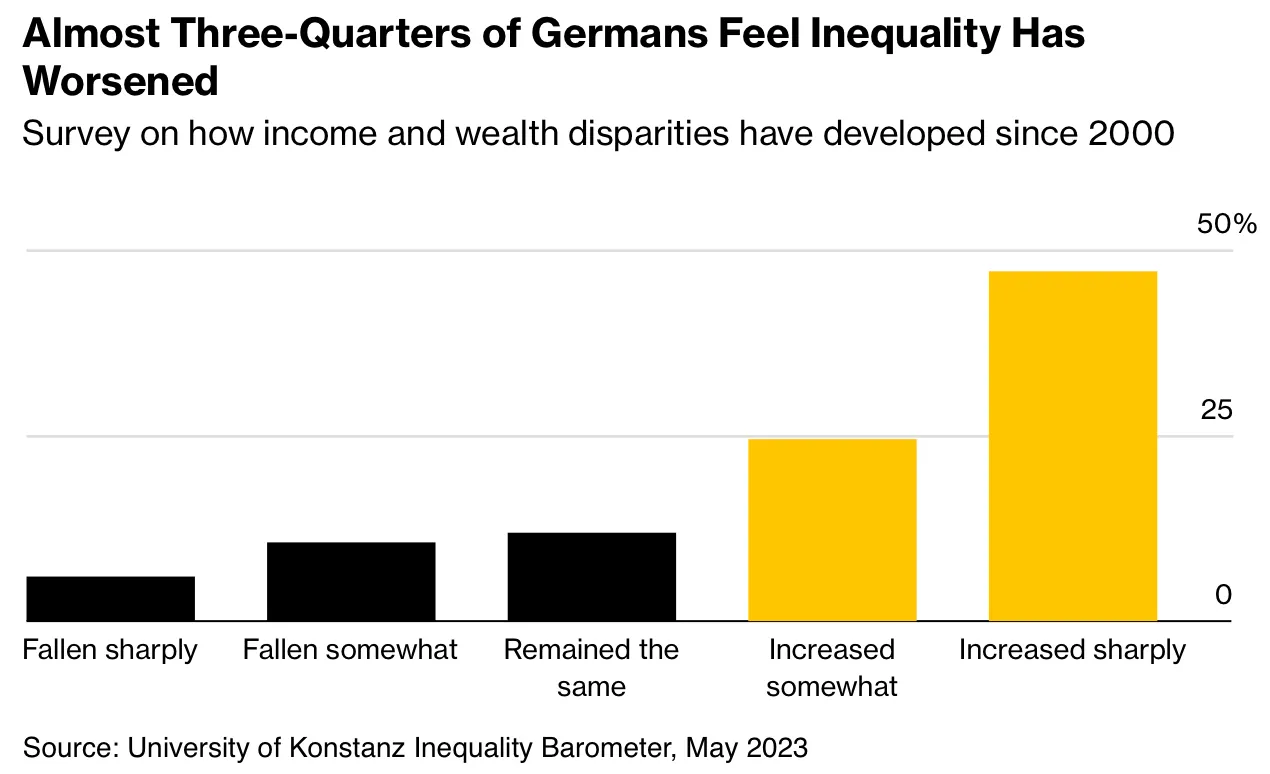
There are many angles from which to frame this piece, but I will state up front: from every avenue, the data coming out of Germany is bleak. In the last two years we have seen Russia’s invasion of Ukraine, rising energy costs, and an election that saw Germany’s Green Party win five cabinet positions in a three-party coalition. Combined with legacy missteps, the result is an industrial superpower on the brink of major economic decline.
Data compiled by Bloomberg showed more than $13.6 billion of loans and bonds issued by the country’s companies were distressed last month, 13 times the level of Italy. This was compounded by a report from consulting firm Alvarez & Marsal finding that 15% of German companies are currently troubled, the highest rate in Europe.
Germany’s industrial machine has been severely damaged by the end of huge volumes of cheap Russian gas, the US drifting away from Europe in an attempt to better compete against China, and rising labour costs, creating a continued output downtrend that started in 2017. After shutting its last nuclear reactors and aiming to phase out coal by 2030, the country has struggled to substitute enough wind and solar capacity to meet demand, and as a result energy prices are at exorbitant levels relative to its peers.
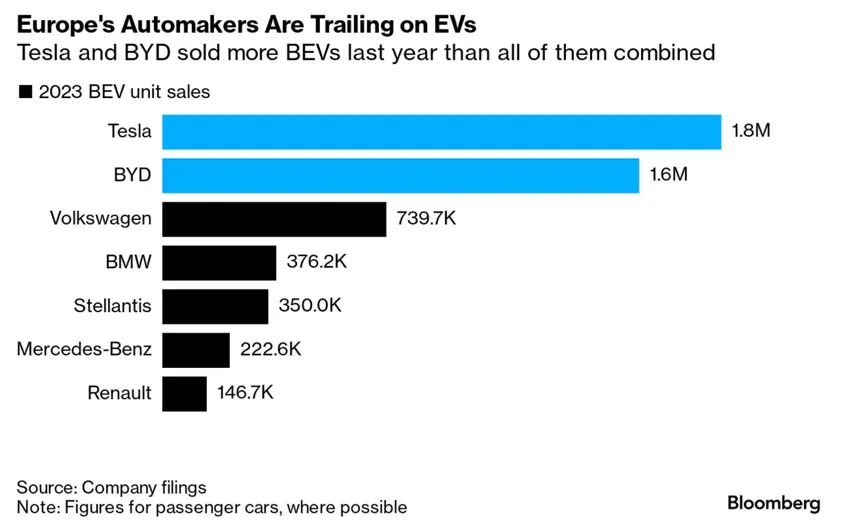
Porsche, BMW and Volkswagen defined the combustion-engine era. BYD and Tesla have now surpassed them as the largest providers of electric vehicles globally.
We would be remiss not to mention the auto sector. Although EV demand in Europe is predicted to remain flat this year, Forbes reported that Chinese manufacturers are expected to own one-third of the global EV market by 2030. If this eventuates alongside Tesla’s current output, the German car industry is the most at risk.
In commercial real estate, January data showed the sharpest decline in office building values in two decades, as higher financing costs and slow-to-implement return-to-work policies reshaped the landscape. This is not an isolated issue, with many global cities, including San Francisco, suffering a similar identity crisis.
On the residential side, German property recorded its steepest decline in 60 years in 2023, as higher inflation and weak political support compounded the slide, with multi-family homes dropping a significant 20%.
While many see the opportunity to inject equity into highly leveraged businesses with sound assets and position long out of this downturn, short sellers remain in abundance. Total shorts on the country’s companies came to €5.7 billion, with the largest position held by Qube Research & Technologies Ltd., which has significant shorts against Deutsche Bank and Volkswagen, among others.
The late, great Charlie Munger advised that when looking to invest, you should ask yourself how you could invest in a disaster waiting to happen. This question leads you to all the pitfalls many investors overlook, and it is the first mental trick in a safeguard against stupidity: imagine a dreadful outcome, work backwards by asking what misguided action might lead you to that sorry fate, and then meticulously avoid that self-destructive behaviour.
Apply this principle to the German economy as a thought experiment. What do you see: Europe’s largest economy reclaiming its dominance, or an identity crisis generating further economic decline? “Fragmentation is a big danger,” said Dresden Mayor Dirk Hilbert, drawing parallels to the fraught atmosphere of the 1920s that preceded the Nazis’ rise to power. “It is a very real risk.”
Parting Shot
“Stop letting anxiety rule you. Today I escaped anxiety. Or no, I discarded it, because it was within me.”
Stop torturing yourself in anticipation of a future event that may or may not happen. Your anxiety is not helping you or making you a better version of yourself. Take responsibility for your feelings and be kind.
— Marcus Aurelius, Meditations