
The Forces Shaping Markets This Year
Second Level Thinking · Issue 40
A macroeconomic and markets outlook for the year ahead.
Happy New Year!
Our first issue is an outlook issue diving into the macroeconomic and financial markets for 2026; I have pulled from multiple sources and you will notice contradictory insights or information as you read through - that’s the point!
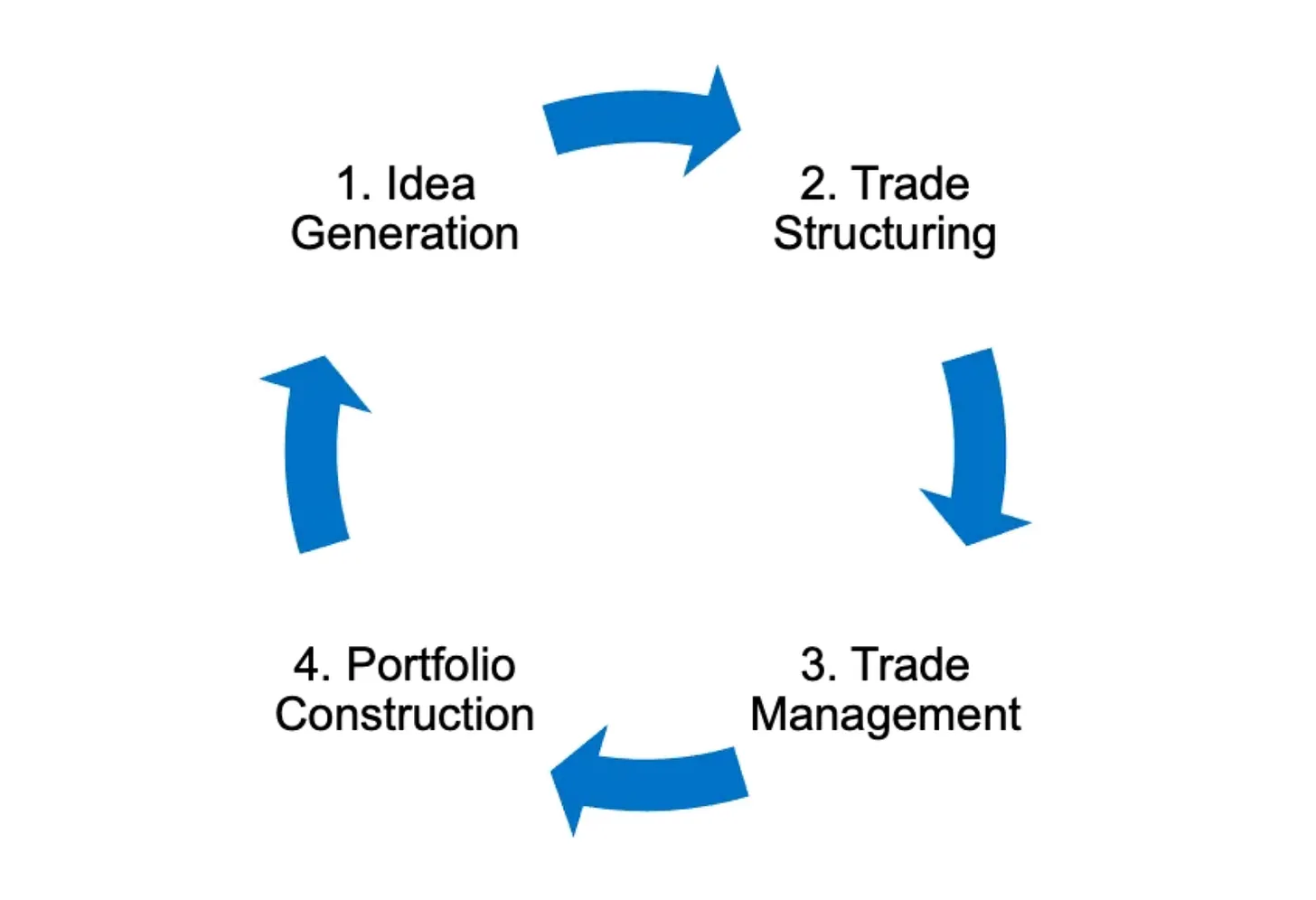
Similar to last year, this helps establish an overarching hypothesis of which you can build on. I will reiterate, further work is required, and for those that wish to take action I suggest starting with storyboarding and/or breaking your mind mapping into two parts:
Determine your overarching themes and economies.
Research all possible ways in which you can express your idea with the strongest possible conviction.
Base Case
Global growth is expected to continue to demonstrate resilience even as some geopolitical and trade concerns linger. Policy support, both fiscal and monetary, combined with unprecedented capital expenditure for AI adoption are key to the extension of the cycle. AI’s broadening boost to productivity is also positive and there’s no bubble yet, claims Bloomberg.
This forecast is mostly in-line with the long-term trend, representing a slight moderation to 2025 in the US, with stimulative policies and AI spending keeping the cycle going. A number of firms see uneven performance across economies, with views split over whether Europe’s fiscal spend and easy monetary policy can finally meaningfully boost the region.
“We expect global growth to remain on a broadly similar track for the next two years, with the economy expanding 2.7% in 2026 and 2.8% in 2027. Tariff pressures will take a further bite out of growth, but the overall effects look manageable.” Citi
Analysts polled by FactSet have forecast, in aggregate, that the benchmark index’s price target will finish 2026 a whisker below 8,000 — at 7,968.78. That would imply, yes, another 16 percent gain from Wednesday’s year-end close of 6,845.50, and would put the S&P 500 on its best four-year pace since the 1990s, according to Bloomberg.
Sure, there are doubts. Sky-high valuations, especially for the so-called Magnificent Seven — the giant technology companies in the thick of the artificial intelligence race — are making some investors antsy. AI exuberance has drawn in investors from around the world. Now, they’re asking tougher questions.
“It’s not that they suddenly hate the AI trade or don’t believe in it,” Calvasina said. “But I think there’s some sticker shock on the valuations.” Even still, Calvasina and her team’s “base-case model” predicts the S&P 500 will end 2026 at 7,750. She said that while the model had not ruled out “some additional volatility,” it expected the prediction to hold even if the overall market were to drop 5 to 10 percent. NYT
Inflation & Policy
Inflation
Bloomberg claims the worst of inflation is behind us, but ongoing trade barriers and US immigration policy (and its impact on the labor market) mean any cooling of price growth is liable to be slow and could be limited. Risks are seen stacked toward higher inflation. Whilst Goldman Sachs believes disinflation is back on track: Inflation set to fall back to target levels by end 2026, as tariffs fade and medium-term forces (AI, China supply) come into view.
“In 2026, the US is positioned for a more modest acceleration in growth to about 2.25%, supported by AI investment and fiscal tailwind from the One Big Beautiful Bill Act. The first half of the year may be softer given the lingering stagflationary effects of tariffs and labor supply plateauing, as well as yet-to-materialise broad-based gains in worker productivity.” Vanguard
Monetary
Global central banks broadly seen leaning into easier policy, aside from the Bank of Japan. The Fed will come under increased political pressure to cut rates, especially once its Chair is replaced, but may be constrained by sticky inflation. A weak labor market may provide an excuse for some US easing, but most firms think the market is currently pricing too many cuts. Bloomberg
Against a backdrop of still-sticky inflation and resilient economic activity, the Fed may cut less than markets expect, limiting further downside in US Treasury yields. Therefore, we’ve reduced our preferred duration for exposure to five-to-seven years to reflect the risk of increasing volatility in longer-dated bonds. HSBC
Fiscal
Sustainability of fiscal expenditure in major countries remains a concern, but little reduction in spending is expected because of political pressures. Bond investors will remain on guard, warns Bloomberg.
We look for US real GDP growth of 2.3% (annual average) in 2026. The improved outlook reflects a more supportive fiscal policy environment, a less restrictive monetary policy setting and a tariff regime that is not characterized by near-constant escalation as it was in 2025. Wells Fargo
Tariffs
No repeat of Liberation Day, and a possibility the Supreme Court strikes down tariffs. In that case, the administration would impose them by other means. In other words, barriers to trade are here to stay, but many firms say the world has adjusted. Bloomberg
We doubt tariffs will at this stage deal a disruptive blow to global growth or inflation, and we judge recession risk as low. Citi
Although, Scott Galloway sees the outlook as slightly more dire: Trump has changed U.S. tariffs on China 17 times this year. Since 2019, China has decreased its share of exports to the U.S. from 17% to 10%. Meanwhile, China’s global exports are up 40%, while imports are flat. It has not inspired an increase in domestic manufacturing, but a decrease in exports, as reciprocal tariffs take effect, and a rerouting of the global supply chain around the U.S. “Higher prices, lower growth” makes for a lousy bumper sticker. Scott Galloway
Eighty percent of a16z startups use open-source Chinese models. Same story at Airbnb. China is registering similar or better performance as the American LLM leaders, but with a fraction of the capex. Flooding the market with competitive, less-expensive AI models will put pressure on the margins and pricing power of the Mag 7, taking down a frighteningly concentrated S&P and likely sending the U.S., possibly the globe, into recession.
AI & Tech
Huge capital expenditure to roll out artificial intelligence is seen supporting multiple sectors and the world economy itself. Adoption of the technology is expected to start meaningfully boosting productivity in areas such as health care. Wall Street doesn’t think it’s a bubble yet; at least, not one that is ready to burst. Bloomberg
As the artificial intelligence trade continues to push the stock market to new highs, investors are asking if we’re living through another bubble that’s destined to burst.
The answer isn’t so simple, if history is any guide.
Over-investment has been a common theme when there’s a technological advancement that will transform society, according to Invesco chief global market strategist Brian Levitt, who pointed to the development of railroads, electricity and the internet. This time may be no different.
“At some point the infrastructure build may exceed what the economy will need over a short period of time,” he said. “But that doesn’t mean that the rail tracks weren’t finished or the internet didn’t become a thing, right?”
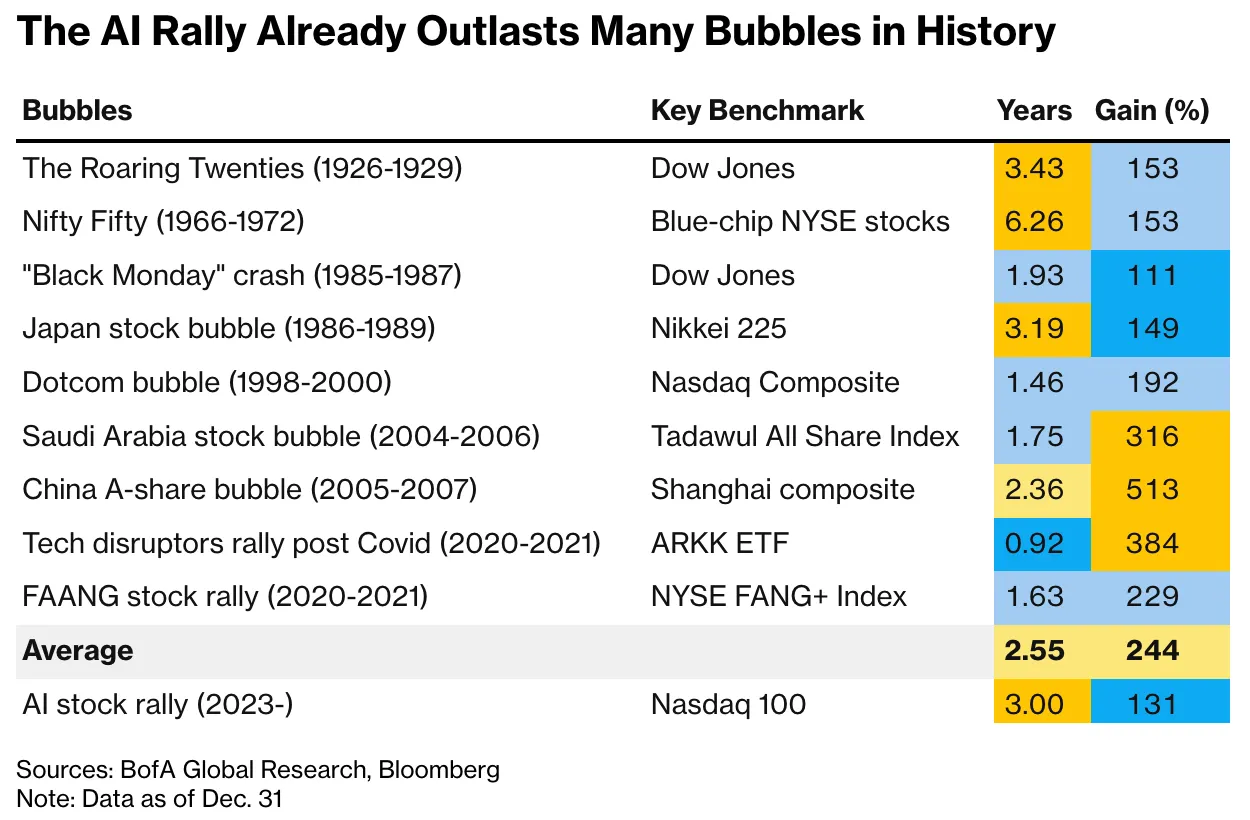
One simple way of assessing the AI-fuelled tech rally is to compare it against past bull runs. Looking at 10 equity bubbles from around the world since 1900, they lasted just over two-and-a-half years on average with a trough-to-peak gain of 244%, according to research by Bank of America strategist Michael Hartnett.
By comparison, the AI-driven rally is in its third year, with the S&P 500 rising 79% since the end of 2022 and the tech-heavy Nasdaq 100 Index gaining 130%.
Although, others worry about the circular investing that is occurring within the AI sector. As Scott Galloway eloquently puts:
OpenAI is promising Oracle $300 billion — money it doesn’t have — for infrastructure Oracle hasn’t built. We can’t see the actual contract, but this is BS. The greatest AI hallucination yet is the assumption that in the next few years we’re going to build anywhere near the required grid and power capacity. OpenAI needs 20% of current U.S. electric capacity — equivalent to 250 nuclear power plants — at a cost of $10 trillion. There’s a five- to eight-year wait to connect a new data center to the grid. Meanwhile, China has more than twice America’s energy capacity at half the cost. Second greatest AI hallucination?
Furthermore, when the projections of the major players are mirrored against other large entities within the financial system, it does make one ponder:
Based on its valuation, Nvidia is telling the market it will add an additional $800 billion in revenue over the next five years — equivalent to the combined revenue of Apple, IBM, Meta, and Tesla. OpenAI, which has $20 billion in annual revenue, is projecting it’ll add $180 billion in revenue over the same period — equivalent to the combined revenue of Disney, Fox, the New York Times, Paramount, and WBD. Also, OpenAI’s $1.4 trillion in spending commitments exceeds Argentina’s national debt.
Meanwhile, the competition is heating up. China is putting out comparable models at a fraction of the price, Anthropic has captured the lead for enterprise users, and, as I predicted last year, the empire (Alphabet) is striking back. Gemini summaries are improving, and arguably the greatest concentration of AI talent resides at Alphabet. OpenAI could be our era’s Netscape, i.e., the disruptor that enjoys a moment in the spotlight before being eclipsed by an incumbent. Ouch!
Market Sectors
Stocks
Policy, AI and capex all add up to stock gains. However, the US market is starting from a position of elevated valuations, meaning equity performance won’t match the past three years. Diversification is recommended to avoid concentrated exposure to the megacaps, and as broader AI adoption helps certain sectors close the gap with the Mag7. Firms are mostly optimistic on European, Asian and emerging markets. Bloomberg
US equities should outperform global peers in 2026, with the S&P 500 rising to 7,800 in the next 12 months — a 14% gain from its current level, compared with expected gains of 7% for Japan’s TOPIX and 4% for the MSCI Europe. Morgan Stanley
China’s tech sector stands out as a top global opportunity. Strong liquidity, retail flows, and earnings expected to rise to 37% in 2026, should sustain momentum for Chinese equities. Broader Asian exposure, in particular to India and Singapore, could provide additional benefits for investors seeking diversification, as could emerging markets. UBS
We like Japanese equities on strong nominal growth and corporate governance reforms. BlackRock
Bonds
Rate cuts to constrain near-term yields, fiscal picture to prop up long end. Result: steeper curve. Some firms worry about bonds’ hedging ability and recommend alternatives. But most embrace the asset class as a source of income, if not capital gains. Bloomberg
The bond market suggests borrowing costs will stay higher for longer. Since September 2024, the Fed has lowered its benchmark lending rate to a range of 3.5 to 3.75 percentage points from 5.25 to 5.5 percentage points. At the same time, the yield on the 10-year Treasury note — a rate that tends to underpin mortgages and other commercial loans — has risen by nearly a half percentage point. The divergence is bad news for borrowers and could hinder spending. NYT
For bonds, higher growth and lower inflation push in opposite directions. We expect yields to remain more range-bound in our baseline forecast as a result. Goldman Sachs
Crypto
Is crypto too big to fail? A Bitcoin crash that wiped $1 trillion in market value in October exposed the volatility of the crypto markets (and dangers of the mountain of bets made on margin). At the same time, the digital currency is an increasingly mainstream feature of the American economy. Congress brought stablecoins into the regulatory fold, crypto is now in some retirement accounts and the currency has been adopted by major banks and asset managers.
If the Fed continues to cut rates — as Wall Street expects — that could increase liquidity and possibly boost the crypto market. But if things go further south for the asset, would a pro-crypto Washington step in to cushion the blow? NYT
Commodities
Bloomberg claims, don’t bet against gold extending its run, and position for industrial metals to benefit from the AI infrastructure build out. Not much love for or interest in crude.
Commodity prices (with the exception of oil) have been soaring. Some metals, including copper and silver, are key to the production of cars, military equipment and more. The prices of both metals, which have been affected by trade policy, could reignite inflation, analysts say. NYT
We maintain our Brent price forecast of $58 in 2026 and introduce our 2027 forecast of $57, while recognising that considerable effort will be required to stabilise prices at these levels. We remain bullish on gold on the back of boosted central bank buying and robust investor demand. Gold prices are expected to soar to $5,000 per ounce by the fourth quarter of 2026, averaging $4,753 for the full year. JP Morgan Chase & Co.
Gold is expected to remain strong in 2026 after repeatedly hitting record highs this year. Continued physical demand and rate cuts should support prices. Morgan Stanley
Currencies
Most firms expect ongoing weakness in the dollar, especially as the Fed leans into easier policy. That should benefit emerging nations in particular. Bloomberg
The dollar just came off its worst year since 2017. Could a slumping U.S. currency reignite concerns about the “sell America” trade? It’s worth noting that dollar skeptics have piled into emerging markets recently. The MSCI Emerging Markets Index last year vastly outperformed the S&P 500. NYT
The euro, Australian dollar, and Norwegian krone are preferred over the US dollar, as anticipated US rate cuts may put pressure on the greenback. Financial repression could contribute to increased currency volatility in the future, and high-yielding currencies are poised to benefit as risk appetite broadens in FX markets over the next year. UBS
Risks
The risks of a policy mistake loom large. Firms see potential for inflation to turn higher as central banks lower rates, with trade barriers a potential catalyst. Stimulative policy at this stage in the cycle could lead to overheating. Bubble or not, the extreme spending to roll out AI coupled with its uncertain payoff is making firms edgy. So is the technology’s potential impact on the labor market and established business models. And never underestimate the potential for geopolitical or trade-related shocks. Bloomberg
Can the borrowing binge continue? Investors’ combined margin debt topped $1.2 trillion in November, a record. The levels of debt have been rising for months as investors borrow to increase their bets on the market boom, leading some analysts to wonder whether even a small drop in asset prices could wipe some of them out. The S.E.C. stepped in last month to reduce some of the more risky leveraged E.T.F.s operating in the market. Will it do so again? NYT
European valuations remain attractive relative to global peers. Political risks in France and fiscal uncertainty in Germany still weigh on sentiment, but improving corporate fundamentals support a constructive view, with potential to add to holdings on price weakness. Barclays Private Bank
While total returns on government bonds may be mostly about earning the yield, bonds are likely to be an effective hedge against the largest risks to equities (a recession or a reversal of AI optimism), particularly at shorter maturities. Goldman Sachs
JP Morgan Wealth Management state investors should be mindful of higher inflation, shifting trade patterns and the potential for increased market volatility. If geopolitical risk and currency volatility increase in a fragmented world – and we think they will – gold and energy commodities can serve as valuable hedges.
The AI builders are leveraging up – investment is front-loaded while revenues are back-loaded. Combined with already highly indebted governments, this is creating a more levered and fragile financial system vulnerable to shocks. BlackRock
Will the Space Industry Blast Off?
A potential SpaceX I.P.O. — at a possible valuation of around $1.5 trillion — could be a watershed market event in 2026. It might also prove to be a seminal moment for the space economy, which McKinsey projects to reach $1.8 trillion over the next decade. China is planning to land on the moon by 2030 while NASA is planning a return. A new space race could help draw in more private equity investment dollars and spark established aerospace players to go start-up shopping. NYT
When technology gets cheaper, startups form, the ecosystem attracts cheaper and cheaper capital, which spurs innovation, and so on and so on. The cost of the personal computer decreased 58% during the 15-year dot-com boom, and U.S. IT spending increased 200%. The same pattern is happening now with AI: The cost of GPU operations has fallen by 74%, while global AI funding has risen by 280%. The key metric for space? Over the past 15 years, the cost to get a kilogram of payload into orbit is down 89%, while private U.S. space investment jumped 6x.
SpaceX is dominant, registering 84% of U.S. space launches in 2024, up from 18% in 2008. If I were running investor relations, I’d position SpaceX as follows: Google owns 93% of information with search, Meta controls two-thirds of social connection, Amazon has half of e-commerce. SpaceX controls 90% of everything else in the universe. Everything is a subset of the addressable market that is space. Scott Galloway
Parting Shot
“We are not investing in the present, we are understanding the present, in order to form multiple hypotheses of a future state. If buying the present, we would be chasing fads as opposed to envisioning the future. What’s obvious is obviously wrong and already reflected in security prices. The world changes and you are only going to identify change if you open your mind to what could be different, for better or worse.”
Stan Druckenmiller