Thinking in Bets: The Art of Strategic Decision Making
Second Level Thinking · Issue 26
Navigating uncertainty without the fear of being wrong. Why great leadership is about sound process, not lucky breaks, according to Annie Duke.
In Super Bowl XLIX (2015), the Seattle Seahawks were trailing the New England Patriots 28-24 with just over 20 seconds left in the game. They had the ball on the Patriots’ 1-yard line with one timeout remaining. Instead of handing the ball to their star running back, Marshawn Lynch, head coach Pete Carroll called a pass play, where quarterback Russell Wilson attempted a quick slant to wide receiver Ricardo Lockette, but Patriots cornerback Malcolm Butler intercepted the pass, sealing the victory for New England.
The Seahawks had one of the best power running backs in the league and a run seemed like the safer option, reducing the risk of an interception. Given how close they were to the end zone, a failed run would have still allowed them to try again on third and fourth down. The resulting interception and loss made it look like a disastrous call in hindsight and Carroll was ridiculed by the NFL community. USA Today went so far as to claim “what on earth was Seattle thinking with worst play call in NFL history?”
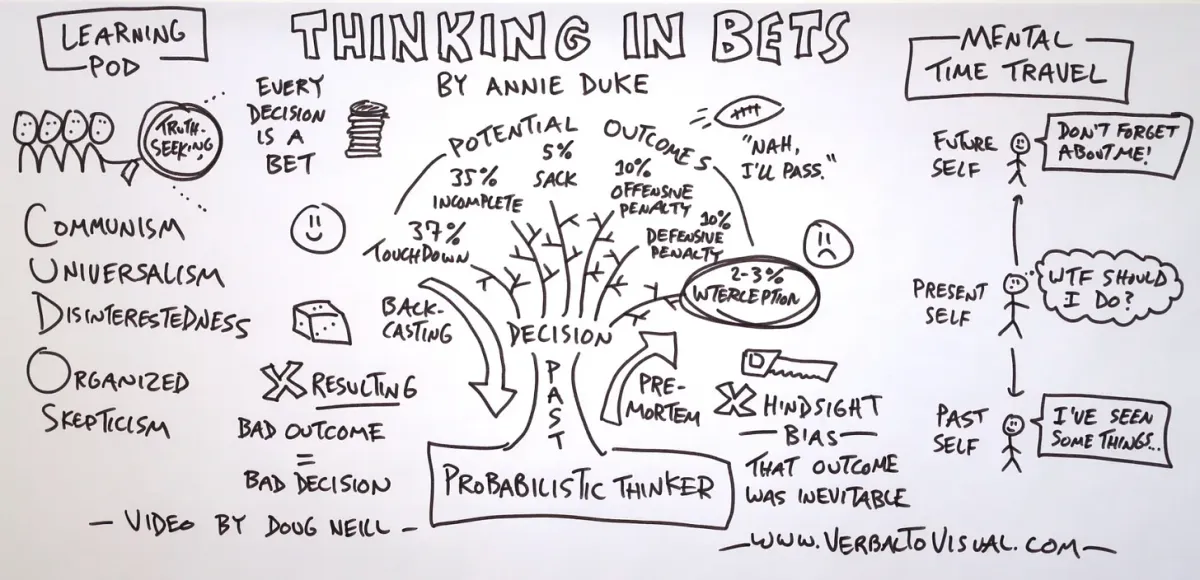
But this simplistic slandering failed to appreciate why the call was the right decision: In the 2014 season, only ~2% of all passes from the 1-yard line were intercepted. Furthermore, the Seahawks were in a three-wide receiver set, and the Patriots were in a goal-line defence. This meant the box was stacked against the run, making a pass play strategically sound. The play was a quick slant, which is usually high-percentage and low-risk. With just one timeout left, Carroll wanted to preserve the option to pass and run on subsequent downs. If they ran on second down and got stopped, they would have had to burn their final timeout, making a pass on third down more predictable.
For those lost in the jargon of American football, in shorter and much clearer terms, the result was catastrophic, but the logic behind the decision was sound. Carroll made a calculated choice to keep all options open and exploit a matchup advantage and the play just simply didn’t work. He got unlucky and made a good quality decision that got a bad result. If the play had worked, he would have been praised for outsmarting the defence and the lesson in this for each of us:
A good decision can still lead to a bad outcome due to unpredictable factors.
The Danger of Resulting
We have talked previously about poker player turned decision making author Annie Duke who discusses this case study and the dangers of resulting in her book, Thinking In Bets: Making Smarter Decisions When You Don’t Have All The Facts. Duke claims we cannot blame the Seattle Seahawk supporters and others in the NFL community, they are merely resulting and failing to consider the probable set of outcomes from a decision after-the-fact, something we all fall prey to.
But why are we so bad at separating luck and skill? Why are we so uncomfortable knowing that results can be beyond our control? Why do we create such a strong connection between results and the quality of the decisions preceding them? And how can we avoid falling into the trap of the Monday Morning Quarterback when analysing someone else’s decision, or in making and reviewing our own?
Try this simple exercise on yourself:
Take a moment to imagine your best decision in the last year.
Now, take a moment to imagine your worst decision in the last year.
I’m willing to bet that your best decision resulted in a good outcome and your worst decision preceded a bad result? In Duke’s case studies she is yet to meet someone that doesn’t present their best and worst results, rather than their best and worst decisions.
Hindsight Bias is the tendency to believe, after an event has occurred, that one would have predicted the outcome, even if one did not. It's a cognitive bias that makes us think we knew something all along, even when we didn't. Its pitfalls include:
Distorted Memory: we tend to remember past events in a way that makes them seem more predictable than they actually were.
Overconfidence: it can lead to overconfidence in our ability to predict future outcomes, as we believe we are better at predicting events than we actually are.
Poor Decision-Making: by misremembering the past, we can make poor decisions in the present, as we may not learn from our mistakes or account for the true uncertainty of events.
Blaming Others: it can also lead to blaming others for events that we now believe were inevitable, as we may have a distorted view of the circumstances leading up to the event.
All Decisions Are Bets
What actually is a bet? The definition of a bet is much broader than our generalised view of casinos, lottery tickets and sports betting. In fact, a “bet” is seen as “a choice made by thinking about what will probably happen - to risk losing (something) when you try to do or achieve something.” Essentially, it is when we make a decision based on a belief that something will happen, or is true.
For example, when we accept one job over another we are removing all other potential outcomes, such as, a raise in current role, additional time away from work, or another career change. Just as our parenting choices are bets. We all want to raise happy, resilient adults who have agency and whenever we make a choice about discipline, nutrition, school, parenting philosophy, where to live, etc., we are betting that our choices will achieve the future vision we have created.
Unlike gambling where there is a clear winner and loser for each transaction, the majority of individual bets we make are against ourselves and we are constantly deciding among alternative futures based on our beliefs in which are formed in haphazard ways.
When we think of ourselves forming an abstract belief, we are under the impression that:
We hear something. We think about it, vet it, determine if it is true or false and only after the fact, form a belief based on our internal assessment.
When in fact:
We hear something. Believe it to be true, and only sometimes and rarely often, do we assess its premise, or if in fact it is actually true.
Harvard psychology professor Daniel Gilbert and author of Stumbling on Happiness, had this to say:
“findings from a multitude of research literatures converge on a single point; people are credulous creatures who find it very easy to believe and very difficult to doubt. In fact, believing is so easy, and perhaps so inevitable, that it may be more like involuntary comprehension than it is like rational assessment.”
These flaws have the potential to snowball, according to Duke. Once a belief is lodged, it becomes difficult to dislodge. It takes on a life of its own, leading us to notice and seek out evidence that further confirms it, ignoring the contrary. And that strikes on the fundamental issues with social media algorithms and so called ‘fake news.’ It entrenches our beliefs and amplifies them. As the late, great, Daniel Kahneman pointed out “we just want to think well of ourselves and feel that the narrative of our life story is a positive one. Being wrong doesn’t fit into that narrative.” If we think of beliefs as 100% right, or 100% wrong, when confronting new information that might contradict our belief, we have two options: 1) make the massive shift in our opinion of ourselves from 100% right, to 100% wrong. 2) ignore or discredit the new information. In most instances the ego will step-in and we will work hard to maintain our current self-narrative.
Outcomes & Improved Process
Given this, if we want to develop a better process and change our behaviours, we can’t just absorb experiences and expect to learn. It is not the experience per se, but what we do with it that matters. As the future unfolds into a set of outcomes we are faced with another decision: why does something happen the way it did? We have the opportunity to learn from the way the future unfolds to improve our beliefs and decisions going forward. Actively using outcomes to assess our beliefs and bets closes the feedback loop, reducing uncertainty.
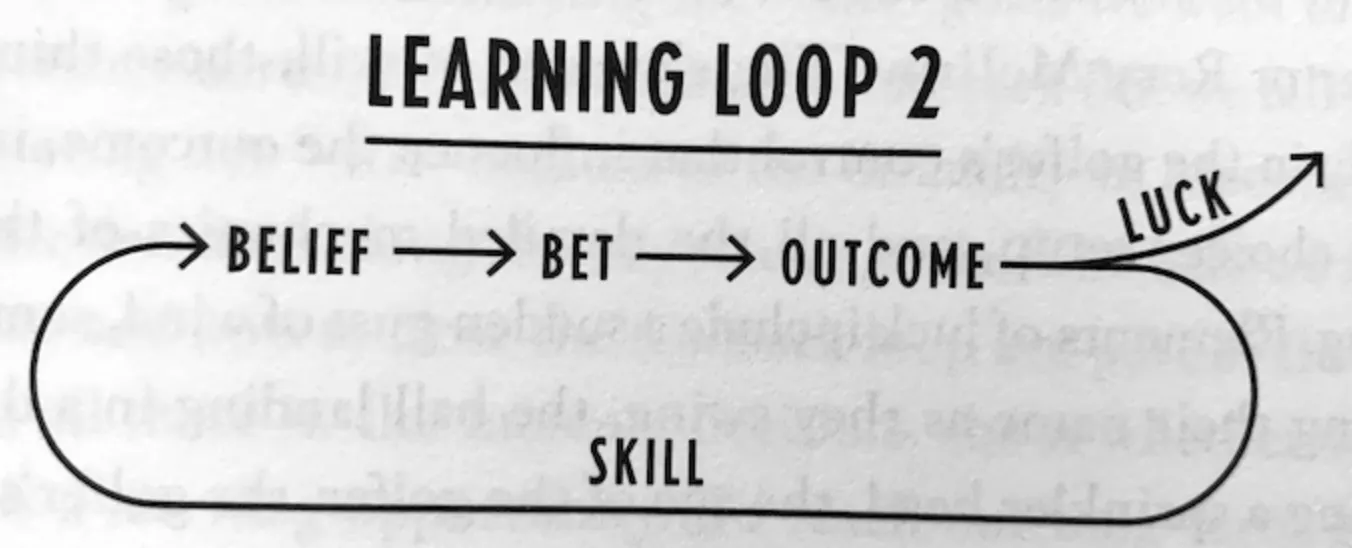
Remember, any given outcome is a result of two things; the influence of skill and the influence of luck. Black-and-white thinking, uncoloured by the reality of uncertainty, is a driver of both motivated reasoning and self-serving bias. Just as blaming others or failing to give others adequate credit is a function of our ego - we all want to feel good about ourselves in the moment, even at the expense of longer term goals, or failing to consider the shades of grey in every outcome. Luck plays an important role.
We touched on this last fortnight in our relationships with others and self in issue #25 where we explained how we benchmark against those around us. If someone we view as a peer is winning, we feel like we are losing by comparison. This runs deep, we think we have the keys to happiness: good job, steady income, nice house, etc., yet we are too often being held ransom to the performance of those around us in which we internally compete.
So, let’s start by building our own framework! One where it is clear that we don’t win bets by being in love with our own ideas, but by relentlessly striving to calibrate our beliefs and predictions about the future to more accurately represent the world.
Truth-seeking Charter:
A focus on accuracy over confirmation, which includes rewarding truth-seeking, objectivity, and open-mindedness within the group.
Accountability, for which members, or an individual has advance notice.
Openness to a diverse range of ideas.
Healthy forms of skepticism can assist this. Not just outright negativity but challenging prompts like: Why might this belief not be true? What other evidence could I acquire to test my hypothesis? What sources of information could I have missed? What other perspectives are there, and so on. Lean into the uncertainty of it.
It is widely agreed that regret can be one of the most intense human emotions and it’s the fact that regret occurs after-the-fact when we can do nothing about it, causing us to just wallow in remorse about something in which we no longer control. To counteract this, business journalist Suzy Welch created the 10-10-10 rule, that is every process starts with a question: what are the consequences of each of my options in ten minutes? In ten months? In ten years? And how do you feel if this were true? In answering these questions upfront, we are drawing on past experiences and recruiting less reactive brain pathways that support executive function.
So, uphold your truth-seeking charter, apply the 10-10-10 regret minimisation rule, figure out the possibilities, and then start to estimate the probabilities. Scenario planning will greatly assist in highly uncertain conditions. Acknowledging that decisions are bets based on our beliefs, getting comfortable with uncertainty, and redefining right and wrong are integral to a good overall approach to decision-making. Think about a large impending decision you have, grab a sheet of paper and start now.
In issue #4 we talked about 6 steps to improved decision making and showcased a decision making tree from one of Annie’s other books, How To Decide. Be sure to circle back for those who want to dig deeper on the topic.
Parting Shot
“What makes a decision great is not that it has a great outcome. A great decision is the result of a good process, and that process must include an attempt to accurately represent our own state of knowledge. That state of knowledge, in turn, is some variation of ‘I'm not sure.’”
— Annie Duke