Better Decision Making and the New Japan Trade
Second Level Thinking · Issue 4
A 6-step framework for optimal decision-making. Why global investors are piling into Japan's 'normalisation' and what it means for the Nikkei 40,000.
The Three Ps of Better Decisions
Our greatest challenge as decision makers is getting comfortable with the uncomfortable, as we will never have all the information required to make repeated high-quality, high-impact decisions without error. When we reflect on a decision, we are reconstructing it through our remembering-self and through the lens of distortion-inducing biases. When approaching decisions, we are assessing an uncertain future as our premise.
Last fortnight we explained what second-level thinking is and how to apply it to your decision making. This fortnight, we continue with the decision-making process and look at the three Ps: preferences, payoffs and probabilities, providing a six-step checklist for improved decision making. Annie Duke, a former professional poker player and author, provides the backdrop for it in her book How to Decide.
For any decision there are payoffs. On the upside, this is the positive potential of your choice; on the downside, the negative potential of your choice, with risk being exposure to the downside. “Assessing the quality of a decision involves figuring out whether going for the upside is worth risking the downside.” A pros (upside) and cons (downside) list will get you thinking in similar terms, but its limitation is that it fails to weight how big the upside and downside are. Size does matter in decision making, as does the probability of various outcomes.
The labels we place on the outcome of a decision will largely depend on our underlying values and goals. Two parents looking to provide for their families can share an objective but have fundamentally different measures of success. For one the goal may be financial security; for another, time spent together each week or month.
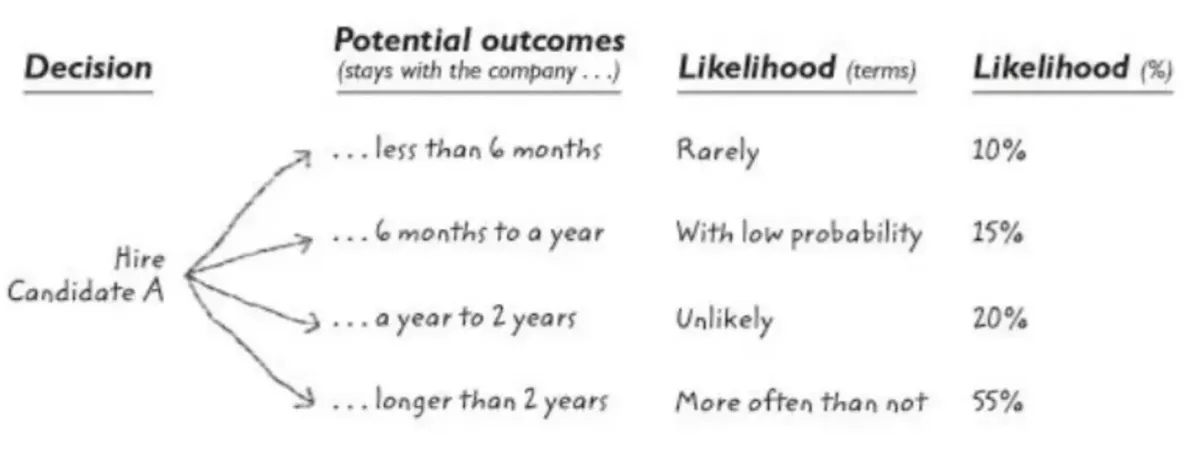
“To figure out whether a decision is good or bad, you need to know not just the things that might reasonably happen and what could be gained or lost, but also the likelihood of each possibility unfolding. That means, to become a better decision-maker, you need to be willing to estimate those probabilities.”
Many are uneasy forecasting the likelihood of a future event and therefore procrastinate on the decision itself, reverting to phrases like, “I’d be guessing.” We get stuck on not having all the information, which results in us overlooking what we actually know. There is no estimate or decision you know absolutely nothing about, and the ability to guess is fundamental.
Avoid simplistic “right” and “wrong” labelling, as the territory between the two is where the value exists. You are essentially trying to figure out two things:
What do I already know that will make my guess more educated?
What can I find out that will make my guess more educated?
Even if you are not explicitly thinking in these terms, your beliefs and subconscious thought patterns are shaping your outcomes. Once we accept this and park our ego, we can let go of the need to be perfect and simply move forward with minimising downside risk and improving the likelihood of a desirable outcome.
When building out your decision tree, there are many terms used to express the likelihood of something being true. Andrew Mauboussin and Michael Mauboussin have built an extensive list through various studies, and I encourage you to explore the probabilistic words in the accompanying Harvard Business Review article. At this point you have multiple dimensions at play, and you can see how far we have progressed from a simple pros and cons list.
Six Steps to Better Decision Making
Identify the reasonable set of possible outcomes. These can be general scenarios or focus on particular aspects of the outcomes you especially care about.
Identify your preference for each outcome. To what degree do you like or dislike each outcome, given your values? Preferences are driven by the payoffs associated with each outcome: gains are the upside and losses the downside. Include this in your decision tree.
Estimate the likelihood of each outcome unfolding. As a start, use common terms that express probabilities. Don’t be afraid to guess.
Assess the relative likelihood of outcomes you like and dislike for the option under consideration.
Repeat steps 1–4 for the other options under consideration.
Compare the options to one another.
Remember, a critical component is converting things we don’t know into things we know. What we already know is generally very little, and it is littered with inaccuracies and biases. Your choices won’t guarantee great outcomes because luck plays its part, but you can get much closer to the outcome you want.
Reflect on an upcoming decision of real magnitude. Start with a blank page, sketch an outline of your decision tree and work through the checklist in one of your planned deep work blocks. Be sure to test it with at least two people: one who is impacted by the decision and one who is not. Be careful not to influence their thinking up front, and create space for their true opinions to be expressed.
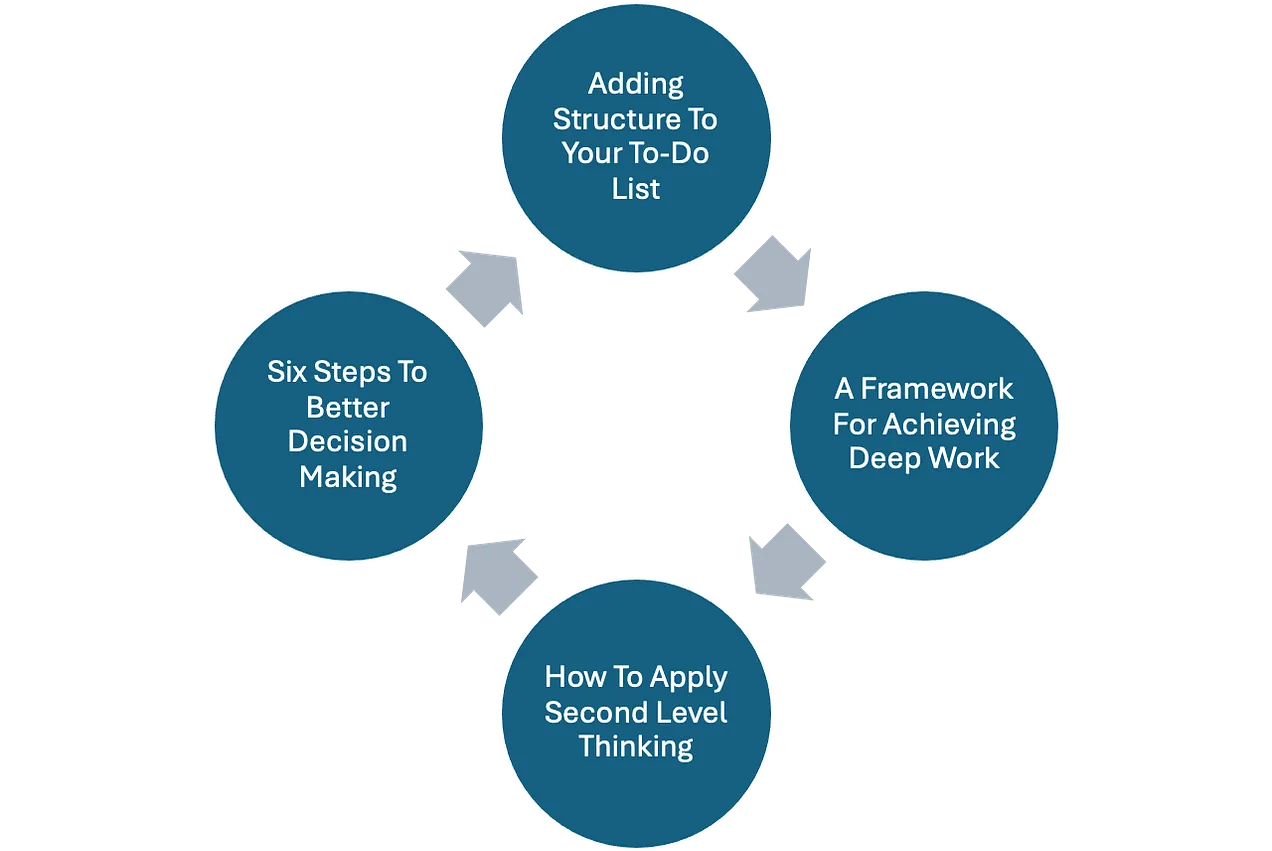
That wraps up our first four-part series, shown in the diagram below. If you missed a previous issue, go back and connect the dots, as next fortnight we move into the next quadrant: changing habits, deliberate practice and more.
The New Japan Trade
The rhythms of history beat upon us, with Japan’s Nikkei 225 index making all-time highs this year for the first time since the last trading day of 1989. Investors globally piled into Japan’s biggest companies on a weaker yen, improving shareholder returns and a confidence boost from endorsements last year by the likes of Warren Buffett. It has been an incredibly long road back since the fleeting excess of the 1980s, but is this another flash in the pan, or is there genuine opportunity here?
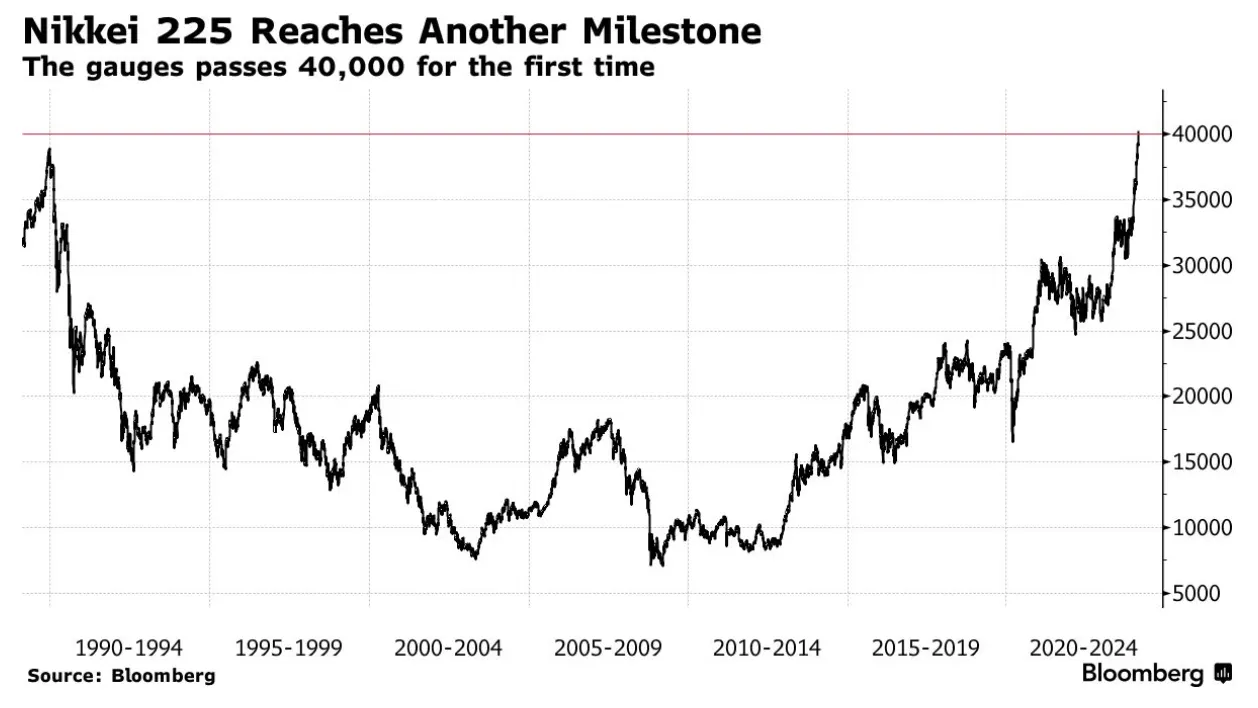
The Nikkei 225’s 50% surge over the past year is coming from a very different valuation. Even at 16 times forward earnings it is still cheap compared with the S&P 500’s more than 20 times, and in a different galaxy to the 70 times it reached at its 1989 peak.
A major catalyst is the Bank of Japan raising its negative 0.1% interest rate to 0% this week, its first hike since 2007. The world’s last central bank with negative rates now faces a normalisation process that is expected to take nine years to complete its balance sheet adjustments, with the bank needing to shed $2.9 trillion of bonds from its portfolio to get there.
Pressure on the BoJ to act grew last week when Rengo, Japan’s largest trade union group, announced agreed wage increases of 5.28%, the largest in 30 years, with many of Japan’s largest manufacturers agreeing to increases of similar size. Inflation has been tracking around the desired 2% for the past 12 months, and further rate increases would mark a mindset shift away from the country’s deflationary culture.
The country has weathered the pandemic extremely well, supported by investors souring on China, as we discussed in a previous issue. The benchmark 10-year yield has risen more than 15 basis points this year to trade around 0.78%, with UBS Asset Management predicting it could rise to about 1.25% by year-end.
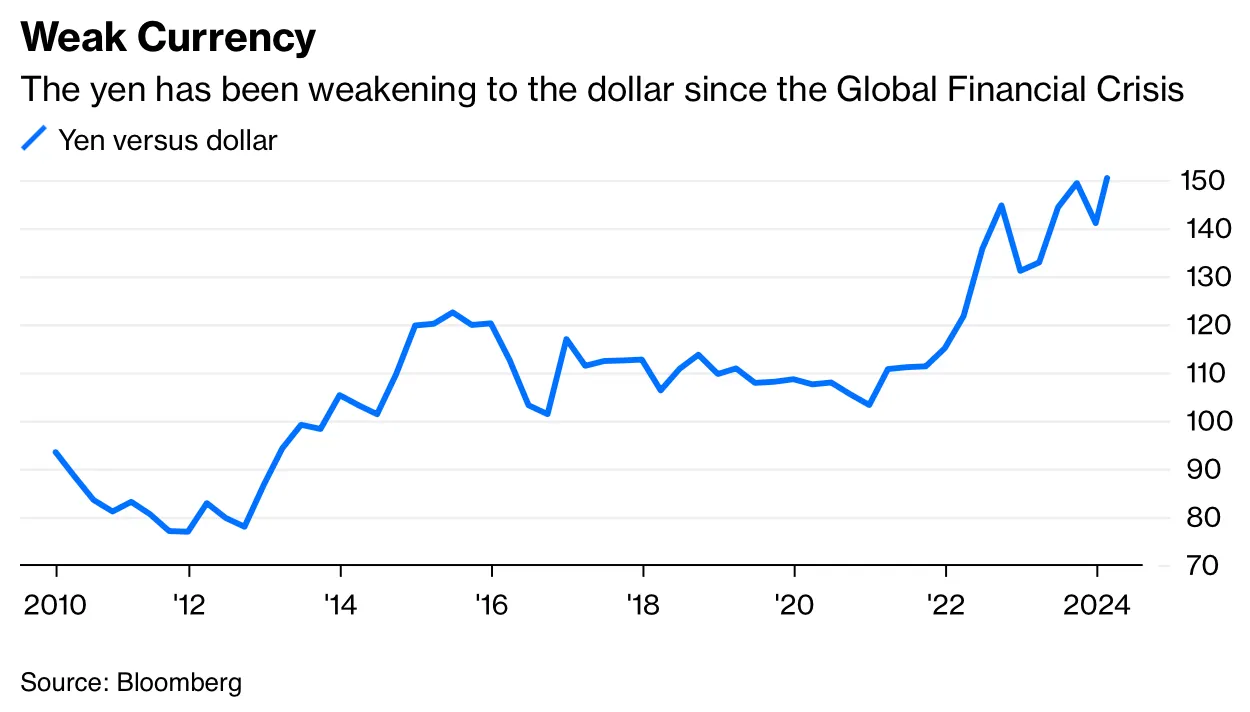
With the yen stuck around 150 to the dollar, everyone’s favourite macro short appears to be reversing.
Many, including JPMorgan Chase & Co., opened long positions on the yen against the euro last month to benefit from the expected gains. There is still opportunity, as the currency remains near the three-decade low it reached in October 2022.
BlackRock is among those seeing further upside for Japanese stocks and the yen, while BlueBay Asset Management has made shorting 10-year Japanese government bonds its largest macro bet. Although many predict rate increases will be gradual, “the drivers of growth are varied, broad and durable. I think we’re a long way away from things being fully priced in,” says Yue Bamba, head of Japan active investments at BlackRock.
As a thought experiment, think about where international stocks or currencies fit into your portfolio and the weighting you place on them relative to your objectives. We have now covered China, Germany and Japan at a high level and will continue to provide deeper analysis on these countries and more market insights in subsequent issues.
Parting Shot
“I always entertain the notion that I’m wrong, or that I’ll have to revise my opinion. Most of the time that feels good; sometimes it really hurts and is embarrassing.”
— Anthony Bourdain