Updating Your Model: Markets and Mindsets for 2025
Second Level Thinking · Issue 22
A guide to the current market landscape and why Richard Feynman’s approach to "un-becoming" is the ultimate competitive advantage.
Merry Christmas, Happy New Year and all that jazz.
First things first, for those yet to read our final issue of 2024; A guide to navigating the holiday period: end-of-year reviews, annual planning templates, New Year's resolution fallacy, recommended reading and more - please revert back and review the year that was before proceeding with this issue.
Now has come the time where we get to assess the state of economies and start to build our investment hypothesis for the year, a continuous process that is always evolving. Remember, in investing, it is not how often you are right but how much you make when you are right, and how much you lose when you are wrong. Life is easy in hindsight!
The general context laid out in each category is a consolidation of many inputs: Bloomberg, New York Times, Wall Street Journal, Venture Capitalists like the All In Pod – basically, left leaning, right leaning and independent groups from mostly US-based media. I have attempted to include a “so what", or prediction at the end of each section but essentially, you must continue by conducting your own mind mapping exercise and develop your own ideas relative to your beliefs about the market. Yes, there is more work to do at the end of this newsletter.
The constant theme will centre on the US as the epicentre for peace and prosperity. A recent example of this was the almost 3hr discussion between Volodymyr Zelenskyy and Lex Fridman where I was left dismayed at how much of the conversation centred on Donald Trump and the US more broadly. The impact of any sitting U.S. President on the world in which we know cannot be overstated. Zelenskyy sees the incoming president as a messiah that can either pressure Vladimir Putin into ending the war, or through counteractive measures like leaving NATO, significantly worsen it.
US | Policy
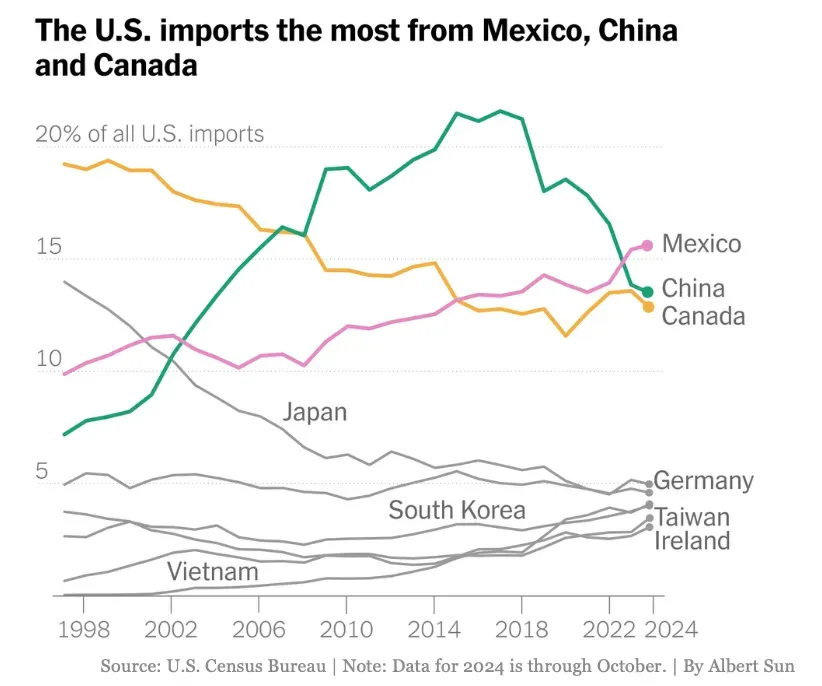
It is no understatement that the policy wildcards of tariffs and immigration could have substantial macro impacts. Much has been written about tariffs since Trump’s return became imminent but we are only this week seeing the rubber hit the road. Furthermore, his erratic behaviour makes it even harder to predict; will he deport one hundred thousand people, or several million? Will he impose a blanket 10% tariff across the board or be more nuanced in his approach? Trump has mentioned the 3 largest US importers of Mexico, China and Canada specifically, so we can expect to see something imposed with these nations at a minimum.
This is similar on the energy front; it is no surprise the incoming administration is bullish energy, but will they be able to clear enough red tape to have an impact and see more support for nuclear quickly and in a timeframe that doesn’t deter investors? There are other marketplaces like China and India that can build and produce greenfield assets at a much faster rate than the U.S., and we are seeing this improve more recently in Argentina with the new administration. Does the U.S. have more capacity to drill right now, even if the new administration favours hydrocarbon extraction? How will booming load growth demand be met?
A more predictable outcome is that deals will flow more generally: “Deal makers pretty much universally expect a flood of deals under President Trump after four years of pent-up activity under President Biden, whose antitrust enforcers challenged a record number of mergers,” writes the New York Times. The more interesting second-level question though is, which kinds of companies will make those deals? More M&A in the energy sector seems probable, bank deals could also take off after the regional banking crisis. Deals may also pop-up to address cybersecurity concerns, the impact of GLP-1 drugs and the fierce AI race, among others.
The stagnation under the Biden administration was real: “the average closing time for U.S. dealmakers in 2022 was 161 days, a 14% increase since 2018. For deals exceeding $10 billion in value, closing times have surged by 66%, to an average of 323 days. Over the past four years, Lina Khan has been an aggressive antitrust enforcer, and the Biden administration has published 209 ‘economically significant’ regulations — more than any president since Reagan. The lesson? Elections have consequences. Setting aside whatever grievances Trump may hold against specific tech and media companies, the perception is that his administration will likely be more friendly to M&A. Some predictions are who will be on top of some big transactions: Comcast, Uber, and Musk. Also, I believe someone will take Intel and/or Boeing private,” documents Scott Galloway.
Trump’s plan to cut taxes and red tape is expected to keep GDP growth steady at about 3% this year and bolster American businesses’ bottom line in the short run. But his vow to impose tariffs on some of the country’s biggest trading partners could result in subsequent impacts to this if not careful and there will be a lagging effect within the transition.
So What
We could further discuss the potential dismantling of the Inflation Reduction Act, which would put billions of dollars’ worth of tax credits in jeopardy and several other critical factors but essentially, we must accept the President is erratic and can move markets on a dime. History tells us that market performance is favourable in the first year of an incoming president, as time is required for them to enact meaningful change when many are optimistic and more forgiving, although that may not be the case with a second Trump term. Based on the information and data we have to-date though, Trump will be favourable to most things business and the broader economy so we must start from this place.
Sticking with tariffs, watch carefully at which industries the initial proposals affect. The government is likely to provide incentive in an attempt to domesticate specific products as it aims to do more things in-house. Be sure to broaden your focus, as the resulting impacts to other nations will also create opportunities there. We are already seeing this with China and the decoupling that exists post-COVID and in anticipation of Trump’s return. Prioritise sectors that enhance a position of power for the nominated country and more specifically, the current administration, like AI, critical minerals, and tech advancements in defence.
Furthermore, anticipation of the build out of nuclear power, large robotic funding deals or autonomy centred mergers that include: Waymo, Uber, Doordash, Amazon, Tesla – a cohort of large participants and a pending IPO surge are important to watch.
On the short side, this translates to selling old defence and airline providers, including Boeing, commercial real estate, government service providers as a result of DOGE and a failure of traditional automobile OEMs that will not be isolated to Germany (if you believe the Nissan merger was just a taste of what’s to come).
US | Interest Rates/Fixed Income
The Federal Reserve cut the short-term rate by 100 basis points last year and although current economic data has been mixed, many are still expecting further cuts in 2025. Oddly enough, the largest talking point in markets currently is the 10-year yield which remains at its highest level in years and mortgage rates are back above 7%. So, what happens if these levels stagnate, or increase? And what are the subsequent impacts to the housing market and commercial real estate, two of the largest parts of the US economy?
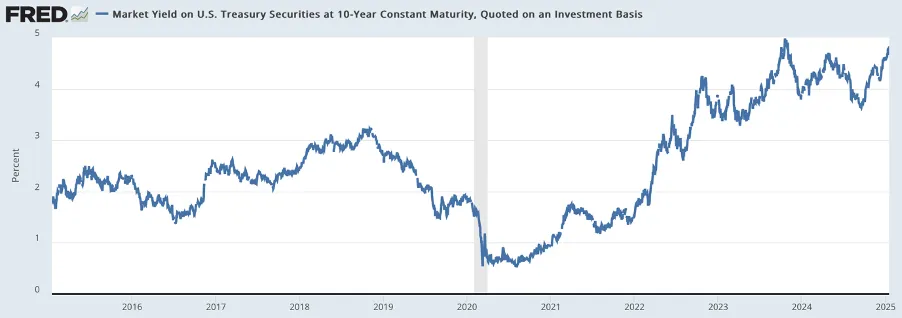
Thankfully, one of the goals of the new administration is to shrink the deficit, that would help ease inflation and bring rates down, albeit, easier said than done. Much of the spending is in areas that are extremely difficult to tackle like entitlements and defence and there will be a lot of angst about the impacts of DOGE and its ability to cut spending writ large. With expectations in the trillions, it will cause widespread disruptions whether it has meaningful effect or not.
“It’s not just Treasuries. Government bonds across the developed world have been selling off. In the UK, the 30-year gilt is yielding more than at any time since the late 90s. In Japan, it’s the highest in over 10 years. In the U.S. it’s not quite so extreme, but the direction of travel is the same.” Bloomberg.
Apollo Chief Economist Torsten Slok published a simple chart comparing the yield trajectory of rates in this cutting cycle versus past cutting cycles.
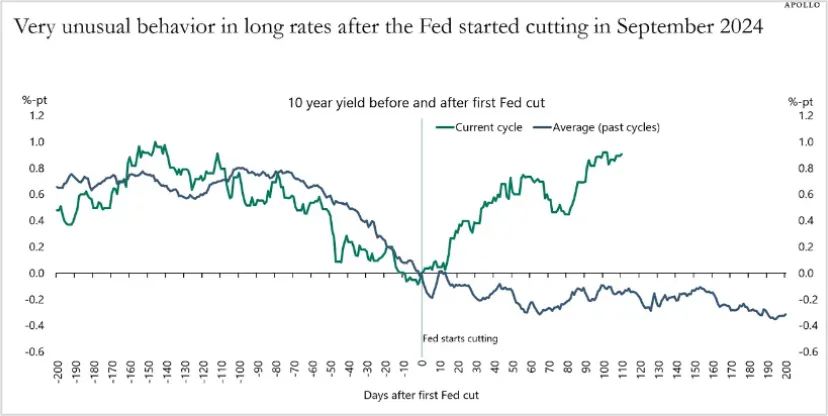
“Normally when the Federal Reserve lowers rates, yields at the long end drop too. But obviously that hasn’t been the case this time around. One possible reason for this is that the cut itself was unusual. Usually, the story with rate cuts is that they come too late, and that the Fed only really moves when the recession is already underway or baked in. By that point, those initial cuts don’t do much because the recession has gathered its own momentum (layoffs and reduced spending leading to more layoffs and more reduced spending and so on). And so, in the normal sequence of events, it’s reasonable to think that it’s not the Fed cut that typically causes the long end to fall, but rather the ongoing recession that drives yields down; The rate cuts are just coincident with the move in yields.” Bloomberg
So What
Disappointingly, we have an extremely narrow focused Fed that appears more concerned with a forever-occurring “soft landing” and the legacy of the current administration, rather than long-term prosperity.
The shorter the focus of the Fed, the more weight traders place on data release, such as CPI, right down to detailed meeting minutes. And don’t get me started on leading versus lagging indicators. Don’t be drawn into the noise and if you cannot identify a larger theme here, look elsewhere in the market until conditions become clearer, as they have already moved a long way. Again, broaden your horizon as we are seeing a similar shift in other countries that may offer better opportunity.
US | Big Tech/AI
Will the long, big-tech trade continue to work? In recent times the trade has worked so well because a few gigantic companies have posted almost unbelievable earnings growth, especially given their size. Last year the Magnificent Seven (Mag 7) had 33% earnings growth, compared to around 3% for the 493 remaining companies in the S&P 500. That’s 30 percentage points excess growth rate. It is staggering how narrow the leadership of equities is across the market. I am not predicting a bear market in 2025 but one has never occurred without such a narrowing-effect.
A big question then is whether the gap between tech earnings growth versus everything else in the index will in fact shrink. And if so, maybe there will be more investing opportunities than just going all in on a big few. “Since the launch of ChatGPT in November 2022, investors have added a staggering $8.2 trillion to the market valuations of six firms: Alphabet, Amazon, Apple, Meta, Microsoft, and Nvidia. For context, the 2024 federal budget was $6.8 trillion.”
Although, big tech may not catch a break, writes the New York Times: “while corporate America has been anticipating a longer leash under the Trump administration, Silicon Valley giants may still face a lot of scrutiny. Unlike Lina Khan, the outgoing FTC Chief whose lawsuits fighting tech giants’ market power came from a progressive perspective, many of Trump’s picks have accused companies like Google and Meta of silencing conservative voices.”
Infrastructure will become a growing focus of the AI race, one that the big players continue to dominate. Traditionally with new advancements in technology, we see a changing of the guard, but will the Mag 7s cash flows prove too great for early adopters and new market participants?
The AI ecosystem is settling into three layers, writes Scott Galloway: applications (Duolingo, Netflix, Tesla), AI models (Anthropic, Gemini, OpenAI), and infrastructure (AWS, Google Cloud, Nvidia). OpenAI has doubled its annualized revenue to $3.4 billion in the past six months and Nvidia continues to rise. But many argue no business is better positioned to register progress in AI than Meta. Nine out of 10 internet users (excluding China) are active on Meta platforms. The company has access to more unique human language data, i.e. raw training data, than Google Search, Reddit, Wikipedia, and X combined. In terms of compute, Meta has purchased more Nvidia Hopper GPUs (advanced AI hardware) than any U.S. company other than Microsoft, giving it unmatched AI training and deployment capacity.
Another area heating up is the defence tech industry; venture investment in defence start-ups soared last year, and by September had surpassed the total amount invested in 2023. Palantir, a data analytics company whose market capitalisation jumped almost five-fold to $180 billion in 2024, its operating margins have risen sharply, and it joined the S&P 500 in September.
Others are also profiting from rising global uncertainty; Anduril Industries, a California-based defence start-up backed by Peter Thiel, the venture capitalist and Palantir co-founder, announced in August that it had raised $1.5 billion in a funding round that valued it at $14 billion. And Helsing, a German start-up that uses A.I. to process live data from the battlefield, is one of Europe’s best-funded companies, writes The Times.
Drones provide constant surveillance capabilities and enable precision strikes at a fraction of traditional costs. 3D printing, AI, and micro-cameras have converged to shape the current wars. Using drones for last-mile delivery of Comtrex and commuters, search and rescue missions, and monitoring and maintenance in manufacturing and agriculture should reap substantial gains and is worth considering.
So What
There are multiple plays here - break it down into applications, models and infrastructure. Look at companies that provide bandwidth memory, and the critical minerals that go into the infrastructure, especially where many are predicting a shortage, or constraint on the supply side. The feeling about the Mag 7s continued dominance is mixed, but be careful picking a turn here as shorting them can be the equivalent to getting run over by a freight train.
The best performing big businesses who use AI thoughtfully will see continued dominance. This would result in being long NVIDIA, chipmakers, and suppliers of compute infrastructure. Tesla and Google - the year of AI and autonomy hardware or robotics. Unitree is another company in China that is doing great things in this space. Google Gemini Deep Research is amazing and they seemed to have fixed issues that caused backlash in early versions. Companies that make high bandwidth memory in the event we run out of compute. Hynix and Micron are two companies that supply NVIDIA and Taiwan GPUs and are critical to everything these companies do. Many are predicting the AI progress per quarter will be greater than the current annual rate.
This translates to being short vertical SAAS, large, bloated companies in any industry, including tech. Enterprise application software. Funny enough, Chamath on the All In Pod took the opposing side of the Mag 7 trade and perhaps the more contrarian view that an absolute dollar drawdown of the Mag 7 will be in the trillions at EOY. Concentration like this generally foreshadows a larger drawdown and we may see a shift in focus to other areas of the market as we have already discussed.
Media
Podcasts, streaming and the war against traditional media is worth touching on briefly. Although brewing for some time, the shift became evident through the Presidential race last year. Many called it the “Podcast” election and for good reason, with long-form and more often relaxed conversations resulting in a deeper understanding of character and a wider-ranging discussion. Kamala Harris’s inability to adapt to this and continued “word salads” when not presenting by teleprompter did negatively impact her campaign.
Ad revenue is improving as listenership grows, but it is isolated to a few and it is suspected that less than a thousand podcasts take almost half of total ad revenue. On the traditional media front it is not much better, I can get a New York Times subscription for ~$1 dollar per week as subscribers head for the exits and revenue declines. It’s not much better over at MSNBC - after the election was called on November 5, MSNBC’s audience decreased by 46% compared to the first 10 months of 2024. Rachel Maddow, a prominent MSNBC anchor reportedly agreed to reduce her annual salary from $30 million to $25 million over the next three years as a result. $25 million in salary for less than 100,000 viewers per show! Something still doesn’t add up from what I can see and I wonder how Rachel even still has a job.
Netflix didn’t win the streaming wars, YouTube did. Last year, YouTube, which spends zero dollars on content — it shares revenue with creators instead of paying them — became the first streaming platform to reach 10% of all television viewing. Eighty-one percent of Gen Alpha viewers said they watched YouTube recently, compared to 62% who said they watched a subscription streaming service, and 44% who said they watched TikTok. In the U.S. and U.K., one-third of kids aged 8 to 12 said YouTube was their No. 1 career choice; movie star didn’t make the list. Also, YouTube is the No. 1 podcast platform, adding a tailwind no other streamer has. If Alphabet were forced to spin off YouTube, the company would likely be worth half a trillion dollars, vs. Netflix’s market cap of $350 billion. Scott Galloway.
So What
Personally, I find the YouTube stats staggering, yet not surprising and Google has found another money printing machine as the market shifts from search, to AI. With podcasts, expect ad revenue to grow as further investment comes with increased viewership. The streaming wars will continue to play out, so pick your target where applicable, as we see many of the large players shift to sport and live streaming of events in an attempt to increase their edge. YouTube will remain dominant in the short term and we will see further rise in independent media and a last grasp by many traditional media outlets that are now shrinking in viewership and haemorrhaging money. An opportunity for a spread trade, perhaps?
Global Markets
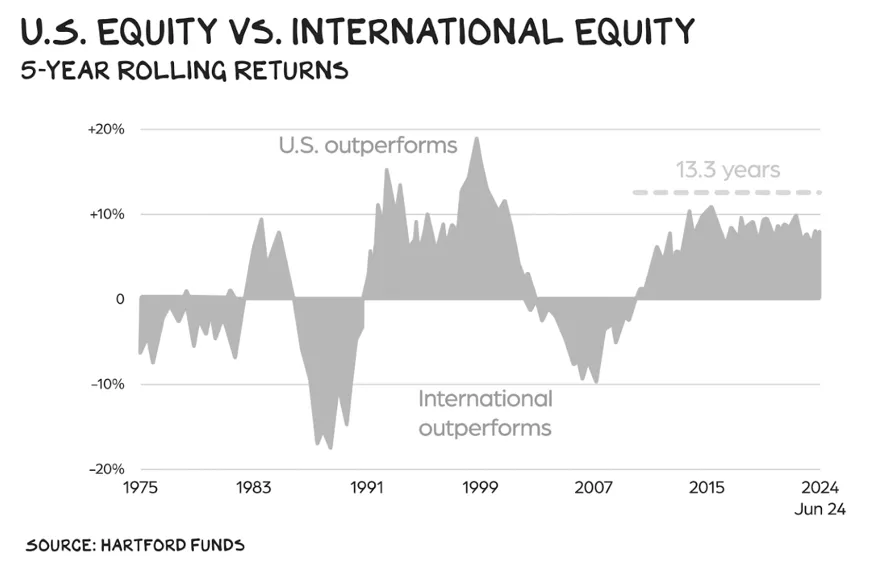
With the U.S. stock market now making up 50% of the total market cap globally, you can be forgiven for targeting U.S. exposure, especially my fellow Australians, as returns have been unrivalled in other parts of the globe. Although, since 1989, emerging markets have typically outperformed developed markets by 27% after a Fed rate cut, as seen in the below chart. Demographics are destiny; the growth in working-age populations favours India, Indonesia, and other developing nations in the near future.
Although, there is no other story that has such cross-partisan interest than China versus U.S. With consistent headlines about Chinese EV, chip, battery or jet breakthroughs, coupled against America’s big push to reignite its own ability to build things. Trump has accused Beijing and its companies of unfair competition in the past. It’s the same stance he took during his first presidency, when he ratcheted up trade restrictions with the world’s second-biggest economy. But Chinese companies have proven adept at finding ways around previous restrictions.
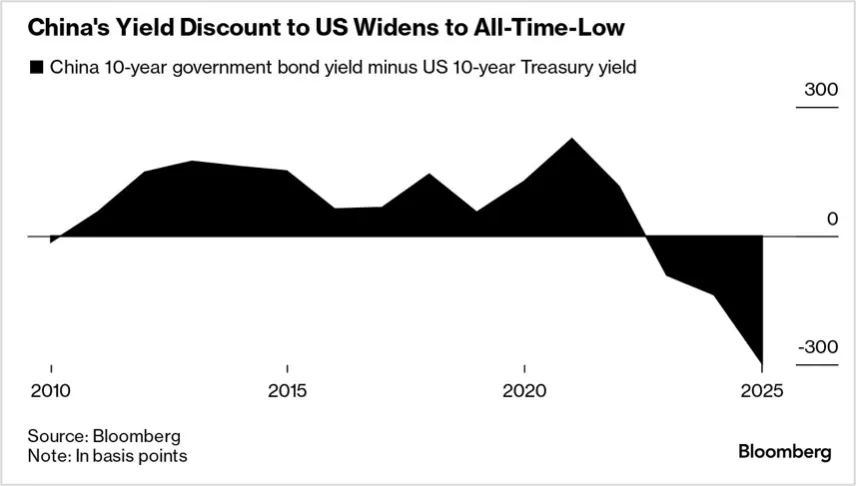
Back to bonds for a second: the contrast in signals from the bond markets of the world’s two largest economies couldn’t be clearer. On one hand, US Treasury yields are climbing higher by the day, powered by seemingly unstoppable economic growth. On the other, traders have rarely been so pessimistic about China, forcing yields to fresh record lows on fears the No. 2 economy is heading for a deflationary spiral, as Joanne Wong and Finbarr Flynn report in Bloomberg’s Big Take:
“China’s dour outlook, meanwhile, has triggered a stampede into bonds. The 10-year securities now yield an unprecedented 3 percentage points less than comparable US debt. The yields are far below levels reached during the Covid pandemic and 2008 global financial crisis, underscoring that Japanification is now a real risk. BlackRock’s Navin Saigal is among those who see bond yields reflecting a ‘desynchronization’ of the US and Chinese economies. Juicy US yields are also presenting an ‘incredible’ opportunity, he says.”
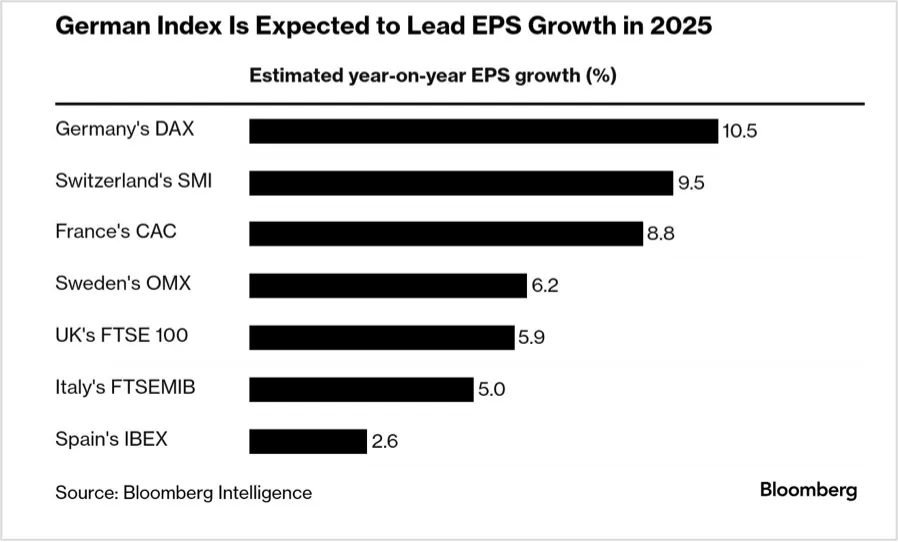
Over in Europe, many are short the German car industry as a result of BYD, Tesla and the slow-to-adopt electrification of the traditional automobile companies. Strangely enough, the companies that make up Germany’s DAX index that include many in that very industry are expected to deliver earnings-per-share growth of more than 10% in 2025, the highest among European peers, data compiled by Bloomberg suggests. Much of the growth will depend on the rebound of the auto industry, but some argue it’s because many of the index’s companies have the majority of revenue deriving from outside the struggling economy. Here is a Bloomberg table below, showing predicted outcomes versus peers.
So What
Find opportunity where the majority are fearful. I could write a complete thesis on the decline of German manufacturing and the spiralling Chinese economy, but simply shorting Volkswagen and Chinese real estate is not enough. In fact, some argue the stimulus and corrective action being taken by the Chinese government, coupled with unprecedented U.S market concentration is why Chinese tech stocks will be some of the best performing companies this year. We already know their LLMs are rivalling that of the U.S. and they hold the key to a vast amount of critical minerals that will support the build out of compute, among other things. I remain skeptical on their real estate industry but like all things, am happy to be proven wrong.
Currencies
The fundamental uptrend of the U.S. dollar is intact as the currency benefits from the strength of the U.S. economy, says Brown Brothers Harriman’s Elias Haddad. “The U.S. economy is in a sweet spot (solid growth and modest disinflation) and outperforming other advanced economies.” The prospect of looser fiscal policy under the incoming Trump-administration could force the Federal Reserve to keep policy restrictive for longer, he says. Expectations for a lower U.S. corporate tax rate and deregulations should also boost foreign inflows into both portfolios and direct investment in the U.S.
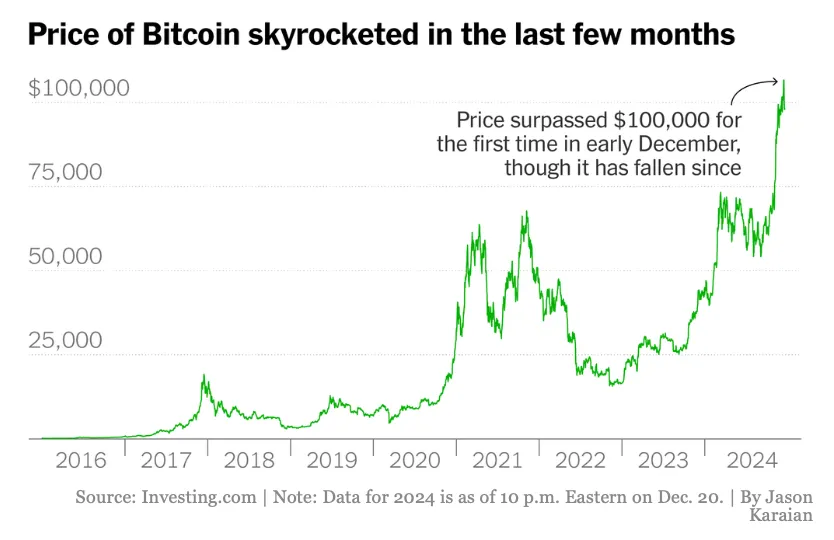
Traders are also returning to cryptocurrencies as Donald Trump returns. Trump is expected to announce crypto-friendly policies, including potentially a plan to create a strategic bitcoin reserve. Further gains could lift bitcoin back toward the record high of $108,379 reached on December 17, with some analysts speculating that the cryptocurrency could reach $200,000 by the end of this year, as reported by the Wall Street Journal.
Long U.S. dollar bets have been matched by a surge in short wagers against currencies including the Canadian dollar and Euro, the CFTC data show. Non-commercial traders held some $11.6 billion in bearish positions against the loonie as of January 14, the most among Group-of-10 currencies tracked by the CFTC. That group of traders is short the Euro by around $7.8 billion, according to data reported by Bloomberg.
“Positioning is now seen as the biggest U.S. dollar headwind, which is a concern we share,” wrote Bank of America currency strategists including Adarsh Sinha and Michalis Rousakis in a Friday report to clients. “U.S. dollar longs stand out versus history and more so versus the past year.”
So What
Currently the U.S. dollar holds firm but we are nearing max positioning. Unless price action and positioning shift do not step in front of this trade amid a changing administration. Put your ego aside, don’t attempt to pick the turn and await further confirmation. On the crypto side, many are bullish on dollar denominated stable coins and believe 2024 was proceeding past a point of no return. Meaning, 2024 was Bitcoin, now 2025 is stable coins and an attack on Visa, Mastercard and another change-of-the-guard. Shorting Visa is easy, but identifying the fair value of a stable coin and doing it through a broker that is reputable and doesn’t carry the risk of hacking or theft is much harder. This is changing rapidly but don’t be sucked into the noise. Play the long game here and stay away from what you don’t understand.
Mind Mapping
Now the fun part, start with an economy, market, or sector and conduct a Mind Mapping exercise, like the below sporting example. As you approach the individual instruments of specific sectors, you will not understand all possible opportunities in which to express your idea. For this reason, I suggest breaking Mind Mapping into 2 parts: 1) determine your overarching theme or economy and complete the first part of the exercise. Then, 2) get to work researching all the possible ways in which you can express your idea with the strongest possible conviction, overlaying both components upon completion.
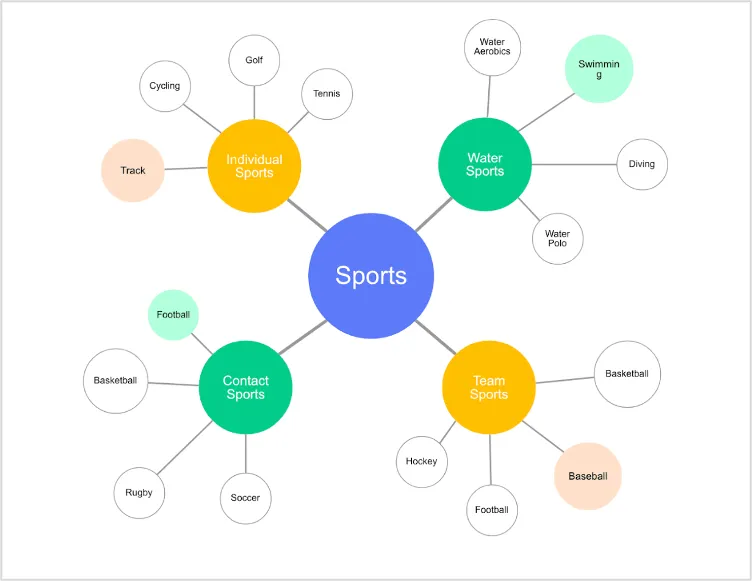
Additionally, I feel a form of storyboarding can help support this effort. Not the drawing of images, but the inclusion of supporting or opposing opinions, quotes and other research information like this newsletter. This will greatly assist your post trade review and allow deeper insight into what your mindset was prior to taking a position and help further cement what is working and what is not.
Reduce friction and just start writing on the page - even in point-form like this:
Palantir defence tech – long.
Cacao supply shortage – long.
Euro short to parity or long reversal – explore.
Germany election in February – research. Track Auto industry sales volume.
China – where do I start. Conflicting data and analysis. Break it down.
Bitcoin holding at $100k – is this done, or still a play. Secondary stable coins?
Gold’s unprecedented run set to continue? Use futures contract for exposure.
U.S. interest rates - will they remain higher for long? What’s the trade?
Rare metals for batteries - China/U.S. tariffs and critical resources in general.
Lithium - Rio Tinto buying. General growth in Argentina given current administration. Index exposure, or company specific?
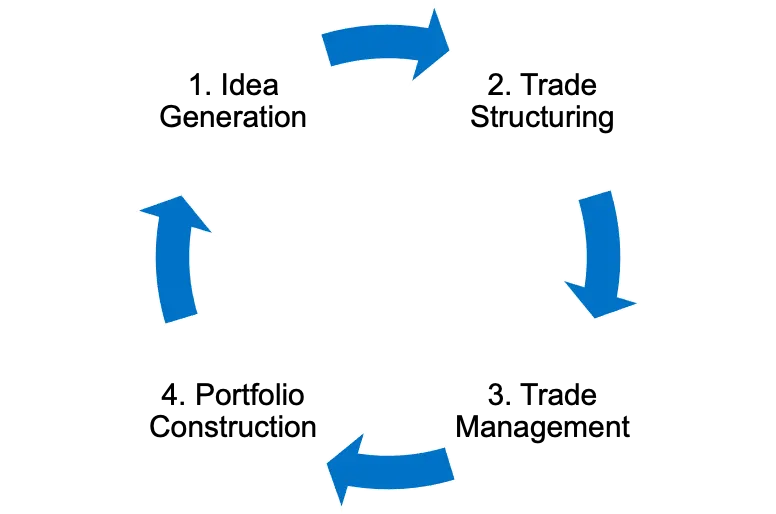
You get the idea - keep going and build it out. Do the work and continue your idea generation as you start to identify and structure specific positions as per our trading as multiple processes cycle below:
And some final words from the great Stan Druckenmiller: “we are not investing in the present, we are understanding the present, in order to form multiple hypotheses of a future state. If buying the present, we would be chasing fads as opposed to envisioning the future. What’s obvious is obviously wrong and already reflected in security prices. The world changes and you are only going to identify change if you open your mind to what could be different, for better or worse.”
Parting Shot
A timely reminder from Richard Feynman that you don't have to be the same person you were yesterday:
"You are under no obligation to remain the same person you were a year ago, a month ago, or even a day ago. You are here to create yourself, continuously."
Go forth and conquer - let’s go!