The End-of-Year Toolkit: Reviews, Templates, and Reading
Second Level Thinking · Issue 21
Everything you need to close the year strong. Includes my recommended reading list and a breakdown of why resolutions are a trap.
Christmas. Really!
Our final newsletter for 2024 is a practical guide for navigating the holiday period, which for many, is one big anxiety fuelled festivity, driven by social activity with extended family and intensified by overeating and increased alcohol intake. If this isn’t enough, compound that with some introspective thinking on all the things you didn’t get done for the year, and it can make for one-hell-of-a good time!
The problem being, if we simply pause momentarily and attempt to review the year by thinking about it, it’s almost impossible to stay present, think in structured sentences and obtain a result of any benefit. And if your mind is anything like mine, it will start to play tricks on you: “what are you even doing with your life,” “have you still not done that,” “another year and you can’t even…,” are all common phrases that spring to mind.
Next minute we are spiralling into a depressive state of how little progress we have made on A, B and C. Conversely, it can be how much progress we have made on something but it fails to take into account all considerations in a structured way and simply leaves us falsely elated, or sad if we allow it.
It is worth noting, it is common to reflect on the year and think about the year ahead but under no circumstance should this be a singular conversation, nor do we need to wait for a magic date on the calendar to make it happen. This is true for the individual and the business: everyone will have their overarching vision, mission, or purpose, with their underpinning goals and objectives. But there needs to be systems in place to take steps forward and move toward these desired outcomes, with defined intervals in which we check against our progress, as we have discussed previously.
A business might break the year into four 90-day blocks, or quarters and then conduct a weekly meeting that rolls up into a monthly review, that then gets checked against at the end of the quarter. Frequency will vary, but the point being we require defined processes and accountability. Personally, I would never wait until Jan 01 to stop an unhelpful behaviour, nor would I wait for Jan 01 to start a helpful one!
But there is something about the end of the year that feels final, it feels different, like you are almost starting again with a clean slate. So, to support this, we are going to share two end of year review processes to maximise our attempt at looking in the rear-view mirror, followed by two annual planning templates to set-up the year ahead.
End of Year Review (1)
For those with defined objectives, your end of year (EOY) review, or past year review (PYR) will be a matter of constructively looking at where you achieved your goals and where you did not achieve your goals. For those that don’t have anything documented, please complete this exercise introspectively and enter your responses into a newly created worksheet of your choosing.
In all instances, start by ranking your performance against each of your objectives, and secondly, use the below framing questions to understand your results more deeply by constructing responses to the following:
What accomplishments are you most proud of?
What factors motivate you to reach your goals and be productive?
Which goals did you accomplish? And which ones did you not accomplish?
What steps can you take to make your goal pursuit more enjoyable?
What are the core strengths that help you excel?
What type of work inspires you the most?
What kind of tasks comes easiest to you?
What tasks do you enjoy doing the most? Why?
What tasks do you enjoy doing the least? Why?
What changes are you planning to make moving forward?
What caused these misses, and how will you do things differently next time?
Tip & Trick: for leaders within organisations, use these framing questions to support EOY performance reviews with your direct reports and reconfigure the sentences as desired.
End of Year Review (2)
A second EOY review template from Tim Ferriss you may wish to use in place of the first template:
Review your calendar or diary by week for the full year.
Write down the people, places, commitments, activities, etc., that created a positive experience for you.
Conversely, write down the people, places, commitments, activities, etc., that created a negative experience for you.
You are basically doing an 80/20 analysis and identifying what are the big rocks that moved the needle in a big way. What are the things that filled your cup, and what are the things that drained it.
This should provide you with a “do more of” and a “do less of” list and understand where you allocated time throughout the year.
The above processes will greatly support our planning activities for the following year. Remember, you need to plan to do the things that are important to you. The urgent will always crush the important and you must schedule the things you want to do. Every time we say yes to something, we are saying no to something else and there is always an opportunity cost for every decision.
I should also note, there are things we want to do, things we have to do, and things we should do. This exercise is not about removing all the things we have to do. It’s about nudging ourselves towards the things that maximise our agency and drive us toward living our purpose.
Annual Planning (1)
As we project our eyes forward to the year ahead, once again, let’s look at some framing questions to support this planning phase:
What are your goals? Define them.
Where do you see yourself in five years? Shorten the time horizon if unsure.
Which areas do you want to focus on to grow and develop in the next period?
How can others help you grow and have you identified the people to support this effort?
What’s the biggest challenge you’re likely to encounter or are already facing?
Tip & Trick: for leaders within organisations, these should be combined with the framing questions in the first section and used to support your EOY performance reviews with your direct reports. Again, reconfigure the sentences where required.
Annual Planning (2)
A second planning template from Shane Parrish you may wish to use in place of the first template:
Eliminate ruthlessly: write down your top ten objectives for 2025. Now circle the three to four that matter most to you. Everything not circled should now be considered your ‘avoid at all costs’ list.
Reflect on where you might be passively waiting for others to act. What proactive steps can you take to initiate positive outcomes?
The lesson is to identify your weaknesses and architect your life to avoid them to the extent possible.
Consider what actions you would want a film crew to document and which ones you would prefer they not see?
As you are conducting your planning session, think more deeply about your personal objectives that sit separate from your professional ones - not to be confused with leisurely tasks that are done ad-hoc - I am talking about specific personal goals you are in pursuit of:
Are they behavioural, or relationship based and connect with how you conduct yourself at home and around others?
Are they fitness or health related?
Are they related to learning a new skill?
Are they connected to giving back or contributing to a local community?
Maybe they are something that gives you more time to self and allows you to more effectively recharge away from others?
Whatever it is, we need to treat them like professional pursuits and ensure time is allocated and our objectives are clear. Otherwise, we will simply get pulled by others and the broader universe. Distraction is stopping you from achieving what you desire.
Personally, I have buckets: a fitness bucket, a health & wellbeing bucket, a learning & skill development bucket, a family bucket and a giving back bucket that sit outside my business or “work” objectives. For each of those buckets I have objectives and I ensure time is allocated to work toward achieving those goals. I then conduct a weekly review that rolls-up into a broader quarterly review where I ask, “am I on track, or off track.” Never do I wait for year-end. I need to course correct where I am off track and double down where I am on track throughout the year and never stagnate. Never stand still.
You need to plan to do the things that are important to you. The urgent will always crush the important and you must schedule the things you want to achieve.
You are now building toward a point where you can start to map out what a day, week, or month looks like relative to all your commitments and objectives. When doing so, remember the task residue effect and the cognitive drain on frequent task switching. We discussed that in a previous issue and the concept derives from Cal Newport’s Deep Work. I have linked to this specific newsletter and several others below.
A concept from Greg McKeown that further supports this is the Daily 1, 2, 3 Method: where you have 1) essential item, 2) urgent items and 3) important items progressed daily. In other words, what’s the 1 essential thing, person, or relationship that I need to do today (Most important thing). What are 2 urgent tasks, things with a deadline, things that need to be done. What are 3 important things, or maintenance tasks, things that will pay dividends in the future and prevent reactive work at a later date. Finally, roll this up into a weekly review. Play around with this and find something that works for you.
“Until you have reckoned up each daytime deed: ‘Where did I go wrong? What did I do? And what duty’s left undone?’ From first to last review your acts and then reprove yourself for wretched or cowardly acts, but rejoice in those done well.” Seneca
Helpful Issues To Support This Effort
We encourage you to review all our content from over the course of the year as required, but below are five issues that connect well with this newsletter’s information to ensure you are set-up for an amazing 2025:
#2 Deep Work
Recommended Reading
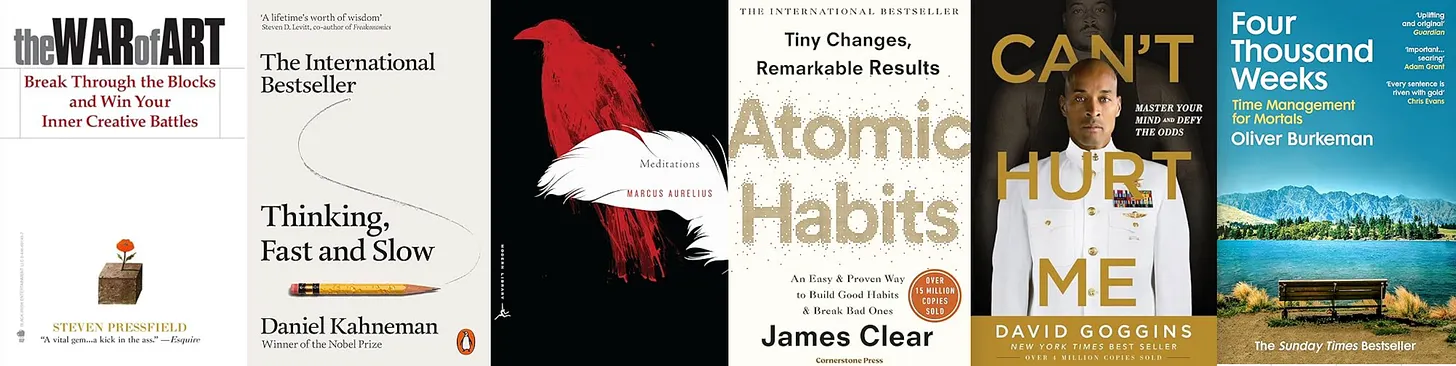
It wouldn’t be Christmas without a book under the Christmas Tree. Below are six that are worth your time and if you have managed to read all of them, please DM me for more options.
Meditations by Marcus Aurelius. Few ancient works have been as influential as the Meditations of Marcus Aurelius, philosopher and emperor of Rome (A.D. 161-180). It is now the standard by which all Stoicism is judged. Gregory Hays translation.
The War of Art by Steven Pressfield. A succinct punch in the face on overcoming the resistance within each of us. Put the naysayer inside to bed once and for all.
Thinking Fast & Slow by Daniel Kahneman. Nobel laureate and founder of the field of behavioural economics, this is a fascinating exploration into the mechanics of our mind and the impact on our choices as a result.
Can’t Hurt Me by David Goggins. Master your mind and defy the odds, is an in-depth look into someone who has overcome a multitude of obstacles and through various mental strategies achieved humbling things. David is a true outlier.
Four Thousand Weeks by Oliver Burkeman. Time management for mortals is a startling reminder that if we live until 80, we have roughly four thousand weeks on earth. An unexpected rethink on what it means to be productive and to use your time wisely.
Atomic Habits by James Clear. The official bible for understanding all things habits; whether you want to stop a hindering habit, start a more helpful habit, or sustain one that keeps slipping you by, this is worth reading.
New Years’ Resolutions
Shane Parrish puts it best:
I don't make New Year's resolutions. To me, they seem like well-intentioned goals that rarely get accomplished. If you're doing something stupid, why on earth would you wait until December to change it?
Here is the system I use instead to rapidly course correct. It takes about 30 minutes and you can do it weekly, monthly, quarterly, or yearly depending on how fast you want to course correct and amplify results.
Go to a place you've been before — one that's familiar enough that you're not curious about its surroundings and one that's not so familiar that people will interrupt you. I usually grab a glass of wine.
Bring the last month of your life with you in whatever format works for you. This can be a diary, print out of your calendar, whatever. Look it over and put things into the three big buckets: Personal, Family/Relationships, and Work.
Critically evaluate how you allocate your time and ask yourself, what one thing you'd eliminate in each bucket. (For example, maybe there is a person in your life who consumes a ton of your time. Your monthly review makes apparent your efforts and brings to mind the relationship as a whole. You decide to stop putting so much effort in for a month with this person and see what happens.)
Next, identify one thing in each category that really makes a difference to you and what you want or something you want to start doing. (This might be a date night with your partner, reading to your kids, reading more, or a special project you're working on at work.)
Take the time from the task you eliminated in 3 and apply it to 4.
That's my system. The harder the choices, the better the result.
If you're having trouble determining what you want or what you don't want — imagine you're 70. What do you want your life to look like? What do you want to avoid? What can you do now to get what you want? What should you stop doing now to help avoid things you don't want.
We’ll reconnect mid-January and communicate some changes to this newsletter, our plans for producing even higher-grade content, and continue to be a reliable source of information you can trust. Until then, have a great festive period and thanks for your support.
Parting Shot
Remember, above all else, the Six Stoic Keys to Happiness:
1. Focus on what you can control.
2. Ignore the inessential.
3. Don’t compare yourself to others.
4. Do good to feel good.
5. Read philosophy every day.
6. You fill in the blank…