Winning Tomorrow Starts with the Framework You Build Today
Second Level Thinking · Issue 11
Moving beyond "corporate speak" to create values that scale. Understanding the rhythm of the markets: how to spot the transition from accumulation to distribution.
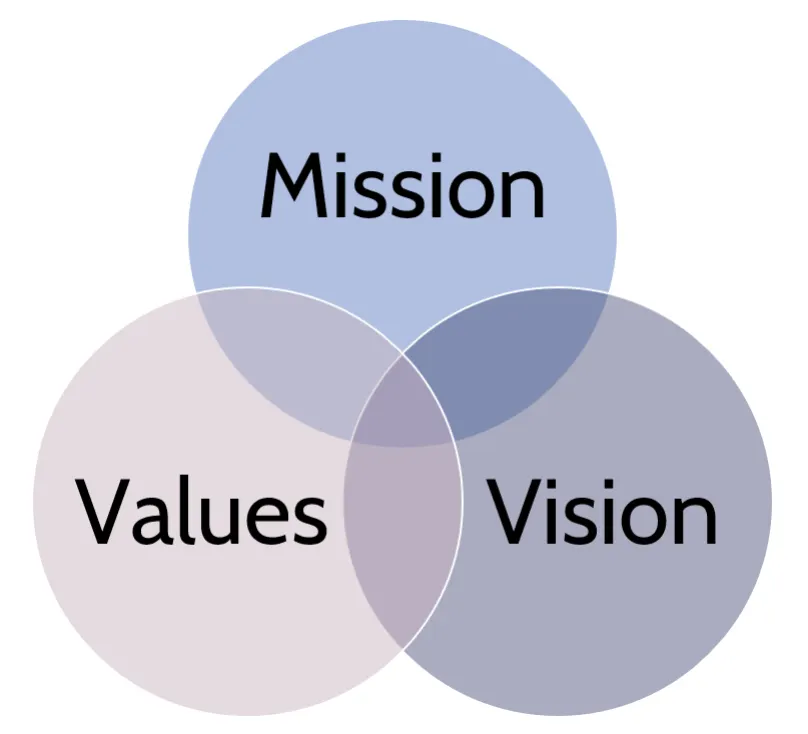
Vision, Mission & Values
We talked previously about finding purpose and increasing agency in our lives, and more recently, distinguishing between principles and values and how to develop our own across various domains. In a business setting we frequently hear the terms vision, mission, and values. Many of this newsletter’s readers are leaders of teams and I have had several questions regarding the overlap and/or point-of-difference between these common terms, and the planning done as a team within an organisation.
As leaders we are essentially forming “what” our team/organisation is working toward, or aspiring to be, and “how” it plans to get there. To add depth to the “what” we create, or add the supporting “why” to strengthen the connection and define our business. Let’s look at an example.
Company: Tesla
Mission: To accelerate the world’s transition to sustainable energy.
Vision: To create the most compelling car company of the 21st century by driving the world’s transition to electric vehicles.
Your mission statement drives the company. It is the core of the business, and from it come the objectives and finally, what it takes to reach those objectives. It also shapes your company’s culture. Mission statement questions look like:
What do we do?
Whom do we serve?
How do we serve them?
Your vision statement gives the company direction. It is the future of the business, which then provides the purpose. The vision statement is about what you want to become. It’s aspirational. Vision statement questions look like:
What are our hopes and dreams?
What problem are we solving for the greater good?
Who and what are we inspiring to change?
In other words: “A mission statement defines the organisation’s business, its objectives, and how it will reach these objectives. A vision statement details where the organisation aspires to go.” Atlassian.
Whether you are a line leader, or a CEO this is critical to understand and if you are not a leader, you should be aware of what your organisation’s are. Even when exploring new job opportunities it is important to assess the companies against your personal framework. This can support a more effective interview process but it can also be a red flag for yourself if the companies are at conflict with your own.
For leaders, the most important thing you will do is recruit the right people into the right roles and we will discuss recruitment along with other leadership tools in future issues. Outside of recruitment and in support of ensuring you have the “right people on the bus,” ask yourself:
Is it clear to your employees what they are striving toward?
Is it clear why the company exists and who it serves?
Does the company have a clear set of values and behaviours which hold true?
On that last point, nothing will erode culture faster than a leader’s tolerance of unacceptable behaviour. In particular, if a lack of integrity or respect, among other values is accepted at a leadership level, a toxic environment will be present that will require very high effort to overturn.
Essentially then, as leaders, what culture are you cultivating and is it clear to your team members why and what they are working toward? I hope yes but if not, seek to intervene immediately. Accountability is critical, but don’t start with the stick, start with the why. If you need support undertaking this work, or the tools to do so, please DM me.
Mastering the Market Cycle
In investing the future is a range of possibilities - some known, some unknown - making risk and uncertainty unavoidable. The range of possibilities is best viewed as a probability distribution. That leads to knowing the most likely outcome, on average, in the long run. “Most likely” is not guaranteed across any single event (think coin tosses). Randomness in any one event can lead to an unlikely outcome. Therefore any opinion on the future should be based on: 1) what’s going to happen, and 2) the likelihood of being correct.
To do this we notice and remember patterns in order to make decisions easier, less painful, and more beneficial, so we don’t think through every decision from scratch. These patterns can be in the form of market cycles as Howard Marks provides the framework for in his book Mastering the Market Cycle.
Let’s start by looking at some framing questions to assess the current or past market condition:
Is it closer to the beginning upswing or the peak leading to a downswing?
Has it been rising for a while? To the point of being dangerous?
Does investor behaviour suggest greed or fear?
Are investors appropriately risk-averse or excessively risk-tolerant?
Is the market overpriced or cheap due to the cycle?
Does the current point in the cycle emphasise an aggressive or defensive portfolio stance?
These questions should help determine the tilt of a portfolio: more aggressive when the odds are in our favour and more defensive when the odds are against us. “The events in the life of a cycle shouldn’t be viewed merely as each being followed by the next, but much more importantly, as each causing the next.” Howard Marks.
Now, let’s look at the nature of cycles in general and define what one is:
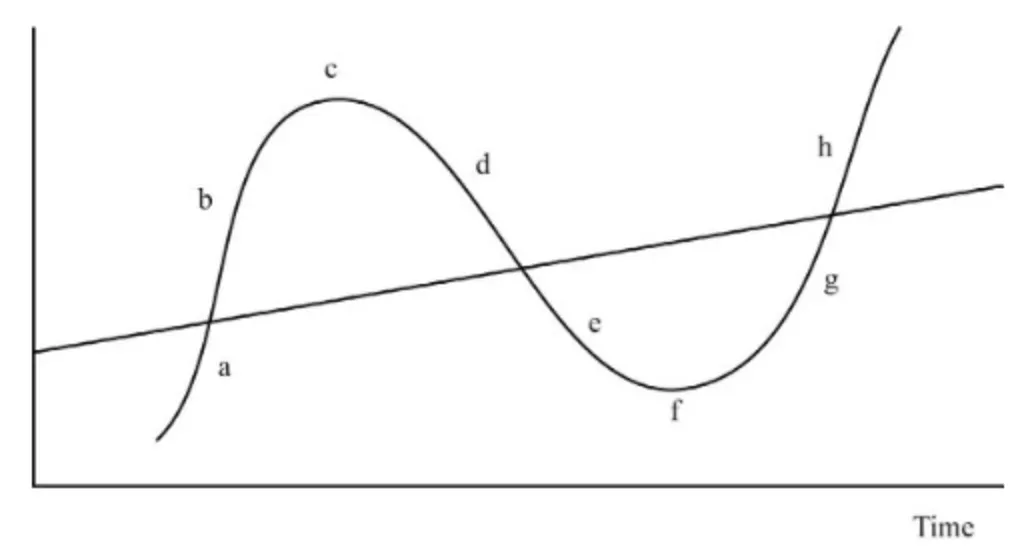
Cycles are a continuous swing around a midpoint, which is often a longer-term trend.
The swings follow a generic pattern of: a) recovery from the lows, b) rise past the midpoint to (extreme) highs, c) the new high, d) downward correction, e) fall past the midpoint to the low, f) the new low, g) recovery from the low, and h) back past the midpoint to another high.
Because cycles are influenced in the short term by people and other variables, it has no constant rate. The duration and speed of each section varies and inevitably causes the next.
Regression to the mean is the move back to the midpoint from the high and low. It’s the powerful self-correcting mechanism in all cycles.
But the force behind regression continues to exert itself, the momentum pushes the cycle past the midpoint to the next high or low.
Those who don’t understand cycles will be surprised by, and often contribute to, it. Those who do understand will find opportunities in it.
Extremes are not guaranteed for every swing, but cycles that reach extremes in one direction are often followed by an opposite extreme in the other direction.
The general pattern of a cycle matters, because the specific details at any point in a cycle will look different from similar points in the past.
Randomness makes recognising the pattern in cycles more complicated and less predictable and dependable. The influence of people, their inconsistent behaviour, emotions, and actions add to the randomness. This causes the market pendulum to swing from greed to fear, optimism to pessimism, risk-tolerant to risk-averse, overpriced to underpriced, and focused on the infinite future to the immediate present. An excess in one direction sets the stage for the swing back.
“After 28 years at this post, and 22 years before this in money management, I can sum up whatever wisdom I have accumulated this way: The trick is not to be the hottest stock-picker, the winningest forecaster, or the developer of the neatest model; such victories are transient. The trick is to survive! Performing that trick requires a strong stomach for being wrong because we are all going to be wrong more often than we expect. The future is not ours to know. But it helps to know that being wrong is inevitable and normal, not some terrible tragedy, not some awful failing in reasoning, not even bad luck in most instances. Being wrong comes with the franchise of an activity whose outcome depends on an unknown future.” Peter Bernstein
Marks provides much more in-depth analysis, even by sector for those interested in exploring this topic further. For the rest, start by working through the above statements and improve your understanding of current state, you can essentially boil it down to: how are things priced, and how are investors around us behaving? Think about the various stages, or market conditions to support your hypothesis:
3 Stages of a Bull Market: 1) when few people believe things will get better, 2) when most people see things improving, 3) when everyone believes things will stay better forever.
3 Stages of a Bear Market: 1) when a few people believe things won’t stay better forever, 2) when most people see things are getting worse, 3) when everyone believes things can only get worse.
When positioning or deciding the appropriate portfolio risk level (more/less risk-averse or risk-tolerant) based on the location in the cycles. Positioning increases or decreases the odds of outperformance. Then, your asset selection will identify asset classes/securities that will be better or worse and weighting them based on the required risk level of the portfolio. Be sure to go back and review last fortnight’s newsletter on introducing structure to your portfolio and start to overlay it with this market cycle framework.
Always remember, future cycles will continue to be driven by the collective emotions and decisions of people, and as John Kenneth Galbraith said, “we have two classes of forecasters: those who don’t know, and those who don’t know they don’t know.”
Parting Shot
Winning tomorrow starts today.
There is a big difference between being interested in something and being committed to something. Committed people do what interested people won't.
No one can get you where you want to go. Only self-motivation can do that.
If you're waiting for someone to motivate you, it's because you don't love it, haven't decided what you want, or are not committed. When you're truly committed to a goal, you'll find the motivation within yourself to push through obstacles and make it happen.
External motivation might get you started, but only internal motivation will carry you across the finish line.
— Shane Parrish (Farnam Street)