Deep Logic: Mastering Second-Level Thinking
Second Level Thinking · Issue 3
How to out-think the consensus in your career and life. From data centres to power grids: unpacking the second-order impacts of the 'most important stock.'
First and Second-Level Thinking
We have all suffered the ramifications of poor decision making. Overcoming lazy thinking can help us take better action and avoid the unintended consequences of mediocre decisions, but what exactly is first and second-level thinking, and how can we avoid the pitfalls of such idle effort?
Howard Marks wrote about first and second-level thinking in his 2011 book The Most Important Thing. An American investor and writer, Marks is co-founder and co-chairman of Oaktree Capital, the largest investor in distressed securities worldwide with $189 billion under management. Warren Buffett once said: “When I see memos from Howard Marks in my mail, they're the first thing I open and read. I always learn something.”
“First-level thinking is simplistic and superficial and just about everyone can do it. Second-level thinking is deep, complex and convoluted, taking more things into account.”
First-level thinking is fast and frictionless, and we are susceptible to it under many conditions. It may be the result of time pressure, overestimating our ability or control, or a failure to collaborate meaningfully.
It should be seen as a warning sign for anyone attempting to exploit an edge in a specific discipline, as exceptional performance is generally a sign of non-consensus thinking. You cannot expect to achieve great things and outperform the majority while thinking the same as everyone else. Being different should not be the goal in and of itself, but unconventionality is a way of thought.
Second-level thinking is methodical and elaborate, and it requires a deeper understanding of the fallacies we are susceptible to. As a result, a second-level thinker takes far more into account when making meaningful decisions.
“The difference in workload between first-level and second-level thinking is clearly massive, and the number of people capable of the latter is tiny compared to the number capable of the former. First-level thinkers look for simple formulas and easy answers. Second-level thinkers know that success is the antithesis of simple.”
In Principles, Ray Dalio describes how those who overweight first-order consequences and fail to understand second and third-order consequences rarely reach their goals. The temptation to play to our biases and accept a first answer without proper analysis, no matter how good it seems, tends to result in failing to achieve what we are really seeking.
Implementing Second-Level Thinking
Ask questions first: What is the range of future outcomes, and which outcome do you think will occur? Continue the thread: and then what, and then what?
Think in probabilities: What is the likelihood I am right? What does the consensus think, and how does my expectation align with or differ from it?
Collaborate: Test your hypotheses across departments or business units, or within your inner circle and peer group. Do employees need to be consulted first? Are there regulatory or supplier impacts that have not been considered?
Time: Think in longer time horizons and reflect on the consequences of your decision 3 minutes, 3 months and 3 years from now (3x3x3).
Practice: Keep slowing down and seek space to think. Make a list of the biases you are susceptible to and challenge your first instinct. Avoid making important decisions on the fly and practise deeper thinking.
Reflect on where you currently face a task or priority that is first-order negative and second-order positive. Lift your thinking to a broader time horizon and think more deeply about the problem. Are you overvaluing the status quo, or the lack of an immediate payoff, over something that will generate long-term value and reward?
Last fortnight we presented a framework for implementing deep work and using time blocking as a tool. Second-level thinking requires effort and has a degree of difficulty relative to the systems, collaboration and time it requires, but it can be overlaid with your deep work blocks to maximise the benefit.
Nvidia: The Most Important Stock on Earth
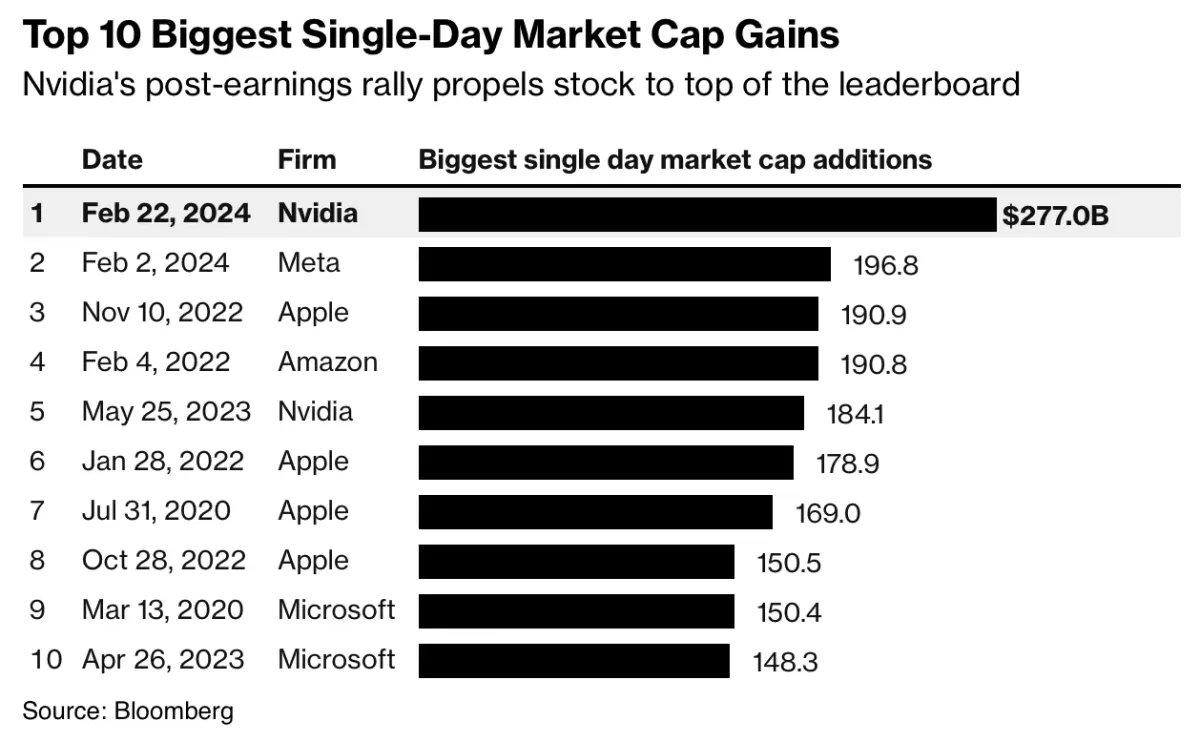
Nvidia’s recent surge to an all-time high was the biggest single-session increase in market value in history, beating Meta’s historic gain just three weeks prior. The chipmaker jumped 16% on its latest earnings, adding about $277 billion in market capitalisation and bringing its total market value near $2 trillion, in what Goldman Sachs labelled “the most important stock on planet earth.”
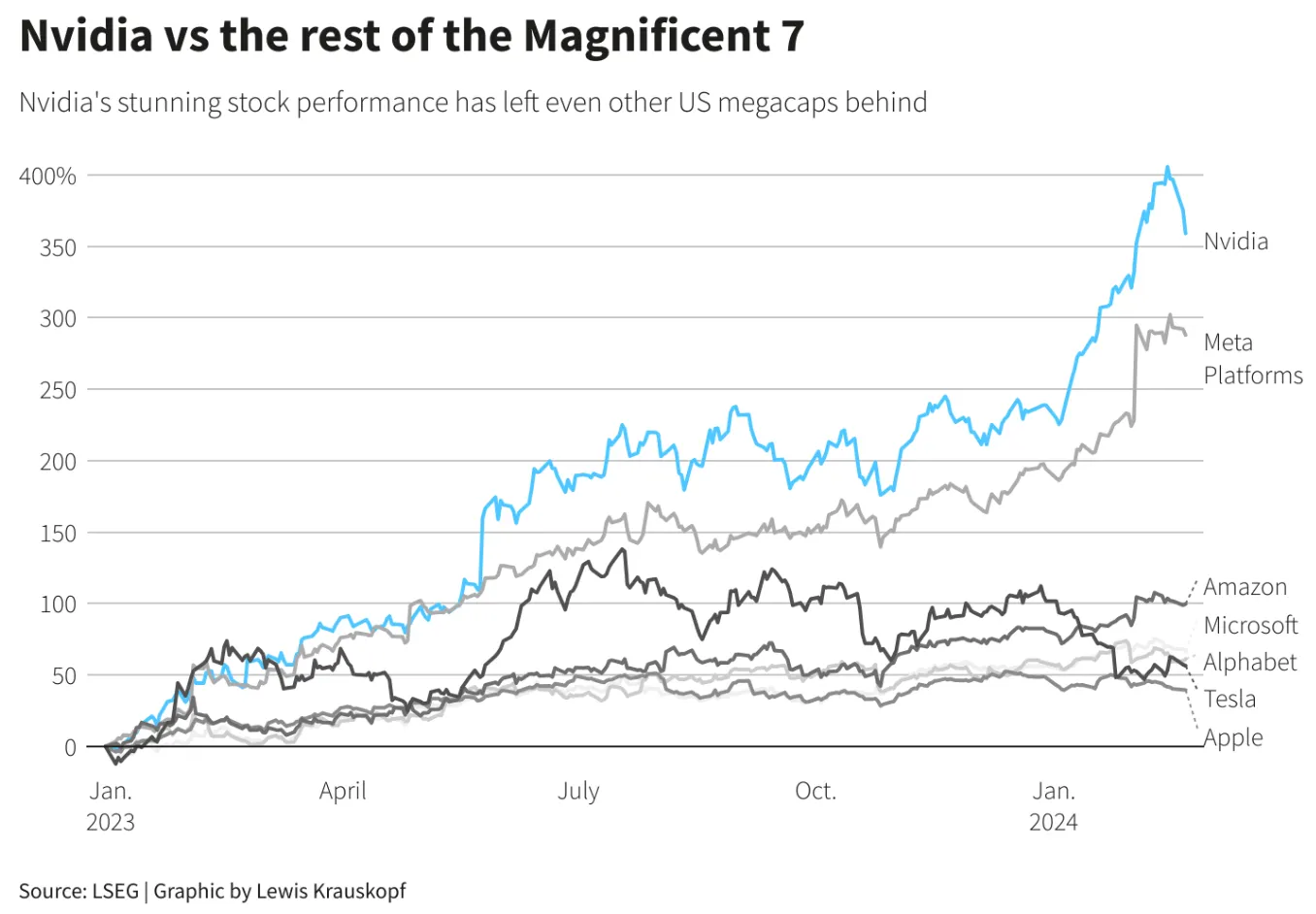
Nvidia’s H100 data centre chip has turned the company into an AI kingmaker, adding $1 trillion to the company’s value since its release in 2023. Demand is so great that lead times are currently six months in some instances. Q4 revenue was $22.1 billion, up 265% year on year, and the company forecasts the increase will continue in the short term, stating supply constraints prevented a higher number.
Essentially a PC graphics processor on steroids, the H100 is optimised to process vast volumes of data and computation at high speed, working seamlessly on the power-intensive task of training AI models. As a result, Nvidia now controls between 80–90% of the accelerator market. Core customers include those with extremely large data centres, like Alphabet, Microsoft and Amazon. As the behemoths reposition themselves for AI, the brilliance for Nvidia is that it can now forecast revenue with confidence for quarters to come.
On a broader scale, Meta (Facebook’s parent company) and Nvidia are doing the heavy lifting for the wider market, with AI the sole source of hope for a continued soft landing of the American economy. It comes as no surprise that the S&P 500 and the Dow Jones Industrial Average closed at all-time highs after the announcement, and as Jack Janasiewicz at Natixis Investment Managers Solutions joked, “Nvidia goes, so goes the world.”
So if we step back from the hysteria and apply some second-level thinking:
Are these results sustainable?
Can Nvidia continue to build out and grow at these outstanding rates?
Who will step up and compete away its profits?
The last question is akin to the famous Jeff Bezos quote: “Your margin is my opportunity.”
To answer these, we need to root ourselves in more fundamental questions:
What is the terminal value of Nvidia?
What is the total addressable market (TAM) for GPUs?
What will Nvidia’s market share be?
If current market share is 80–90%, we can start to apply probabilistic thinking and approximate future market share, which helps us understand with greater certainty whether current growth holds up or falls away. In fewer words: is this a one-time build-out, or sustainable ongoing revenue under steady conditions?
As a final thought experiment: during the original build-out of the internet and the dotcom era, companies centred on supplying infrastructure were never able to sustain their exuberant valuations. We saw this first with the fall of many telecom companies in the US, followed by the likes of Cisco and others.
You could argue that Nvidia has a greater competitive moat than the companies of that period, but fundamentally, the value shifted to the application layer once the infrastructure was in place and the mass of developers arrived. We stand on the precipice once more. Unless you feel confident in your answers to the questions above, do not blindly follow consensus; seek out the coming wave. Always remember: the market can stay irrational longer than you can stay solvent.
Parting Shot
“It doesn’t matter what you do, the criticism is always going to be there. So you might as well do what you think ought to be done. You might as well do what seems meaningful and important and fulfilling and right to you. People are going to say what they’re going to say, haters will find a way to hate. In the meantime, just be true to yourself, be true to the mission you have, fight for the respect (and praise) of yourself, not the mob, not the future. That’s hard enough to win anyway.”
— Ryan Holiday, The Daily Stoic